2015 · Bae et al. — Determination of rifaximin treatment period according to lactulose breath test values in nonconstipated irritable bowel syndrome subjects.
Super-Abstract
This retrospective study in 102 IBS patients with confirmed SIBO used lactulose breath test (LBT) H₂ values to determine optimal rifaximin treatment duration (4, 8, or 12 weeks), finding that higher baseline breath H₂ required longer treatment and that symptomatic improvement preceded LBT normalization. (Journal of Korean Medical Science, 2015.)
Commentary
This paper is not a therapeutic H₂ intervention study. Molecular hydrogen here appears purely as a diagnostic breath test marker — lactulose is fermented by gut bacteria producing H₂, which is measured in exhaled breath to detect small intestinal bacterial overgrowth (SIBO). The study optimizes antibiotic (rifaximin) treatment duration based on LBT H₂ levels at baseline. It does not involve H₂ administration to patients. The clinical finding is useful for IBS/SIBO management: higher baseline breath H₂ correlates with needing longer rifaximin courses, and symptom relief comes before breath test normalization — a clinically important distinction. This paper belongs in a H₂-research database as an example of H₂ measurement utility in gastroenterology, not as a H₂ therapy study.
Key quotes
- „The groups with a longer treatment exhibited an increase in the hydrogen gas value at 90 min and its sum during 90 min at the initial LBT.“ — higher breath H₂ at baseline correlates with need for longer antibiotic treatment
- „Symptomatic improvement occurred earlier than LBT normalization in the treatment period over 4 weeks.“ — clinically important: symptom relief precedes breath test normalization — don't stop treatment when symptoms improve
- „different rifaximin treatment periods are needed in accordance with LBT levels to effectively eradicate SIBO.“ — main clinical conclusion: personalize treatment duration based on breath H₂ values
Our assessment
This is a diagnostic utility study for breath H₂ testing in SIBO/IBS, not a therapeutic H₂ intervention trial. Its inclusion in a H₂ medicine database is valid but requires careful framing: the H₂ here is a biomarker produced by gut bacteria, not an externally administered therapeutic agent. Limitations: retrospective design; single center; n=102 with unequal group sizes; LBT has known sensitivity/specificity limitations for SIBO diagnosis. The clinical finding (individualize rifaximin duration by LBT) has practical value for gastroenterology practice.
Study design
- Type: Retrospective chart review · n: 102 nonconstipated IBS patients with positive LBT at initial visit · H₂ measurement: Lactulose breath test (LBT) — H₂ as gut bacterial fermentation marker, not therapeutic agent
- Groups: 4 weeks (n=36), 8 weeks (n=43), 12 weeks (n=23) rifaximin treatment
- Result: Higher baseline LBT H₂ (90 min value and sum) → longer treatment needed; symptomatic improvement precedes LBT normalization; most significant treatment response in first 4 weeks across all groups
Abstract
Small intestinal bacterial overgrowth (SIBO) can partly explain irritable bowel syndrome (IBS), and rifaximin has been observed to improve abdominal symptoms in nonconstipated IBS patients. However, there are few reports on the association of the rifaximin treatment periods with the results of a lactulose breath test (LBT). Therefore, we performed a retrospective review of patient charts to investigate the relation between the rifaximin treatment periods with LBT results in nonconstipated IBS patients. We also evaluated the time to achieve a symptomatic improvement in the IBS patients as compared to the changes in the LBT. We reviewed the charts for patients who showed IBS symptoms with documented positive results for LBT during their initial visit and who had a follow-up LBT after treatment with rifaximin. The LBT values were compared to the subjects' symptom scores. A total of 102 subjects had a follow-up LBT to assess LBT normalization. The subjects were divided into groups according to treatment periods of 4 weeks (n = 36), 8 weeks (n = 43), and 12 weeks (n = 23). The groups with a longer treatment exhibited an increase in the hydrogen gas value at 90 min and its sum during 90 min at the initial LBT. There were significant differences in hydrogen gas value at 90 min and in its sum during 90 min at the initial LBT between the groups treated for 4 and 12 weeks. The most significant treatment response was observed during the first 4 weeks for all treatment groups. Symptomatic improvement occurred earlier than LBT normalization in the treatment period over 4 weeks. The results indicate that different rifaximin treatment periods are needed in accordance with LBT levels to effectively eradicate SIBO.
Source & links
Screenshot of the PubMed page
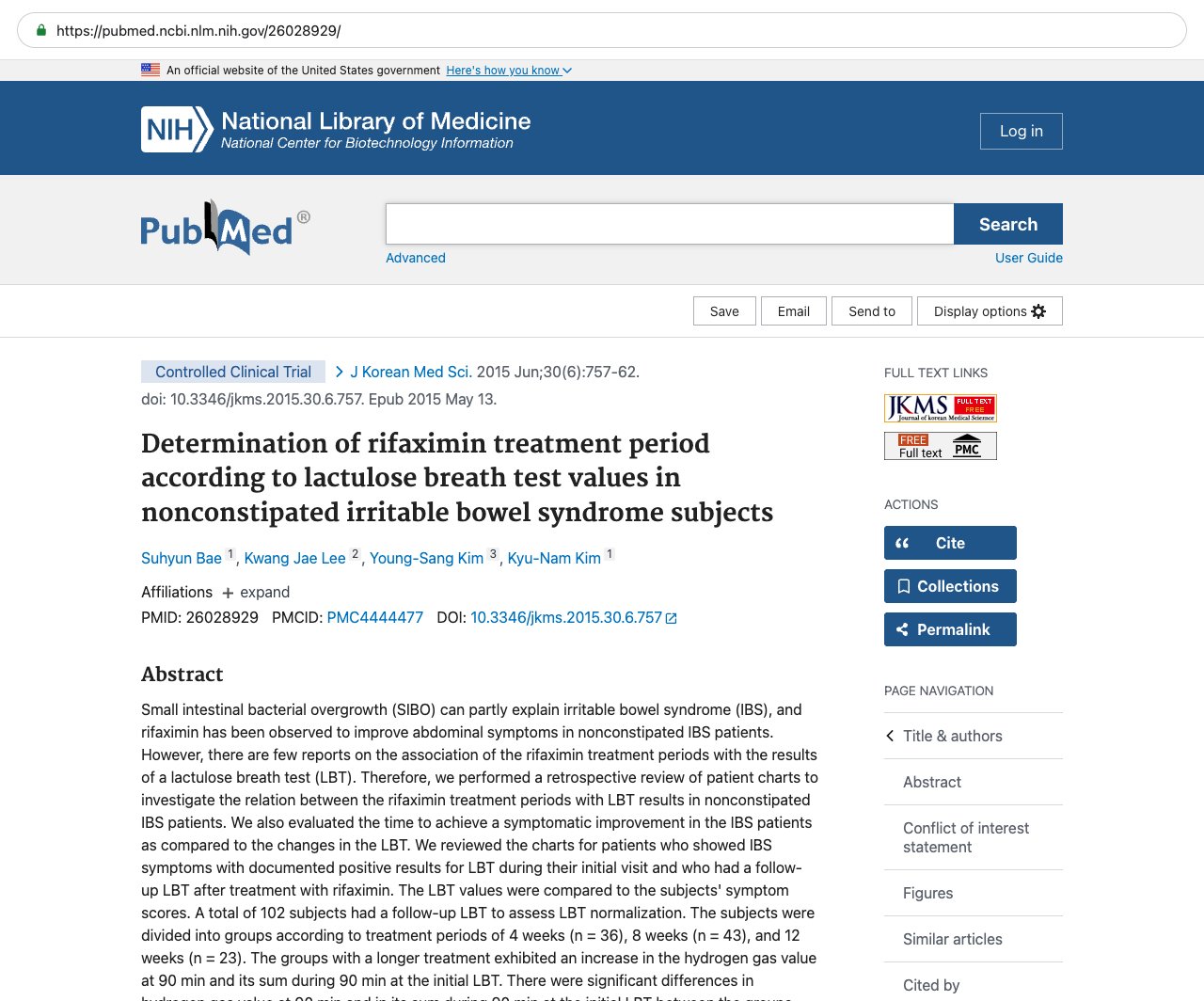
This page mirrors the published abstract (© the authors / publisher) for reference and citation. The canonical source is the PubMed record linked above. This is not medical advice.