2023 · Campbell — H2 generated by fermentation in the human gut microbiome influences metabolism and competitive fitness of gut butyrate producers.
Super-Abstract
Hydrogen gas produced by gut bacteria during carbohydrate fermentation is not a passive waste product — it actively regulates which metabolites the microbiome produces. High gut H₂ concentrations stimulate butyrate production by beneficial bacteria, while H₂-consuming methanogens suppress butyrate — a finding with direct implications for colon health and inflammation. (Microbiome, 2023.)
Commentary
This paper asks a fundamental question: what happens to gut fermentation when H₂ accumulates? Gut bacteria that produce butyrate (butyrogens) face a reducing-power management problem during fermentation — they use branched pathways to dispose of electrons, generating a mix of butyrate, lactate, formate, acetate, H₂, and CO₂. The authors show that when H₂ is high (either experimentally via a high-H₂ atmosphere or via the hydrogenase inhibitor CO), butyrogens shift their output toward butyrate and lactate — the anti-inflammatory products. The flip side: gut methanogens like Methanobrevibacter smithii consume H₂ and thereby indirectly reduce butyrate. In a large human cohort, higher M. smithii activity was associated with lower fecal butyrate — but only during resistant starch supplementation (when H₂ production is high). This is microbiome-level systems biology. The H₂ connection here is endogenous gut-produced H₂, not exogenous supplementation — a key distinction. However, it provides mechanistic grounding for why increasing luminal H₂ (e.g. through H₂-rich water or gut H₂-producing substrates) might favor anti-inflammatory microbiome states.
Key quotes
- „high H2 concentration stimulates production of the anti-inflammatory metabolite butyrate.“ — the central mechanistic finding: H₂ drives butyrate production
- „By consuming H2, gut methanogenesis can decrease butyrate production.“ — the competing mechanism: methanogens remove H₂ and thereby reduce butyrate
- „M. smithii metabolic activity in a large human cohort was associated with decreased fecal butyrate, but only during consumption of a resistant starch dietary supplement.“ — human cohort confirmation: the effect is most visible when gut H₂ production is high
Our assessment
This is a high-quality mechanistic microbiome study published in a leading journal, combining in vitro bacterial cultures, synthetic gut communities, and a large human cohort. It provides strong mechanistic rationale for why gut H₂ concentration matters for butyrate production. Limitations: the study examines endogenous H₂, not exogenous H₂ supplementation — the therapeutic translation (does drinking H₂-rich water raise luminal H₂ enough to shift butyrate production?) is not tested here; individual microbiome variability is high; methanogen status varies widely between individuals. The human cohort finding is associational, not interventional. Nevertheless, this paper is one of the strongest mechanistic foundations for the microbiome rationale of H₂ supplementation.
Study design
- Type: mechanistic microbiome study (in vitro bacterial cultures + synthetic community experiments + human cohort) · n (human): large cohort (size not specified in abstract) · H₂ source: endogenous gut fermentation (not exogenous supplementation)
- Result: high H₂ → increased butyrate, lactate, formate in butyrogens; M. smithii (H₂ consumer) → decreased butyrate in synthetic communities and in human cohort during resistant starch supplementation; H₂ identified as regulator of gut fermentation balance
Abstract
BACKGROUND: Hydrogen gas (H2) is a common product of carbohydrate fermentation in the human gut microbiome and its accumulation can modulate fermentation. Concentrations of colonic H2 vary between individuals, raising the possibility that H2 concentration may be an important factor differentiating individual microbiomes and their metabolites. Butyrate-producing bacteria (butyrogens) in the human gut usually produce some combination of butyrate, lactate, formate, acetate, and H2 in branched fermentation pathways to manage reducing power generated during the oxidation of glucose to acetate and carbon dioxide. We predicted that a high concentration of intestinal H2 would favor the production of butyrate, lactate, and formate by the butyrogens at the expense of acetate, H2, and CO2. Regulation of butyrate production in the human gut is of particular interest due to its role as a mediator of colonic health through anti-inflammatory and anti-carcinogenic properties. RESULTS: For butyrogens that contained a hydrogenase, growth under a high H2 atmosphere or in the presence of the hydrogenase inhibitor CO stimulated production of organic fermentation products that accommodate reducing power generated during glycolysis, specifically butyrate, lactate, and formate. Also as expected, production of fermentation products in cultures of Faecalibacterium prausnitzii strain A2-165, which does not contain a hydrogenase, was unaffected by H2 or CO. In a synthetic gut microbial community, addition of the H2-consuming human gut methanogen Methanobrevibacter smithii decreased butyrate production alongside H2 concentration. Consistent with this observation, M. smithii metabolic activity in a large human cohort was associated with decreased fecal butyrate, but only during consumption of a resistant starch dietary supplement, suggesting the effect may be most prominent when H2 production in the gut is especially high. Addition of M. smithii to the synthetic communities also facilitated the growth of E. rectale, resulting in decreased relative competitive fitness of F. prausnitzii. CONCLUSIONS: H2 is a regulator of fermentation in the human gut microbiome. In particular, high H2 concentration stimulates production of the anti-inflammatory metabolite butyrate. By consuming H2, gut methanogenesis can decrease butyrate production. These shifts in butyrate production may also impact the competitive fitness of butyrate producers in the gut microbiome. Video Abstract.
Source & links
Screenshot of the PubMed page
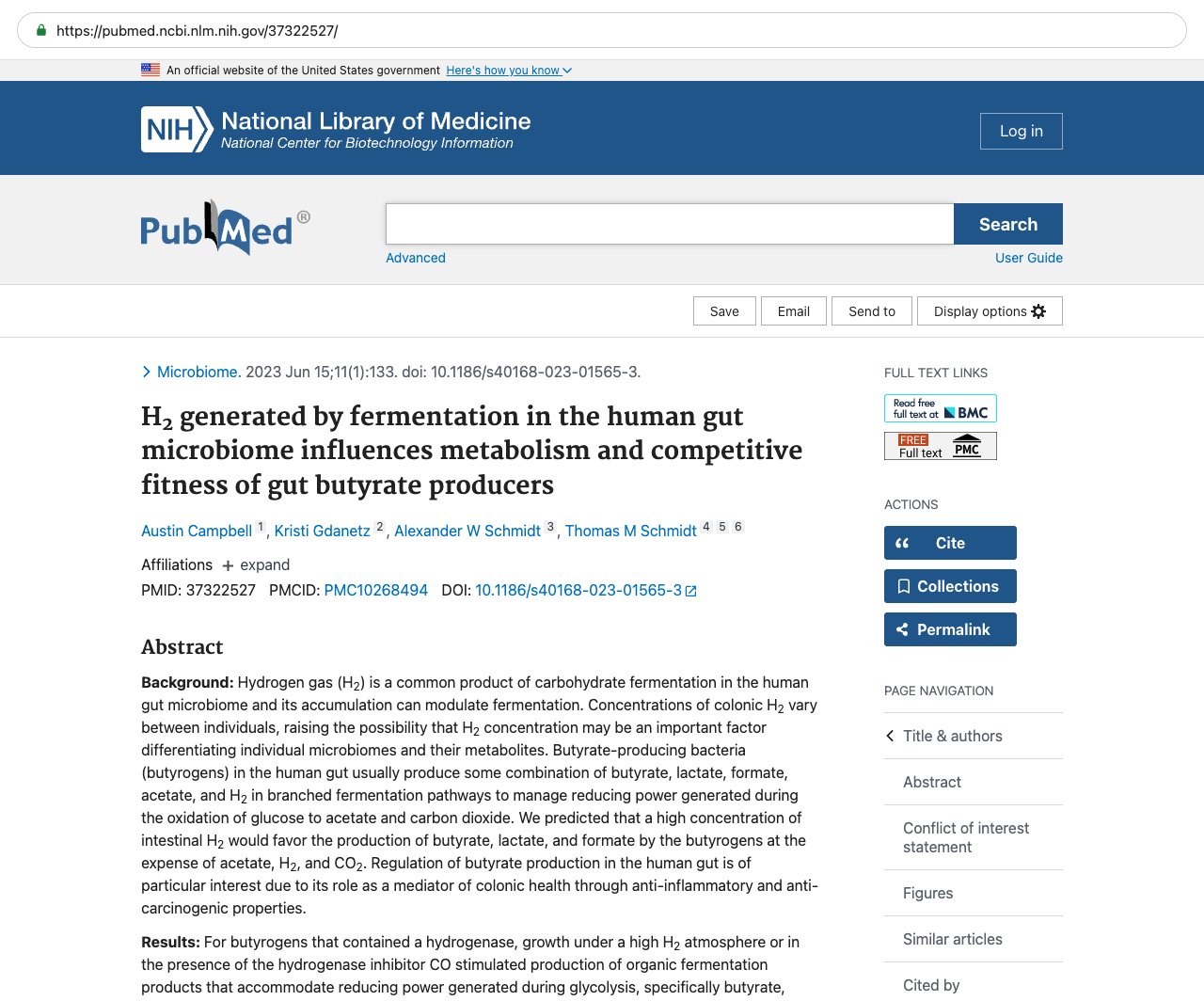
This page mirrors the published abstract (© the authors / publisher) for reference and citation. The canonical source is the PubMed record linked above. This is not medical advice.