1988 · Chung et al. — Endoscopic Measurement of Gastric Mucosal Blood Flow by Laser Doppler Velocimetry: Effect of Chronic Esophageal Variceal Sclerosis
Super-Abstract
A technique validation study demonstrating that laser Doppler velocimetry can measure gastric mucosal blood flow endoscopically — calibrated against hydrogen gas clearance as the reference standard. In portal-hypertensive patients, gastric mucosal blood flow was elevated, but sclerotherapy of oesophageal varices did not alter it. (The American Surgeon, 1988.)
Commentary
This paper develops and validates an endoscopic method for measuring gastric mucosal perfusion using laser Doppler. The hydrogen gas clearance technique serves as the gold-standard reference method against which laser Doppler readings are calibrated — both in animal (dog) experiments and in human patients. H₂ is inhaled as a tracer; its clearance from mucosa via electrode measurement defines the conversion factor for interpreting Doppler signals. Clinical application: in patients with portal hypertension (enlarged liver veins causing back-pressure), gastric mucosal blood flow was elevated compared to normal subjects. Sclerotherapy (injection treatment to obliterate variceal veins) did not reduce mucosal blood flow. This is a gastroenterology methodology paper; H₂ is only the calibration and reference tool.
Key quotes
- „A conversion factor was established for converting the readout of the instrument (Hertz x 10(2]) into ml/100g/min by synchronously measuring mucosal blood flow by hydrogen gas clearance technique and laser Doppler velocimetry in the gastric and duodenal mucosa.“ — H₂ clearance used as reference for laser Doppler calibration
- „Gastric mucosal blood flow was elevated in portal hypertensives, but sclerotherapy did not appear to cause changes in blood flow.“ — clinical null finding: sclerotherapy does not normalise mucosal perfusion
Our assessment
Important note on scope: This is a gastroenterology methodology and diagnostic study. The hydrogen gas clearance technique is used only as a calibration reference — H₂ is the gold-standard comparator, not the therapeutic agent. The study involves both animal (dog) experiments for technical validation and human clinical measurements. The clinical null finding (sclerotherapy not changing mucosal flow) is relevant to gastroenterology practice but has no H₂ therapy implications. Limitations: mixed animal/human design; n for human clinical portion not specified in abstract; no therapeutic H₂ endpoint.
Study design
- Type: technique development and validation study (dog model + human clinical) · n: not specified for human cohort · H₂ delivery: inhalation as reference calibration standard only — not therapeutic
- Result: laser Doppler velocimetry validated against H₂ clearance; gastric mucosal blood flow elevated in portal hypertension; sclerotherapy did not change mucosal flow · H₂ therapy relevance: none
Abstract
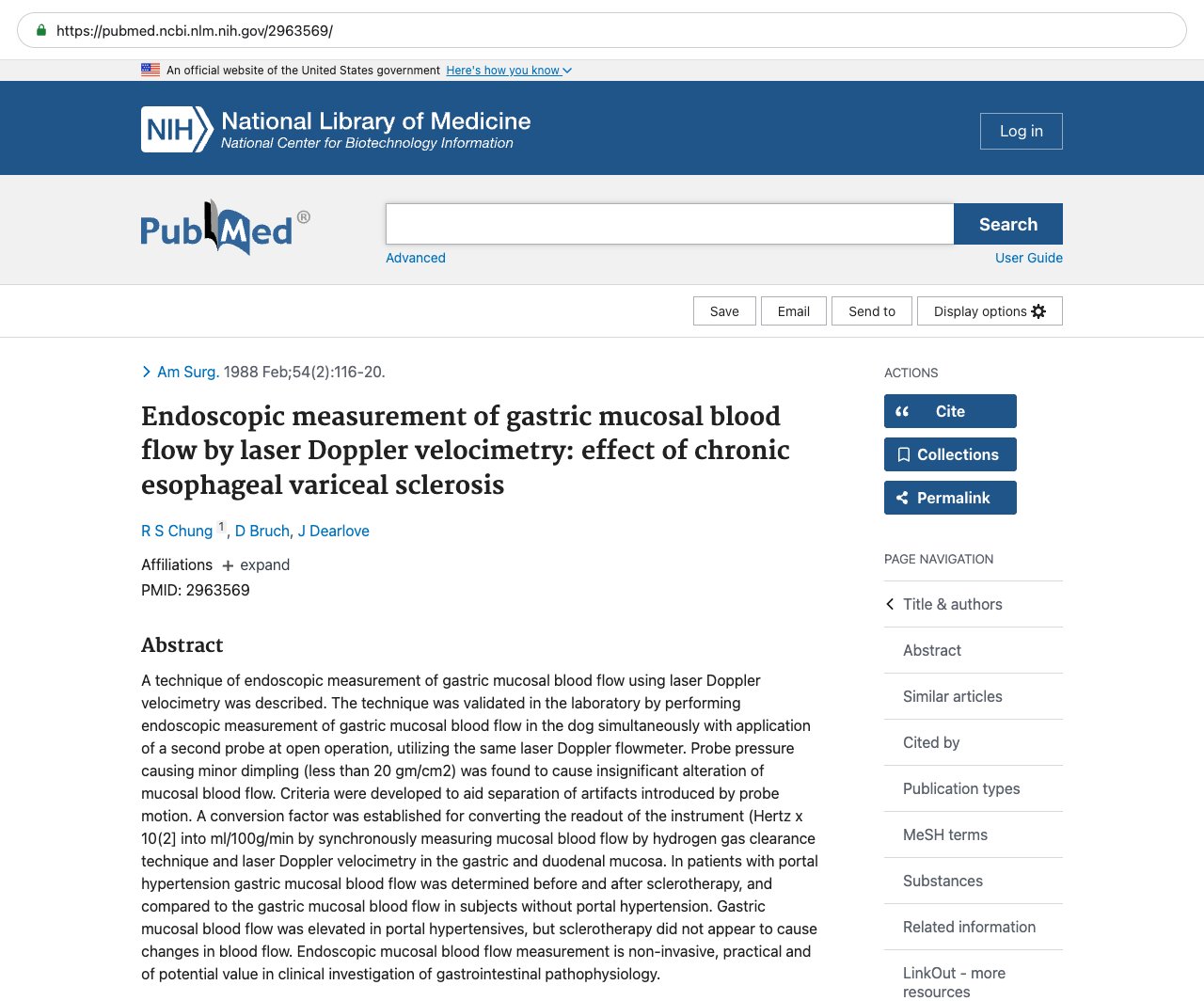
A technique of endoscopic measurement of gastric mucosal blood flow using laser Doppler velocimetry was described. The technique was validated in the laboratory by performing endoscopic measurement of gastric mucosal blood flow in the dog simultaneously with application of a second probe at open operation, utilizing the same laser Doppler flowmeter. Probe pressure causing minor dimpling (less than 20 gm/cm2) was found to cause insignificant alteration of mucosal blood flow. Criteria were developed to aid separation of artifacts introduced by probe motion. A conversion factor was established for converting the readout of the instrument (Hertz x 10(2] into ml/100g/min by synchronously measuring mucosal blood flow by hydrogen gas clearance technique and laser Doppler velocimetry in the gastric and duodenal mucosa. In patients with portal hypertension gastric mucosal blood flow was determined before and after sclerotherapy, and compared to the gastric mucosal blood flow in subjects without portal hypertension. Gastric mucosal blood flow was elevated in portal hypertensives, but sclerotherapy did not appear to cause changes in blood flow. Endoscopic mucosal blood flow measurement is non-invasive, practical and of potential value in clinical investigation of gastrointestinal pathophysiology.
Source & links
Screenshot of the PubMed page
This page mirrors the published abstract (© the authors / publisher) for reference and citation. The canonical source is the PubMed record linked above. This is not medical advice.