1965 · Cosyns — Detection of minimal left-right shunts by hydrogen inhalation.
Super-Abstract
This study assessed the sensitivity of hydrogen inhalation in detecting minimal (small) left-to-right intracardiac shunts — a clinical challenge where other methods of the era often failed. The high electrochemical sensitivity of the platinum electrode to H₂ gave this technique an advantage in identifying haemodynamically insignificant but anatomically real shunts. (Acta Cardiologica, 1965.)
Commentary
Detecting small intracardiac shunts — particularly patent foramen ovale or small atrial/ventricular septal defects — was a significant diagnostic challenge in the pre-echocardiography era. This study focused specifically on the lower limit of detection of the hydrogen indicator technique for this purpose. A key advantage of H₂ is the extremely high sensitivity of platinum electrodes, making it possible to detect trace amounts of shunt flow that might be invisible to dye-dilution or radiographic methods. This is a diagnostic sensitivity study, not an H₂ therapy study. No abstract text was available for this article.
Key quotes
- „Detection of minimal left-right shunts by hydrogen inhalation.“ — title-level summary — no abstract available; H₂ as sensitive diagnostic tracer for minimal cardiac shunts
Our assessment
This study has no relevance to H₂ therapy. It is a cardiac diagnostic sensitivity study — evaluating the detection limit of the hydrogen indicator technique for small intracardiac shunts. H₂ is an inert tracer. No abstract was available; assessment based on title, journal, and established historical context of the hydrogen indicator method. Off-topic for a therapeutic H₂ database.
Study design
- Type: diagnostic methodology / sensitivity study · n: not stated · H₂ delivery: inhaled H₂ as indicator (platinum electrode) — NOT therapeutic
- Indication: detection of minimal left-to-right intracardiac shunts · Result: technique shown to detect minimal shunts; no abstract available
Source & links
Screenshot of the PubMed page
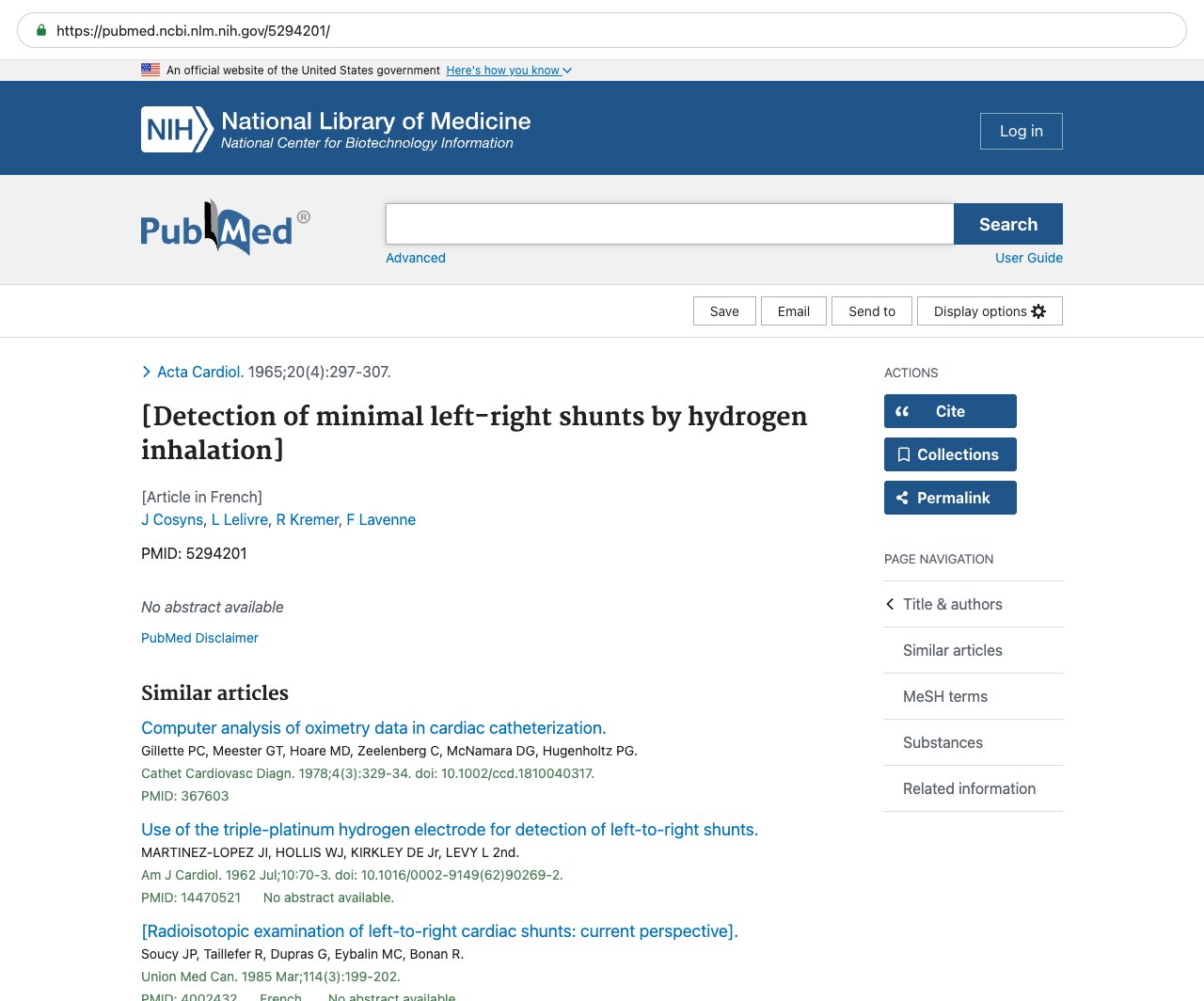
This page mirrors the published abstract (© the authors / publisher) for reference and citation. The canonical source is the PubMed record linked above. This is not medical advice.