1998 · Ditto et al. — A one-hour active coping stressor reduces small bowel transit time in healthy young adults
Super-Abstract
A one-hour stress task (avoiding mild electric shocks by playing video games) reduced small intestine transit time from 79 to 55 minutes in healthy males. The reduction was linked to cardiac sympathetic activity, suggesting the gut–brain axis responds rapidly to psychological stress. Hydrogen is used here as a diagnostic breath-test marker only — not as a therapeutic agent. (Psychosomatic Medicine, 1998.)
Commentary
This study examines the gut–brain axis and the effect of acute psychological stress on gut motility. The breath hydrogen method is employed as a standard clinical tool: participants ingest lactulose (a non-absorbable carbohydrate), and the time until exhaled hydrogen rises signals when the substrate has reached the colon. This is a well-established diagnostic technique in gastroenterology and has nothing to do with molecular hydrogen therapy. The finding — that stress speeds small bowel transit comparably to exercise — is relevant for understanding irritable bowel syndrome and functional gut disorders.
Key quotes
- „Stress produced a statistically and clinically significant reduction in mean transit time, from 79 to 55 minutes.“ — the magnitude of the stress effect on gut motility
- „The magnitude of stress-induced reduction in small bowel transit time was significantly correlated with change in an index of cardiac sympathetic activity, pulse transit time.“ — sympathetic nervous system mediates the gut response
- „A prolonged active coping stressor with minimal motor requirements produced a decrease in small bowel transit time comparable with that observed in several studies of the effects of physical exercise.“ — stress effect equals exercise effect on gut transit
Our assessment
Important context: this study does not investigate molecular hydrogen (H₂) as a therapeutic intervention. Breath hydrogen is used as a diagnostic tracer via the lactulose breath test — a standard gastroenterological method to measure small bowel transit time. The study topic is psychosomatic medicine and gut motility. The design is a well-controlled crossover (n = 12, within-subject comparison). Limitations: small all-male student sample, laboratory stressor may not generalise, single-session design. Not relevant to H₂ therapy.
Study design
- Type: randomised crossover within-subject · n: 12 healthy male undergraduates · H₂ delivery: none — lactulose breath hydrogen test used as diagnostic gut transit marker
- Result: mean small bowel transit time reduced from 79 to 55 min under stress (p < 0.05); reduction correlated with cardiac sympathetic activation
Abstract
OBJECTIVE: To examine the effect of a prolonged active coping stressor on the transit of a substance from the mouth through small intestine in normal human volunteers. METHOD: Twelve healthy undergraduate males were administered 10 g of the nonabsorbable carbohydrate lactulose in two experimental sessions. In normal individuals, lactulose produces hydrogen gas upon exposure to bacteria residing in the colon. Repeated measurements of breath hydrogen were obtained for 2 hours. In one session, subjects rested quietly for the 2-hour period. In the other counterbalanced session, subjects avoided mild electric shocks by playing videogames for the first hour. RESULTS: Stress produced a statistically and clinically significant reduction in mean transit time, from 79 to 55 minutes. The magnitude of stress-induced reduction in small bowel transit time was significantly correlated with change in an index of cardiac sympathetic activity, pulse transit time. CONCLUSIONS: A prolonged active coping stressor with minimal motor requirements produced a decrease in small bowel transit time comparable with that observed in several studies of the effects of physical exercise and in comparisons between normal controls and patients with diarrhea-predominant irritable bowel syndrome.
Source & links
Screenshot of the PubMed page
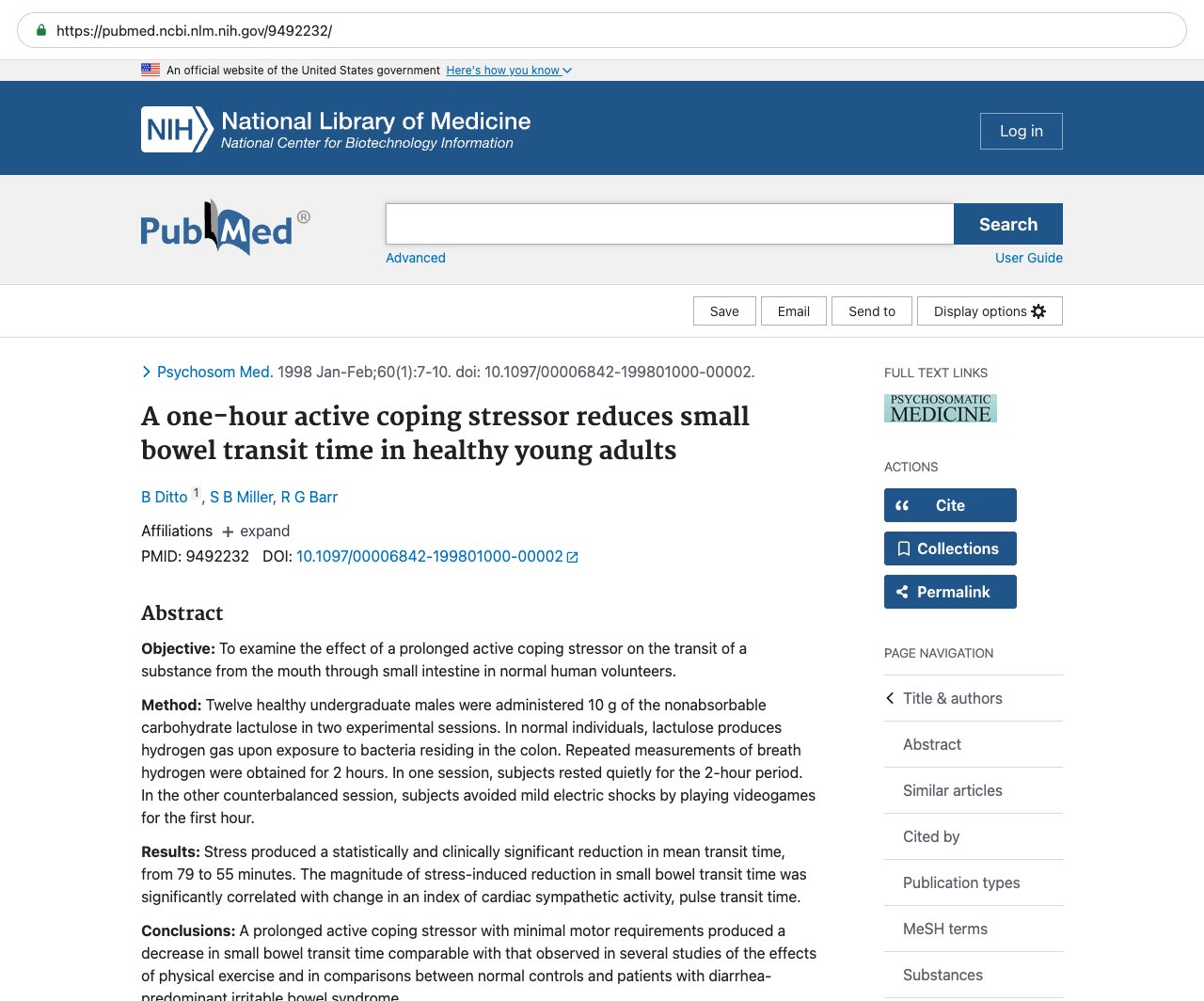
This page mirrors the published abstract (© the authors / publisher) for reference and citation. The canonical source is the PubMed record linked above. This is not medical advice.