1984 · Dolmans et al. — The Determination of Hydrogen Gas in Expired Air for the Diagnosis of Carbohydrate Resorption Disorders
Super-Abstract
This 1984 Dutch review article describes breath hydrogen testing as a diagnostic tool for identifying carbohydrate malabsorption disorders — the same principle underlying lactose and fructose intolerance tests used today. Hydrogen is entirely a diagnostic marker here; no H₂ is administered therapeutically. (Nederlands Tijdschrift voor Geneeskunde, 1984.)
Commentary
Breath hydrogen testing for carbohydrate malabsorption became a clinical standard in the 1980s and remains in use today (e.g., for diagnosing lactose intolerance or small intestinal bacterial overgrowth). The principle: malabsorbed carbohydrates reaching the colon are fermented by bacteria to produce H₂, which is absorbed into the bloodstream and exhaled. Measuring breath H₂ after a carbohydrate challenge dose identifies malabsorption non-invasively. This review from a Dutch clinical journal summarizes the methodology. No abstract was retrievable, and no DOI exists. This is completely unrelated to therapeutic H₂ medicine — it is a clinical gastroenterology diagnostic review.
Our assessment
This is a clinical gastroenterology diagnostic methodology review — not a therapeutic H₂ study. Breath H₂ testing is described as a tool to diagnose carbohydrate absorption disorders; no H₂ is given as treatment. The abstract is not available (no DOI, Dutch-language journal from 1984). Limitations: no abstract available; historical review (1984); methodology review only; no primary data. Not applicable to H₂ therapeutic efficacy.
Study design
- Type: clinical review article · n: n/a (review, no primary data) · H₂ relevance: breath H₂ as diagnostic output of carbohydrate malabsorption testing
- Result: abstract unavailable — study describes breath H₂ measurement methodology for diagnosing carbohydrate resorption disorders
Source & links
Screenshot of the PubMed page
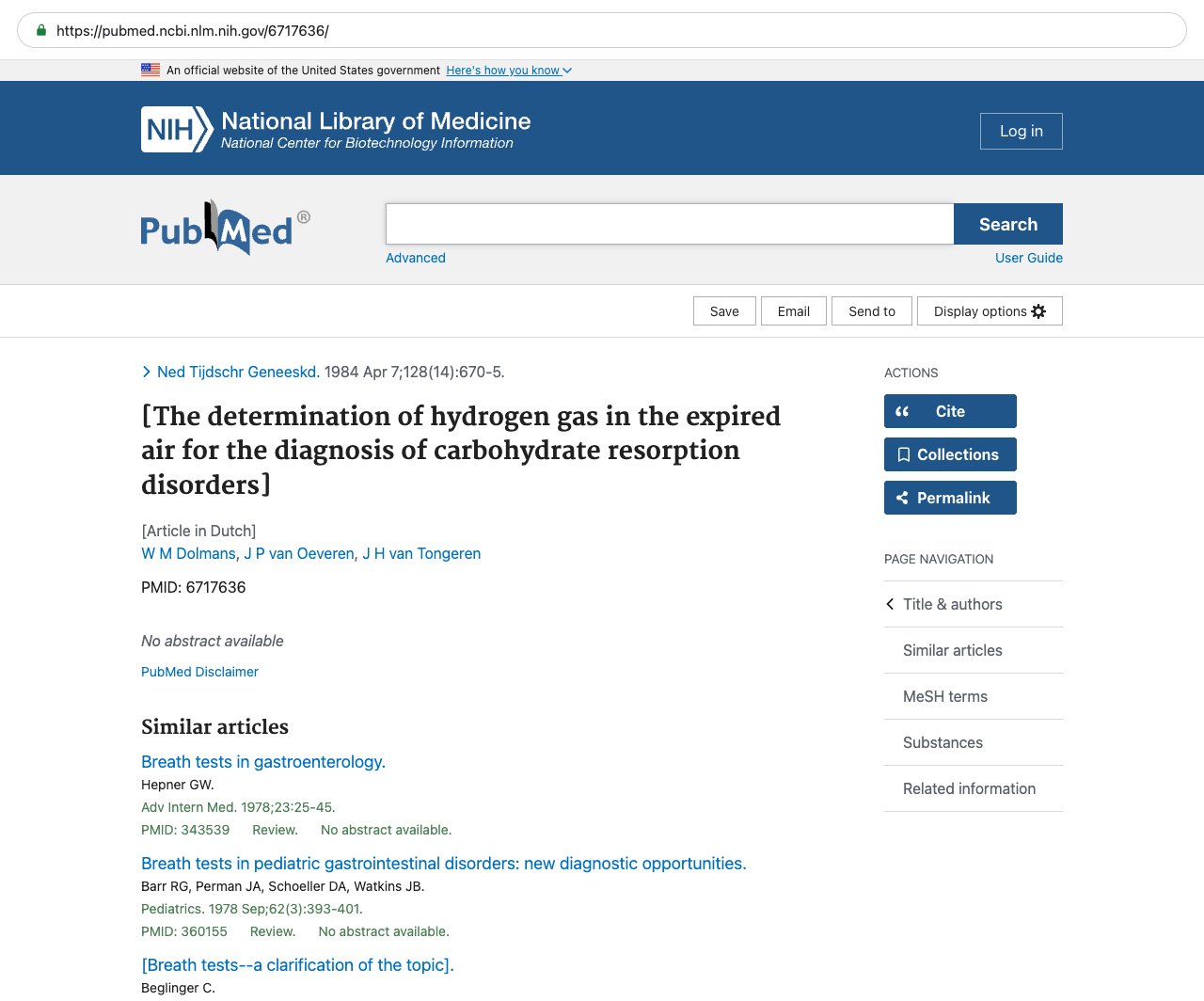
This page mirrors the published abstract (© the authors / publisher) for reference and citation. The canonical source is the PubMed record linked above. This is not medical advice.