1998 · Evans — Fructose-sorbitol malabsorption and symptom provocation in irritable bowel syndrome: relationship to enteric hypersensitivity and dysmotility.
Super-Abstract
In 15 female IBS patients, fructose-sorbitol mixtures provoked symptoms and elevated breath hydrogen in those who malabsorbed the sugars — but symptom severity was not associated with the presence of jejunal hypersensitivity or dysmotility. Breath H₂ is a fermentation biomarker here, not a therapeutic agent. (Scandinavian Journal of Gastroenterology, 1998.)
Commentary
This study investigated whether IBS patients who are hypersensitive to intestinal distension experience more symptoms from fructose-sorbitol malabsorption and the resulting fermentation-derived H₂ gas. Ten of 15 patients had sugar malabsorption by breath hydrogen testing; 8–12 developed symptoms within 3–12 hours. However, neither jejunal hypersensitivity nor dysmotility predicted who would develop symptoms. The finding is important for understanding IBS dietary triggers (FODMAP overlap), but H₂ plays no therapeutic role here — it is purely a marker of fermentation and a potential mechanistic driver of symptoms via intestinal gas production.
Key quotes
- „Although carbohydrate malabsorption can provoke symptoms in some IBS patients, there is no consistent association between such a phenomenon and the presence of either jejunal hypersensitivity or dysmotility.“ — the null finding: gut hypersensitivity and motility dysfunction do not predict who reacts to sugar malabsorption
- „Of the patients with symptom provocation after F-S (n = 8 within 3 h, n = 12 within 12 h) or with F-S malabsorption (n = 10), the relative proportion did not differ on the basis of the presence or absence of jejunal hypersensitivity.“ — hypersensitivity did not segregate symptom responders — an important null result
Our assessment
This is an honest null-finding study with implications for IBS management and FODMAP research. Breath H₂ was used as a validated diagnostic marker of colonic fermentation. H₂ is not a therapeutic agent here — it is an endogenous byproduct of sugar fermentation measured to confirm malabsorption. Limitations: small sample (n = 15, all female); no randomization; single-center. The negative finding regarding hypersensitivity and dysmotility as predictors of symptom response is the scientifically interesting contribution. This study should not be included in an H₂ therapy database without a clear disclaimer.
Study design
- Type: observational study with oral fructose-sorbitol challenge + breath hydrogen test + gut physiology assessments · n: 15 female IBS patients (age 44 ± 15 years) · H₂ delivery: none — breath H₂ measured as fermentation biomarker after oral sugar challenge
- Result: 10/15 had fructose-sorbitol malabsorption; 8/15 had symptoms within 3 h, 12/15 within 12 h; no significant association between symptom response and jejunal hypersensitivity or dysmotility (null finding)
Abstract
BACKGROUND: Fructose-sorbitol (F-S) mixtures can provoke symptoms in irritable bowel syndrome (IBS) patients, and a proportion of IBS patients also have enteric hypersensitivity to distension. We hypothesized, therefore, that sugar malabsorption and fermentation to produce hydrogen gas may provoke symptoms to a greater extent in IBS patients hypersensitive to distension than in those patients without such hypersensitivity. Our aims were therefore to compare, in IBS patients, symptoms and breath hydrogen responses after F-S, on the basis of jejunal sensitivity and jejunal motor function. METHODS: Fifteen female IBS patients (44 +/- 15 years) underwent, on separate occasions, 3-h breath hydrogen analyses after ingesting 10 g lactulose and 25 g fructose with 5 g sorbitol. Jejunal sensitivity and motor function were determined by balloon distension and 24-h manometry studies, respectively. Cumulative symptom scores and breath hydrogen production were analysed on the basis of the presence or absence of jejunal hypersensitivity and dysmotility. RESULTS: Four and seven patients had jejunal hypersensitivity for initial perception and pain, respectively. Eleven, nine, and nine patients had jejunal dysmotility for fasting phase 3, phase 2, and fed motor activity, respectively. Of the patients with symptom provocation after F-S (n = 8 within 3 h, n = 12 within 12 h) or with F-S malabsorption (n = 10), the relative proportion did not differ on the basis of the presence or absence of jejunal hypersensitivity or of motor dysfunction. Symptom scores and hydrogen production also were not different in these subgroups. CONCLUSIONS: Although carbohydrate malabsorption can provoke symptoms in some IBS patients, there is no consistent association between such a phenomenon and the presence of either jejunal hypersensitivity or dysmotility.
Source & links
Screenshot of the PubMed page
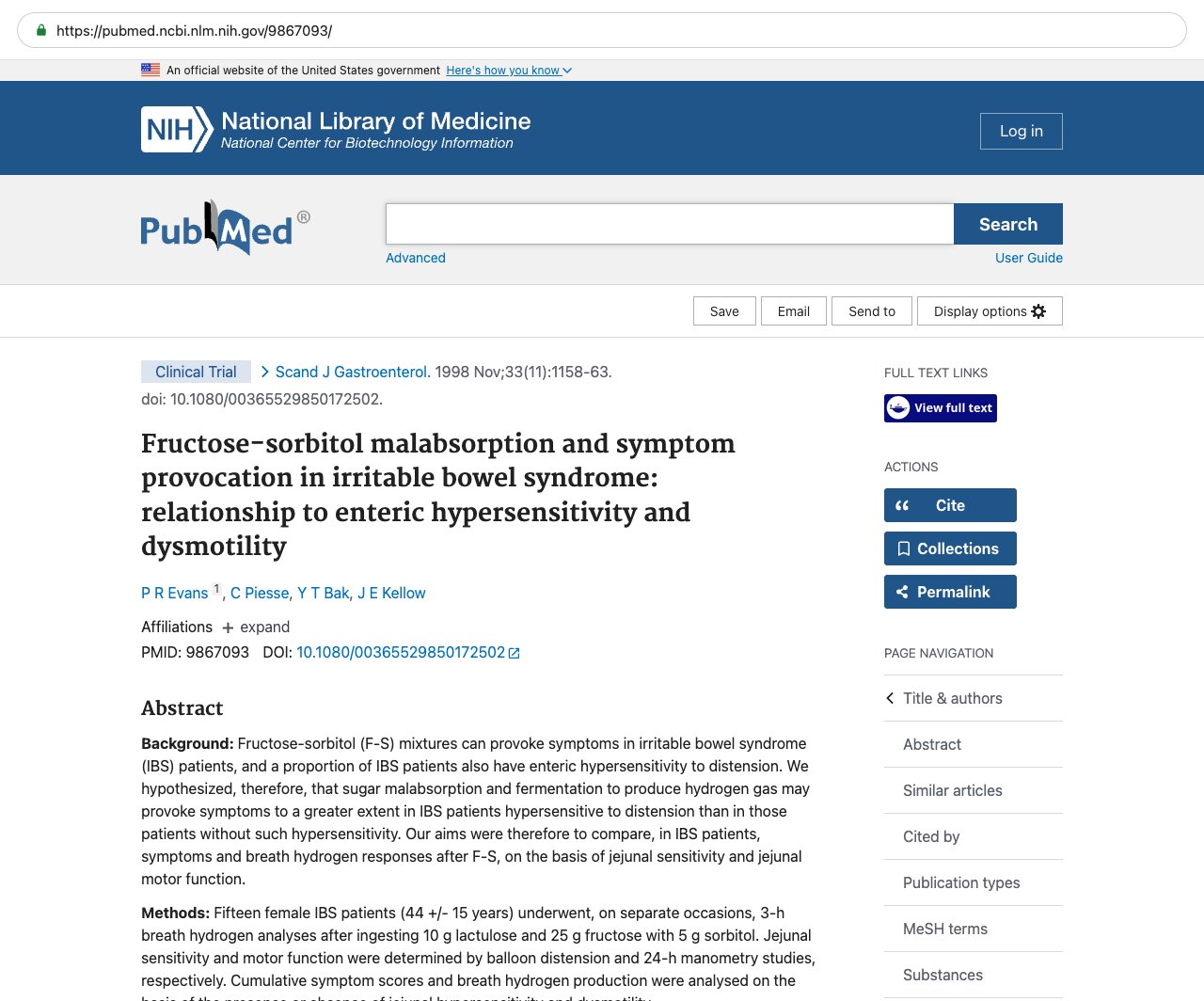
This page mirrors the published abstract (© the authors / publisher) for reference and citation. The canonical source is the PubMed record linked above. This is not medical advice.