1985 · Hanson et al. — Dietary Fiber Effects on Passage Rate and Breath Hydrogen
Super-Abstract
This 1985 study measured how different types of dietary fiber affect intestinal transit and the amount of hydrogen gas produced by gut bacteria and measurable in exhaled breath. Gel-like fibers (oat bran, citrus flour) produced more breath H₂ and less accelerated transit than particulate fibers (wheat bran, corn bran). This is a nutrition/gastroenterology study using breath H₂ as a diagnostic marker, not as a therapy. (American Journal of Clinical Nutrition, 1985.)
Commentary
Breath hydrogen testing relies on a simple fact: humans produce no H₂ themselves — any H₂ in exhaled air comes from bacterial fermentation of unabsorbed carbohydrates in the colon. This makes it a practical, non-invasive readout of gut fermentation and transit. This study used breath H₂ as a proxy marker to understand how different fiber types behave in the gut. The five-subject crossover design is minimal, but the physiological findings are mechanistically coherent: gel-forming fibers slow transit and allow more fermentation, while particulate fibers accelerate transit and produce less cumulative fermentation. This has nothing to do with H₂ therapy — it is basic nutritional science. The study is interesting contextually because it demonstrates the gut microbiome's natural capacity to generate H₂, which is the basis for understanding endogenous H₂ production.
Key quotes
- „Mean H2 concentration (ppm), averaged over the 9 h test period, ranged from 7.5 (CB) to 12.0 (OB) and tended to increase with addition of OB, CF, or WB but decrease with addition of CB.“ — the range of breath H₂ responses across different fiber types
- „The gel-like fibers (OB and CF) resulted in greater H2 concentration and less acceleration of passage rate than the particulate fibers (WB and CB).“ — key finding: fiber structure determines both transit speed and fermentation yield
Our assessment
This is a nutritional gastroenterology study, not a therapeutic H₂ study. Breath H₂ is used exclusively as a diagnostic marker of colonic fermentation and transit — it is the outcome measured, not an intervention. No H₂ is administered. Limitations: extremely small sample (n = 5); no randomization described; single-day meal challenge; 1985 methodology predates modern breath H₂ standardization; no clinical endpoints (symptoms, inflammation, etc.) assessed. Provides useful context for understanding endogenous H₂ production from the gut, but contributes no evidence for H₂ as a therapeutic agent.
Study design
- Type: crossover dietary intervention study · n: 5 healthy subjects · H₂ measurement: breath H₂ sampled every 30 min for 9 h (diagnostic marker only, no H₂ given)
- Interventions: no added fiber (baseline), wheat bran (WB), corn bran (CB), oat bran (OB), citrus flour (CF) — each 40 g added to test meal
- Result: breath H₂ ranged 7.5–12.0 ppm mean; peak H₂ earliest with WB (4.7 h), latest at baseline (8.2 h); gel fibers (OB/CF) → higher H₂, less transit acceleration vs. particulate fibers (WB/CB)
Abstract
Fermentation of fiber and passage to the large intestine were monitored by measuring hydrogen gas (H2) concentration in expired breath. Five subjects consumed meals containing no added fiber or 40 g of wheat bran (WB), corn bran (CB), oat bran (OB), or citrus flour (CF) replacing white flour. Breath samples were obtained at 30 min intervals for 9 h after the test meals. Mean H2 concentration (ppm), averaged over the 9 h test period, ranged from 7.5 (CB) to 12.0 (OB) and tended to increase with addition of OB, CF, or WB but decrease with addition of CB. Hours from the meal to the highest H2 peaks were 4.7 (WB), 5.6 (CB), 6.2 (OB), 6.4 (CF), and 8.2 (basal). The gel-like fibers (OB and CF) resulted in greater H2 concentration and less acceleration of passage rate than the particulate fibers (WB and CB).
Source & links
Screenshot of the PubMed page
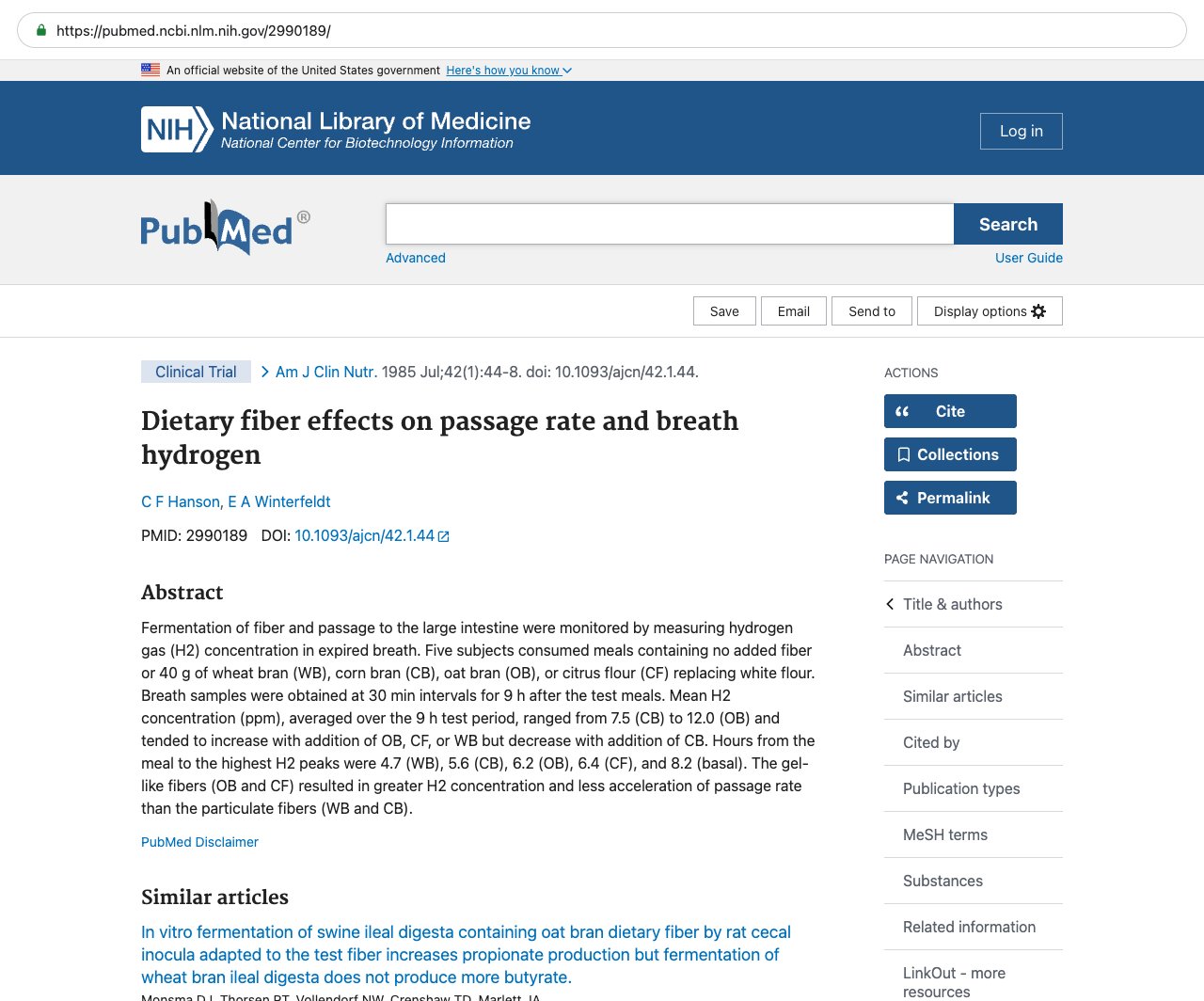
This page mirrors the published abstract (© the authors / publisher) for reference and citation. The canonical source is the PubMed record linked above. This is not medical advice.