2021 · Haworth — The prevalence of intestinal dysbiosis in patients referred for antireflux surgery
Super-Abstract
In 104 patients evaluated for antireflux surgery, 60.6% had intestinal dysbiosis — with small intestinal bacterial overgrowth (SIBO) detected by hydrogen breath testing in 39.4% of cases. Hydrogen here is a diagnostic marker produced by gut bacteria, not a therapeutic agent; but the study highlights that gut-produced H₂ may contribute to reflux symptoms misattributed to acid alone. (Surgical Endoscopy, 2021.)
Commentary
This study belongs to the diagnostic rather than therapeutic branch of hydrogen medicine. The hydrogen breath test (HBT) is a well-established clinical tool: gut bacteria fermenting carbohydrates produce H₂, which is absorbed and exhaled; elevated exhaled H₂ after a sugar challenge indicates bacterial overgrowth in the small intestine (SIBO). In patients lined up for antireflux surgery — most of whom had been on long-term proton pump inhibitors — the study found that SIBO was present in 39.4% and intestinal methanogen overgrowth (IMO) in 35.6%. These patients were more likely to report bloating and belching, and those with dysbiosis had a significantly higher positive reflux-symptom association. Critically, higher hydrogen gas production specifically correlated with regurgitation and belching symptoms. The implication: many patients' gas and reflux symptoms may be driven by dysbiosis, not just acid — and operating on them without treating the dysbiosis first may not resolve symptoms.
Key quotes
- „60.6% of patients had intestinal dysbiosis (39.4% had SIBO and 35.6% had intestinal methanogen overgrowth).“ — the high prevalence of dysbiosis in this surgical candidate population — clinically actionable
- „Hydrogen gas production was significantly greater in patients with a positive reflux-symptom association for regurgitation (228.8 ppm vs 129.1 ppm, P = 0.004).“ — gut-produced H₂ tracks with regurgitation severity — a diagnostic signal
- „SIBO may be a contributory factor to refractory reflux symptoms and gas bloating in antireflux surgery candidates.“ — the clinical takeaway: screen for SIBO before recommending surgery
Our assessment
A clinically relevant gastroenterological study using hydrogen breath testing as a diagnostic tool. Its contribution to the H₂ field is in the diagnostic/physiological domain — not therapeutic H₂ supplementation. Limitations: retrospective design, single centre, no follow-up post-surgery to show whether treating dysbiosis improved outcomes, breath test thresholds for SIBO vary across laboratories, and the causal direction (does SIBO cause reflux symptoms, or does reflux cause dysbiosis?) is not established. For readers of this database: this study does not assess H₂ as a health supplement — it uses the body's own H₂ production as a window into gut health.
Study design
- Type: retrospective observational study · n: 104 consecutive patients referred for antireflux surgery · H₂ role: diagnostic — exhaled hydrogen and methane breath testing (glucose challenge) to detect SIBO and IMO
- Workup: history, endoscopy, oesophageal manometry, 24-h pH-impedance monitoring, hydrogen + methane breath test
- Result: SIBO in 39.4%, IMO in 35.6%, total dysbiosis 60.6%; dysbiosis associated with ↑ bloating, ↑ belching, ↑ positive reflux-symptom association; hydrogen production ↑ in regurgitation/belching subgroups
Abstract
BACKGROUND: Prior to antireflux surgery, most patients with symptoms of gastroesophageal reflux disease (GERD) have been taking long-term proton pump inhibitors (PPIs). PPIs have been shown to cause changes to the intestinal microbiota, such as small intestinal bacterial overgrowth (SIBO), which is characterised by symptoms of gas bloating. Patients undergoing antireflux surgery are not routinely screened for SIBO, yet many patients experience gas-related symptoms postoperatively. METHODS: Data from consecutive patients (n = 104) referred to a speciality reflux centre were retrospectively assessed. Patients underwent a routine diagnostic workup for GERD including history, endoscopy, oesophageal manometry and 24-h pH-impedance monitoring off PPIs. Intestinal dysbiosis was determined by hydrogen and methane breath testing with a hydrogen-positive result indicative of SIBO and a methane-positive result indicative of intestinal methanogen overgrowth (IMO). RESULTS: 60.6% of patients had intestinal dysbiosis (39.4% had SIBO and 35.6% had IMO). Patients with dysbiosis were more likely to report bloating (74.6% vs 48.8%; P = 0.01) and belching (60.3% vs 34.1%; P = 0.01). The oesophageal acid exposure time and number of reflux episodes were similar between dysbiosis and non-dysbiosis groups, but patients with dysbiosis were more likely to have a positive reflux-symptom association (76.2% vs 31.7%; P < 0.001), especially for regurgitation in those with SIBO (P = 0.01). Hydrogen gas production was significantly greater in patients with a positive reflux-symptom association for regurgitation (228.8 ppm vs 129.1 ppm, P = 0.004) and belching (mean AUC 214.8 ppm vs 135.9 ppm, P = 0.02). CONCLUSIONS: The prevalence of intestinal dysbiosis is high in patients with GERD, and these patients are more likely to report gas-related symptoms prior to antireflux surgery. Independently, SIBO may be a contributory factor to refractory reflux symptoms and gas bloating in antireflux surgery candidates.
Source & links
Screenshot of the PubMed page
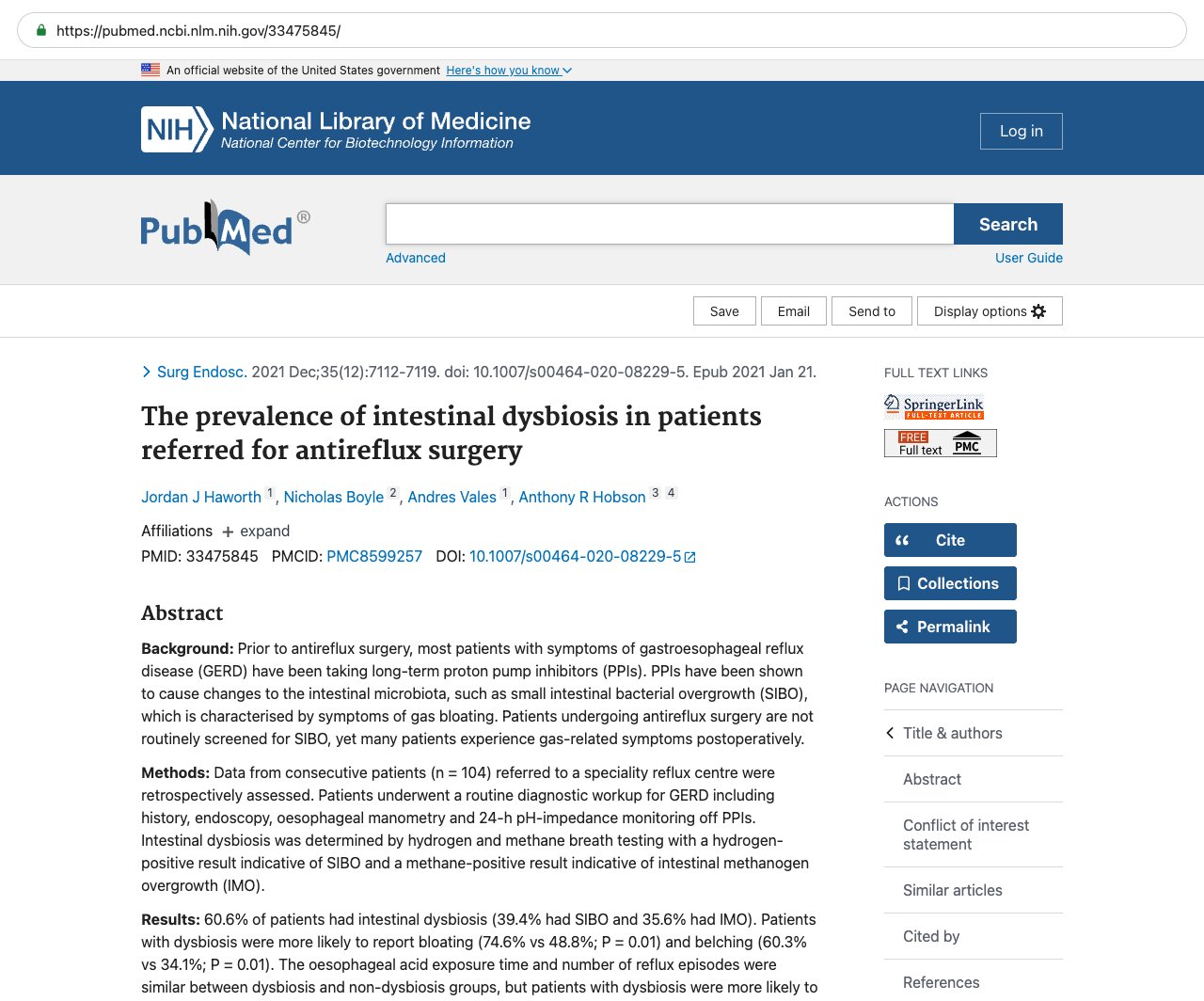
This page mirrors the published abstract (© the authors / publisher) for reference and citation. The canonical source is the PubMed record linked above. This is not medical advice.