1996 · Hertzler et al. — How much lactose is low lactose?
Super-Abstract
Lactose-intolerant adults tolerated up to 6 g of lactose per serving without significant symptoms, even though fermentation could be detected at that dose by breath hydrogen testing. Only doses of 12 g or more triggered abdominal pain; flatulence did not increase until 20 g. Breath hydrogen serves here as a diagnostic fermentation marker, not as a therapeutic agent. (Journal of the American Dietetic Association, 1996.)
Commentary
This is a practical dietary study for people with lactose maldigestion — the kind of question that matters at the supermarket: how much dairy can someone with lactase deficiency actually tolerate? The answer is more than the „zero lactose“ rule commonly advised. The breath hydrogen test quantifies fermentation in the colon, which correlates with but does not perfectly predict symptoms. The study has direct implications for dietary counselling: hard cheeses and small milk servings are likely safe. Hydrogen in this study is strictly a biomarker of gut bacterial activity, with no connection to molecular hydrogen therapy.
Key quotes
- „No significant increase in breath hydrogen production or intolerance symptoms occurred after consumption of a 2-g dose of lactose.“ — very small lactose amounts are well tolerated
- „Up to 6 g was tolerated, even though maldigestion could be measured at the 6-g dose.“ — detectable fermentation does not equal symptoms — an important distinction
- „Lactose maldigesters may be able to tolerate foods containing 6 g lactose or less per serving, such as hard cheeses and small servings (120 mL or less) of milk.“ — practical dietary recommendation
Our assessment
Important context: this study does not investigate molecular hydrogen (H₂) as a therapeutic intervention. Breath hydrogen is used exclusively as a diagnostic marker of colonic fermentation of undigested lactose. The study is a well-designed double-blind randomised dose-escalation trial (n = 13 lactose maldigesters, 5 challenge doses). Its findings are useful for dietary management of lactose intolerance. Limitations: small sample, single-dose challenges (not with real foods or meals), free-living adults may metabolise lactose differently in the context of a full meal. Not relevant to H₂ therapy.
Study design
- Type: double-blind randomised crossover (dose escalation) · n: 13 lactose-maldigesting adults · H₂ delivery: none — breath H₂ used as diagnostic marker of colonic fermentation
- Result: 2 g lactose: no significant hydrogen rise or symptoms; 6 g: measurable fermentation but tolerated; 12 g: abdominal pain increases; 20 g: flatulence increases; no significant diarrhoea at any dose
Abstract
OBJECTIVE: To test the hypothesis that complete elimination of lactose is not necessary to ensure tolerance by lactose maldigesters. DESIGN: Double-blind, randomized protocol in which challenge doses of 0, 2, 6, 12, and 20 g lactose in water were fed to subjects after a 12-hour fast. SUBJECTS: 13 healthy, free-living adults who were lactose maldigesters. MAIN OUTCOME MEASURES: Breath hydrogen production (a measure of maldigestion) and symptom response to each challenge dose. STATISTICAL ANALYSIS: Analysis of variance was done to determine overall differences in mean hydrogen gas production (peak and sum of hours 1 through 8). Friedman's test was used to determine overall differences in the mean ranks for each symptom. Fisher's least significant difference test was used for multiple comparisons for hydrogen and symptom and data. RESULTS: Hydrogen production after consumption of the 0- and 2-g lactose doses was not significantly different. Hydrogen production increased with the 6-g dose. Intensity of abdominal pain increased when the dose of lactose was 12 g. Episodes of flatulence did not increase until the dose reached 20 g. No significant differences in the occurrence of diarrhea were observed after the five treatments. CONCLUSIONS: No significant increase in breath hydrogen production or intolerance symptoms occurred after consumption of a 2-g dose of lactose. Up to 6 g was tolerated, even though maldigestion could be measured at the 6-g dose. Thus, lactose maldigesters may be able to tolerate foods containing 6 g lactose or less per serving, such as hard cheeses and small servings (120 mL or less) of milk.
Source & links
Screenshot of the PubMed page
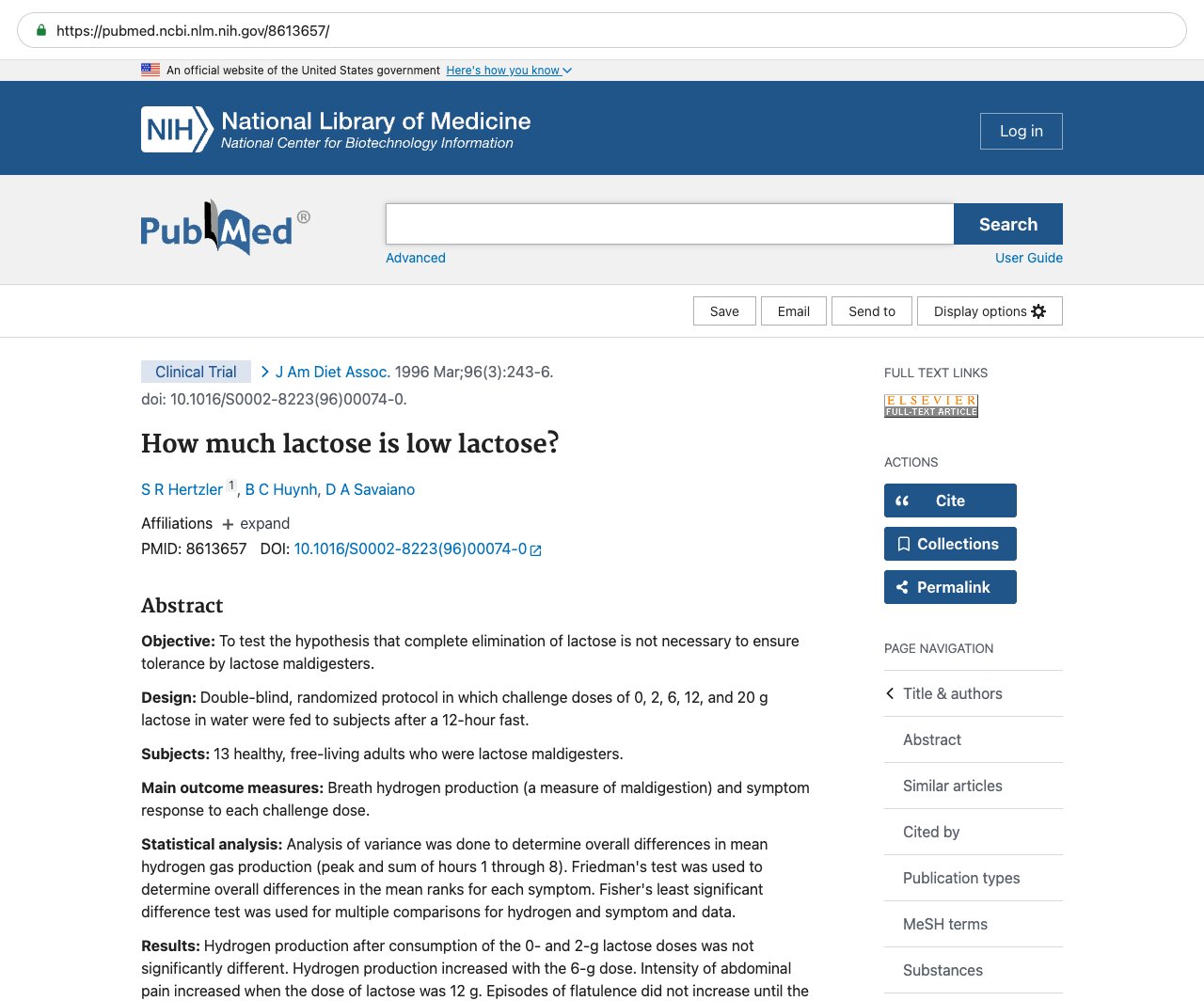
This page mirrors the published abstract (© the authors / publisher) for reference and citation. The canonical source is the PubMed record linked above. This is not medical advice.