1984 · Hiramatsu et al. — Endoscopical Determination of Gastric Mucosal Blood Flow by the Crossed Thermocouple Method
Super-Abstract
This 1984 study introduced the crossed thermocouple method as an endoscopic alternative to the hydrogen gas clearance method for measuring gastric mucosal blood flow. The authors explicitly note that the H₂ inhalation required by the conventional method is „possibly harmful to humans“ — and their thermocouple method avoids it. This is a diagnostic methodology paper; H₂ is the technique being replaced, not a therapeutic agent. (Gastroenterologia Japonica, 1984.)
Commentary
This paper has a historically interesting dimension for the H₂ field: the authors of this 1984 study regarded inhaled H₂ as a potential safety concern, framing their thermocouple method as preferable because it does not require H₂ inhalation. This reflects the uncertainty of that era about H₂ safety at the concentrations used clinically for blood flow measurement. From the perspective of modern H₂ medicine, this concern was overstated — but the fact that researchers felt the need to develop alternatives illustrates how H₂ was viewed at the time. The study measured blood flow at 8 stomach sites in 11 healthy controls, finding higher flow in the corpus than the antrum, and higher in those under 50 years. Results agreed with H₂ clearance data, validating the new method.
Key quotes
- „This method dose not require the inhalation of hydrogen gas which is necessary for the hydrogen gas clearance method and which is possibly harmful to humans.“ — the authors' concern about H₂ inhalation safety — reflecting 1984 era uncertainty
- „The blood flow rates at all sites in the corpus were found to be higher than those at the antrum.“ — the main physiological finding: regional variation in gastric mucosal perfusion
Our assessment
This is a diagnostic methodology development study, not a therapeutic H₂ investigation. The H₂ inhalation referenced is a comparative method being supplanted — it is not studied as therapy. Interestingly, the authors flagged H₂ inhalation as „possibly harmful to humans“ — a concern not supported by modern safety literature, but historically instructive. Limitations: small sample (n = 11 healthy controls); only one measurement session per subject; no clinical outcomes beyond the technical comparison; the phrasing „possibly harmful“ regarding H₂ inhalation appears unsubstantiated and reflects 1984 concerns rather than established toxicology.
Study design
- Type: diagnostic methodology validation study · n: 11 healthy control subjects · H₂ relevance: H₂ clearance method used as comparator only — new crossed thermocouple method tested as replacement
- Measurements: gastric mucosal blood flow at 8 stomach sites; comparison of thermocouple vs. H₂ clearance readings
- Result: thermocouple results agreed with H₂ clearance data; corpus blood flow > antrum; flow higher in subjects <50 years; method validated as H₂-free alternative
Abstract
A crossed thermocouple method in combination with endoscopy was applied to determine the blood flow rate of the human gastric mucosa. Determination was carried out with 11 healthy control subjects at 8 sites of the stomach. The blood flow rates at all sites in the corpus were found to be higher than those at the antrum. In subjects less than 50 years old the blood flow rate in the corpus was higher than in older subjects. These results were in agreed well with those obtained by the hydrogen gas clearance method, which is widely adopted clinically. The crossed thermocouple method is easily applicable to all sites in the gastric mucosa and the time required for the assay is very short. This method dose not require the inhalation of hydrogen gas which is necessary for the hydrogen gas clearance method and which is possibly harmful to humans. Although the values obtained by the crossed thermocouple method are relative to the value at a certain fixed site, this method will holds great potential for the determination of gastric mucosal blood flow rate.
Source & links
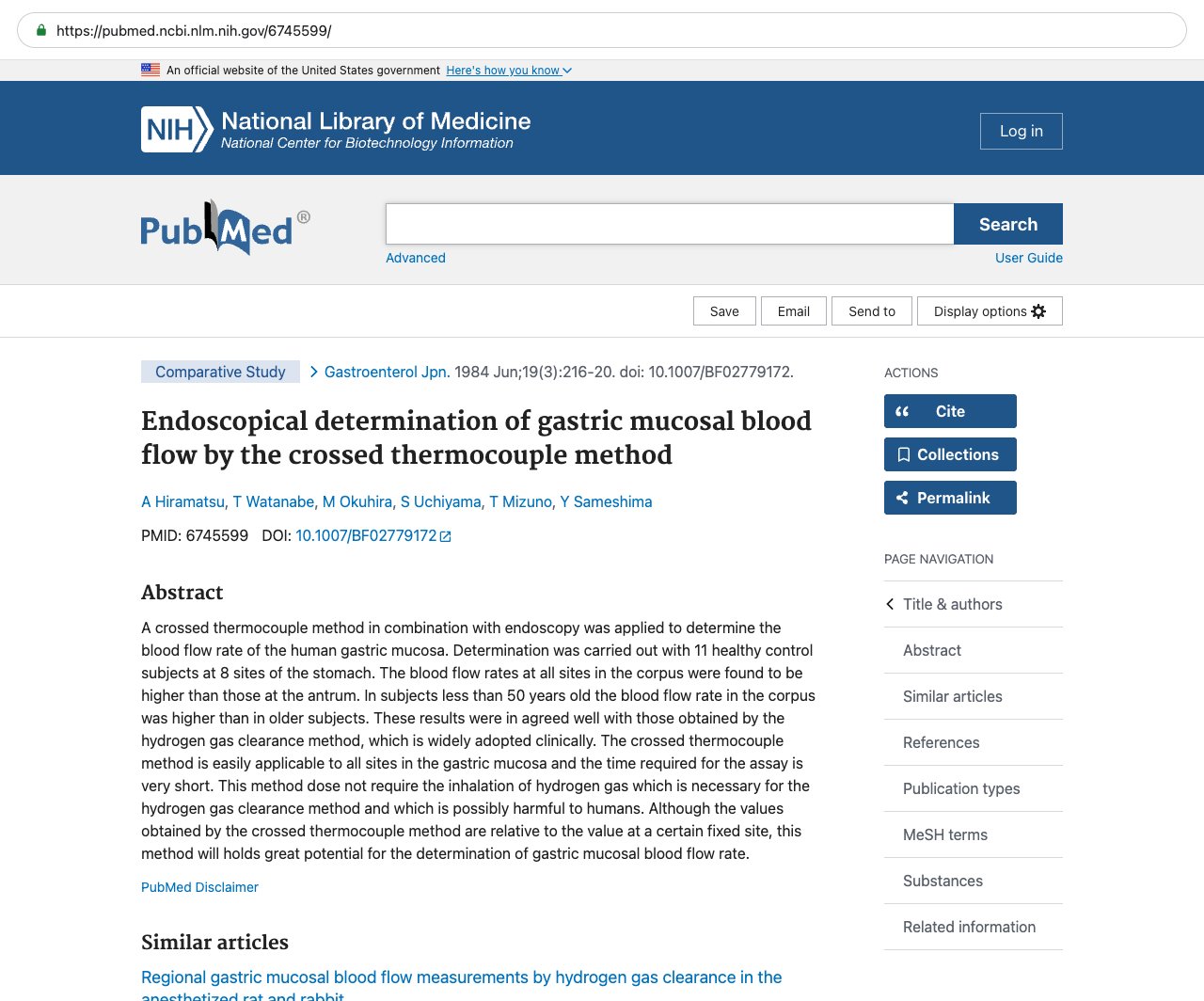
Screenshot of the PubMed page
This page mirrors the published abstract (© the authors / publisher) for reference and citation. The canonical source is the PubMed record linked above. This is not medical advice.