2010 · Iida et al. — Failure of D-Psicose Absorbed in the Small Intestine to Metabolize into Energy and Its Low Large Intestinal Fermentability in Humans
Super-Abstract
This nutrition study uses breath hydrogen as a standard fermentation marker to assess the metabolic fate of d-psicose (a rare sugar) in humans — it is not an H₂ therapy study. The finding is that d-psicose is poorly fermented and has an energy value below 1.6 kJ/g. Hydrogen-rich water and H₂ as a therapeutic agent are not investigated. (Metabolism: Clinical and Experimental, 2010.)
Commentary
D-psicose is a rare sugar with potential use as a low-calorie sweetener. This study assessed whether it is metabolized to energy in the small intestine (answer: no) and whether it is fermented in the colon (answer: barely). Breath hydrogen excretion was used as the standard clinical nutrition tool for detecting colonic fermentation — the same technique used in lactose intolerance tests. The „methods: inhalation, drinking-hrw“ classification in the source metadata is a clear error; no hydrogen-rich water and no H₂ inhalation therapy were used. This paper belongs to food science/nutrition research.
Key quotes
- „the energy value of d-psicose was expected to be less than 1.6 kJ/g.“ — the central finding: d-psicose has very low available energy — breath H₂ was the measurement tool, not the therapy
Our assessment
Off-topic for H₂ therapy. Breath hydrogen is used exclusively as a colonic fermentation marker in this food science study. No hydrogen-rich water, no H₂ inhalation therapy, no H₂ therapeutic intervention of any kind was applied. The source metadata classification (methods: „inhalation, drinking-hrw“) is incorrect. This study investigates the nutritional properties of a rare sugar, not molecular hydrogen medicine.
Study design
- Type: human nutrition study · n: 6 (calorimetry), 14 (breath H₂ and urine tests), 8 (adaptation sub-study) · H₂ delivery: none — breath H₂ used as fermentation marker only
- Result: d-psicose not metabolized to energy; urinary excretion ~70%; colonic fermentability very low; energy value < 1.6 kJ/g
Abstract
Experiments with rats have produced data on the metabolism and energy value of d-psicose; however, no such data have been obtained in humans. The authors assessed the availability of d-psicose absorbed in the small intestine by measuring carbohydrate energy expenditure (CEE) by indirect calorimetry. They measured the urinary excretion rate by quantifying d-psicose in urine for 48 hours. To examine d-psicose fermentation in the large intestine, the authors measured breath hydrogen gas and fermentability using 35 strains of intestinal bacteria. Six healthy subjects participated in the CEE test, and 14 participated in breath hydrogen gas and urine tests. d-Psicose fermentation subsequent to an 8-week adaptation period was also assessed by measuring hydrogen gas in 8 subjects. d-Psicose absorbed in the small intestine was not metabolized into energy, unlike glucose, because CEE did not increase within 3 hours of d-psicose ingestion (0.35 g/kg body weight [BW]). The accumulated d-psicose urinary excretion rates were around 70% for 0.34, 0.17, and 0.08 g/kg BW of ingested d-psicose. Low d-psicose fermentability was observed in intestinal bacteria and breath hydrogen gas tests, in which fructooligosaccharide (0.34, 0.17, and 0.08 g/kg BW) was used as a positive control because its available energy is known to be 8.4 kJ/g. Based on the results of the plot of breath hydrogen concentration vs calories ingested, the energy value of d-psicose was expected to be less than 1.6 kJ/g. Incremental d-psicose fermentability subsequent to an adaptation period was not observed.
Source & links
Screenshot of the PubMed page
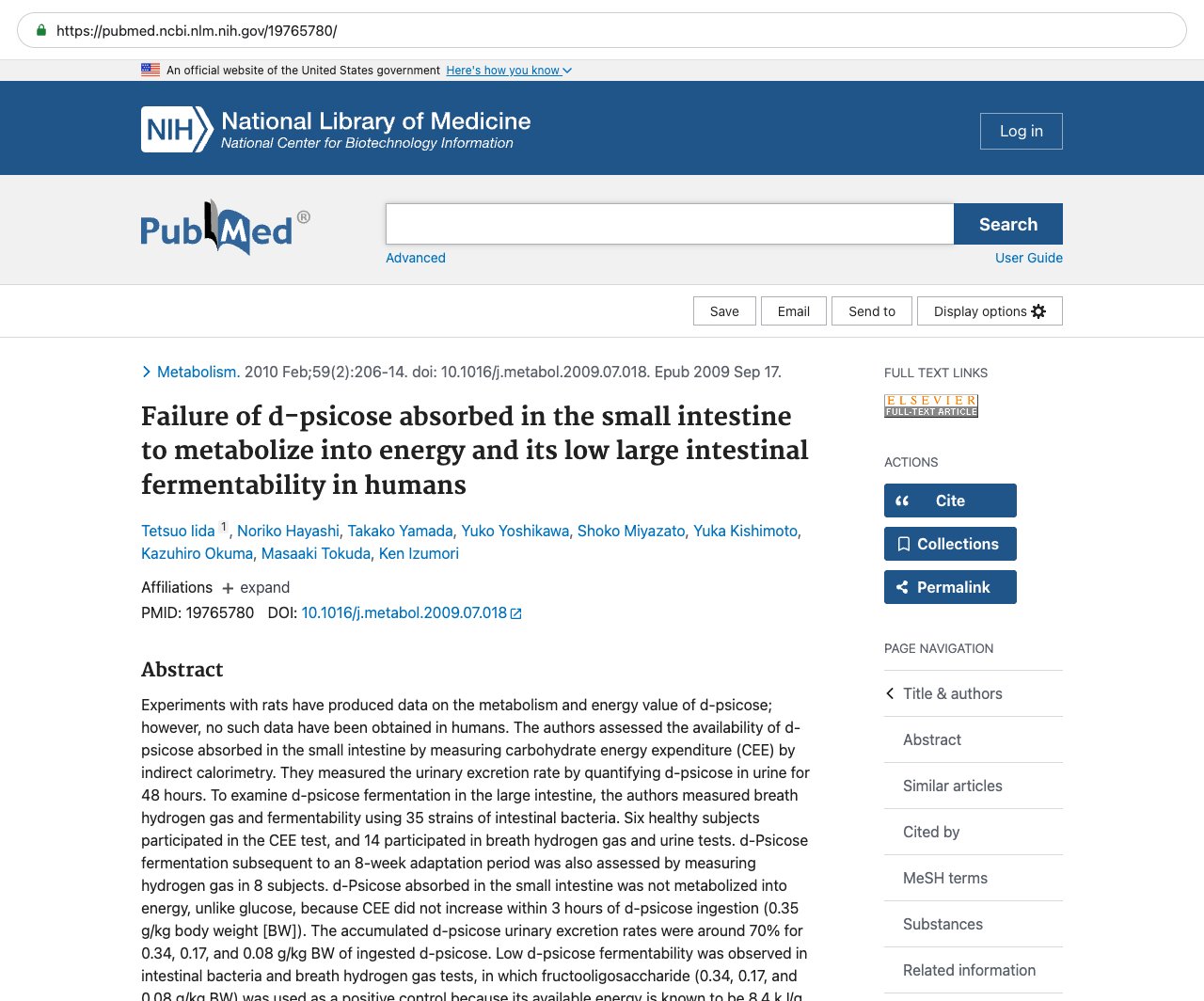
This page mirrors the published abstract (© the authors / publisher) for reference and citation. The canonical source is the PubMed record linked above. This is not medical advice.