1983 · Ishida — Laparoscopic measurement of pancreatic blood flow.
Super-Abstract
Using inhaled hydrogen gas as a tracer, researchers measured pancreatic blood flow laparoscopically in humans for the first time. Healthy subjects showed a mean flow of 87.8 ml/min/100 g; patients with chronic pancreatitis showed markedly reduced flow at 58.0 ml/min/100 g. The method demonstrates that laparoscopy can assess physiological organ function, not just anatomy. (Endoscopy, 1983.)
Commentary
This study belongs to an older body of work that used inhaled molecular hydrogen as a vascular tracer — exploiting the gas's ability to cross membranes rapidly and be detected by a platinum electrode. Here, the clinical question was entirely diagnostic: can laparoscopy be extended from morphological assessment to functional measurement of pancreatic perfusion? The hydrogen clearance technique was the available tool for this purpose. This is not a study of hydrogen therapy or the biological effects of H₂; hydrogen serves solely as an inert indicator gas. The finding — reduced blood flow in chronic pancreatitis — is physiologically plausible, but the study is small and the methodology (hydrogen clearance via laparoscope) is today largely obsolete, replaced by Doppler ultrasound and imaging.
Key quotes
- „we attempted, despite many difficulties, to measure the pancreatic blood flow in man, using the hydrogen gas clearance method.“ — hydrogen used as a diagnostic tracer, not as therapy
- „The mean pancreatic blood flow for persons with a normal pancreas was 87.8 +/- 20.6 ml/min/100 g, and the mean value for patients with chronic pancreatitis was 58.0 +/- 33.3 ml/mn/100 g.“ — key quantitative finding: reduced perfusion in pancreatitis
- „Laparoscopy has been used merely as a means of morphological examination, but should also be turned to account in the investigation of various intraperitoneal organs for physiological function.“ — the authors' conclusion about extending laparoscopy to functional assessment
Our assessment
This study has no relevance to H₂ therapy. Hydrogen gas is used here exclusively as an inert vascular tracer in the hydrogen clearance technique — a method from diagnostic physiology. The results document a measurable perfusion deficit in chronic pancreatitis, which is scientifically interesting but does not speak to any therapeutic effect of H₂. Limitations: very small sample (n not explicitly stated but implied to be very limited); the technique is invasive (laparoscopy under general or heavy sedation); no control for confounders; method long superseded. Should be categorised as a diagnostic methodology study, not an H₂ therapy study.
Study design
- Type: observational, diagnostic methodology study · n: small case series (exact n not stated) · H₂ delivery: inhaled hydrogen gas as vascular tracer (clearance method) — not therapeutic
- Indication: pancreatic perfusion measurement; chronic pancreatitis vs. healthy controls · Result: reduced pancreatic blood flow in chronic pancreatitis (58.0 vs. 87.8 ml/min/100 g); H₂ used solely as diagnostic indicator
Abstract
Laparoscopy is a morphological examination and is employed in the examination of the liver and other visceral organs. Further, as a result of recent remarkable progress in endoscopy it has become possible to examine not only the intraperitoneal organs but also the pancreas, a retroperitoneal organ, by means of laparoscopy. With a view to expanding the application of laparoscopy, we attempted, despite many difficulties, to measure the pancreatic blood flow in man, using the hydrogen gas clearance method. The mean pancreatic blood flow for persons with a normal pancreas was 87.8 +/- 20.6 ml/min/100 g, and the mean value for patients with chronic pancreatitis was 58.0 +/- 33.3 ml/mn/100 g. Laparoscopy has been used merely as a means of morphological examination, but should also be turned to account in the investigation of various intraperitoneal organs for physiological function.
Source & links
Screenshot of the PubMed page
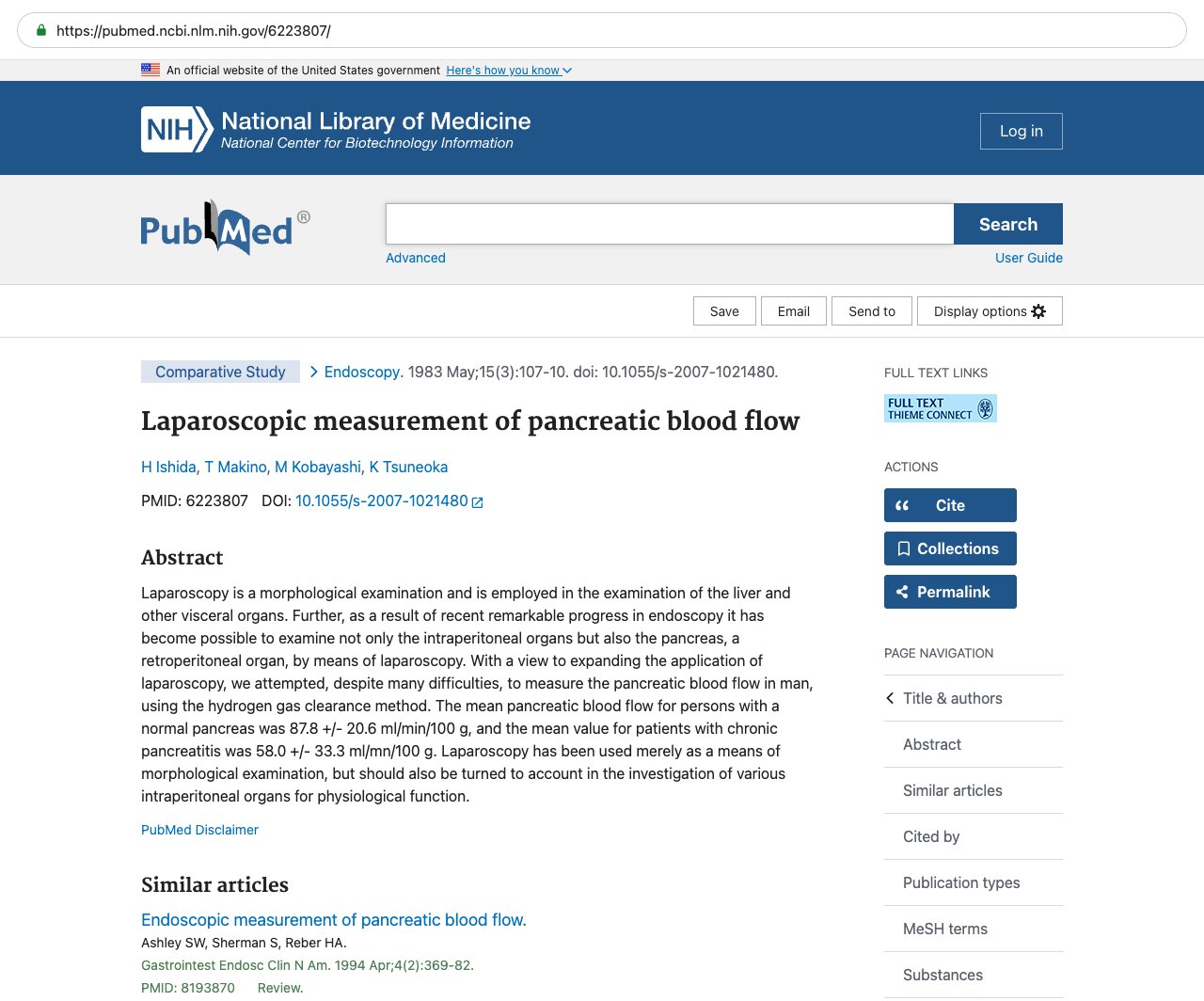
This page mirrors the published abstract (© the authors / publisher) for reference and citation. The canonical source is the PubMed record linked above. This is not medical advice.