2023 · Kiyama — Changes in the negative logarithm of end-tidal hydrogen partial pressure indicate the variation of electrode potential in healthy Japanese subjects.
Super-Abstract
Breath hydrogen, produced by gut bacteria and exhaled in measurable amounts, can serve as a non-invasive window into the body's redox state. This study in 149 healthy Japanese adults shows that a simple handheld breath H₂ sensor can detect meaningful changes in the body's electrode potential over the course of a day. (Scientific Reports, 2023.)
Commentary
This paper introduces „pH2“ — the negative logarithm of the end-tidal hydrogen partial pressure — by analogy with pH. Using the Nernst equation, the authors show that changes in pH2 correspond to changes in electrode potential in solution. In 149 healthy Japanese subjects, exhaled H₂ was measured in the morning and again at noon after daily activities using a portable sensor. The midday pH2 was on average 0.15 units higher than at baseline, corresponding to approximately +4.6 mV of oxidation — meaning the body's redox state had shifted slightly toward more oxidative after daily activity. The concept is elegant and the measurement method is accessible, but this is fundamentally a methods and proof-of-concept study. It establishes a framework for non-invasive monitoring of redox variation in daily life, which could eventually be useful in research contexts and to track H₂ interventions. It does not evaluate any therapeutic H₂ intervention itself.
Key quotes
- „pH2 is defined as the negative logarithm of the H2 effective pressure in this study.“ — defining the new measurement concept by analogy with pH
- „The variation of electrode potential was obtained by multiplying the pH2 difference, which suggested approximately + 4.6 mV oxidation after daily activities.“ — quantifying how much oxidation occurs over the course of a normal day
- „Changes in end-tidal pH2 indicate the variation of electrode potential during daily activities in healthy human subjects.“ — the core conclusion: breath H₂ tracks the body's redox state in real time
Our assessment
This is a methodological proof-of-concept study, not a therapeutic trial. Its contribution is conceptual: it validates the use of a portable breath H₂ sensor as a proxy for the body's redox potential. Limitations: the study was conducted exclusively in healthy Japanese subjects (n=149), limiting generalisability; no intervention was applied; the clinical significance of a +4.6 mV oxidation shift during daily activities is not established. The concept of breath pH2 monitoring is innovative but has not yet demonstrated clinical utility. For the H₂ research community, this paper offers a potentially useful non-invasive measurement tool for future intervention studies.
Study design
- Type: observational, cross-sectional measurement study · n: 149 healthy Japanese adults · H₂ delivery: none (measurement of endogenous gut-produced H₂ via breath sensor)
- Result: median baseline pH2 = 4.89; increased by 0.15 units at noon, corresponding to approx. +4.6 mV oxidation; end-tidal pH2 proposed as non-invasive redox indicator
Abstract
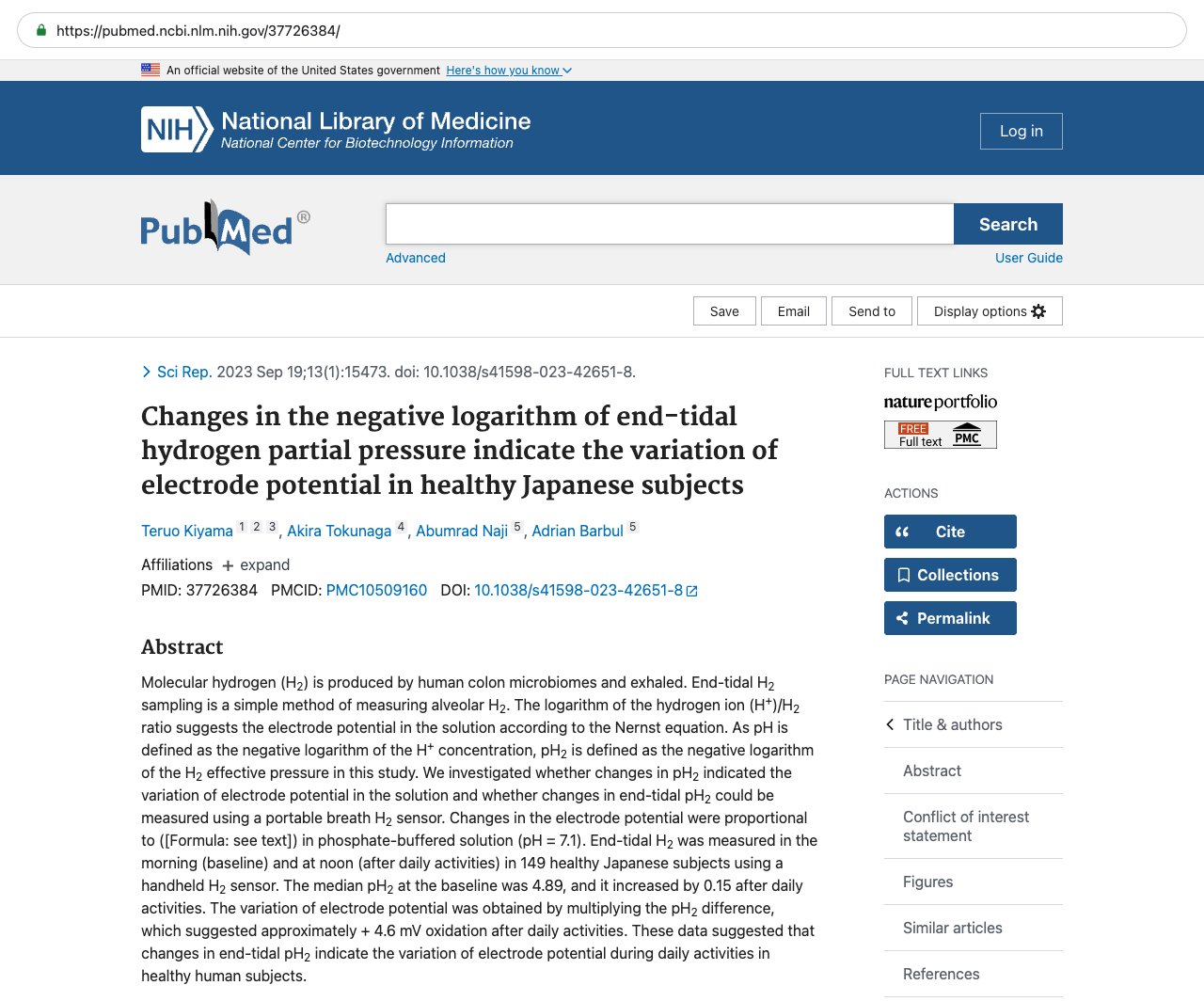
Molecular hydrogen (H2) is produced by human colon microbiomes and exhaled. End-tidal H2 sampling is a simple method of measuring alveolar H2. The logarithm of the hydrogen ion (H+)/H2 ratio suggests the electrode potential in the solution according to the Nernst equation. As pH is defined as the negative logarithm of the H+ concentration, pH2 is defined as the negative logarithm of the H2 effective pressure in this study. We investigated whether changes in pH2 indicated the variation of electrode potential in the solution and whether changes in end-tidal pH2 could be measured using a portable breath H2 sensor. Changes in the electrode potential were proportional to ([Formula: see text]) in phosphate-buffered solution (pH = 7.1). End-tidal H2 was measured in the morning (baseline) and at noon (after daily activities) in 149 healthy Japanese subjects using a handheld H2 sensor. The median pH2 at the baseline was 4.89, and it increased by 0.15 after daily activities. The variation of electrode potential was obtained by multiplying the pH2 difference, which suggested approximately + 4.6 mV oxidation after daily activities. These data suggested that changes in end-tidal pH2 indicate the variation of electrode potential during daily activities in healthy human subjects.
Source & links
Screenshot of the PubMed page
This page mirrors the published abstract (© the authors / publisher) for reference and citation. The canonical source is the PubMed record linked above. This is not medical advice.