1969 · Levitt — Production and excretion of hydrogen gas in man.
Super-Abstract
This study characterised how the human body produces and eliminates hydrogen gas — almost entirely through bacterial fermentation of unabsorbed carbohydrates in the colon — and established hydrogen breath testing as a tool for studying intestinal fermentation. The findings laid groundwork for the clinical use of the H₂ breath test, which remains in use today. (The New England Journal of Medicine, 1969.)
Commentary
This is a seminal physiological study of endogenous hydrogen metabolism in humans. Levitt demonstrated that humans produce virtually no H₂ via mammalian cellular metabolism; all measurable H₂ originates from colonic bacteria fermenting undigested carbohydrates. The H₂ produced diffuses into the bloodstream and is exhaled via the lungs, forming the basis of the H₂ breath test still used diagnostically (e.g., for lactose intolerance, SIBO). This is not a study of inhaled or ingested H₂ therapy — it is a metabolic/physiological characterisation of endogenous H₂ production. Nevertheless, it represents foundational knowledge about H₂ in human biology: the body has been producing and tolerating H₂ for millions of years of co-evolution with gut microbiota. No abstract text was available for this article.
Key quotes
- „Production and excretion of hydrogen gas in man.“ — title-level summary — no abstract available; foundational study on endogenous H₂ physiology
Our assessment
This study is not an H₂ therapy study — it characterises endogenous H₂ physiology. However, it is foundational context for H₂ medicine: it establishes that molecular hydrogen is a natural product of human gut microbiome metabolism, that humans are chronically exposed to H₂ without harm, and that H₂ readily crosses biological membranes. No abstract was available; assessment based on title, journal (NEJM 1969), and known scientific context. Published in a high-impact journal. Not directly applicable to therapeutic H₂ claims.
Study design
- Type: physiological/metabolic characterisation study · n: not stated · H₂ source: endogenous (colonic bacterial fermentation) — NOT exogenous therapeutic H₂
- Result: H₂ in humans produced almost exclusively by gut bacteria; exhaled H₂ reflects colonic fermentation activity; basis of H₂ breath testing · No abstract available — see DOI 10.1056/nejm196907172810303
Source & links
Screenshot of the PubMed page
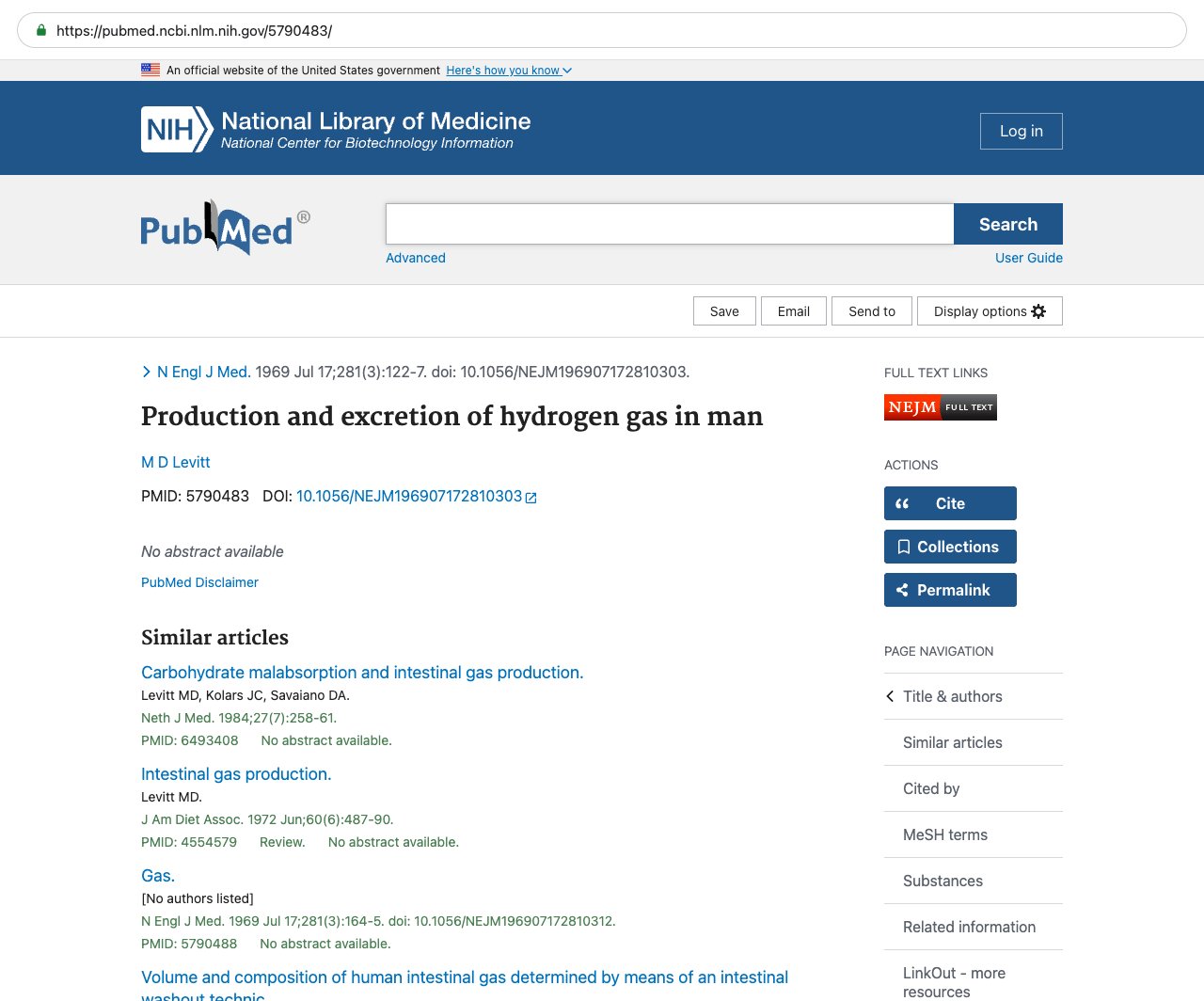
This page mirrors the published abstract (© the authors / publisher) for reference and citation. The canonical source is the PubMed record linked above. This is not medical advice.