2000 · Lewis — Endoscopic measurement of pancreatic tissue perfusion in patients with chronic pancreatitis and control patients.
Super-Abstract
Pancreatic blood flow was measured endoscopically using the hydrogen gas clearance technique in patients with chronic pancreatitis, revealing significantly lower perfusion compared to controls. H₂ here is an inert diagnostic gas used to measure tissue perfusion — not a therapeutic agent. (Gastrointestinal Endoscopy, 2000.)
Commentary
The hydrogen gas clearance technique is a validated method for measuring local tissue blood flow: inhaled or locally applied H₂ is detected at the tissue of interest via a platinum electrode, and the rate of clearance reflects perfusion. In this study, a platinum ductal electrode was placed endoscopically in the pancreatic duct to measure pancreatic blood flow. Patients with chronic pancreatitis had significantly lower flow (51.5 vs. 91.7 mL/min/100g, p < 0.01) than controls, consistent with the known vascular fibrosis of the condition. This is a pure diagnostic/physiological study; H₂ is a tracer gas, not a therapeutic molecule.
Key quotes
- „Patients with chronic pancreatitis had a significantly lower pancreatic blood flow compared with control patients (51.5 versus 91.7 mL/min/100 gm, p < 0.01).“ — key finding: chronic pancreatitis reduces pancreatic perfusion by nearly half
- „Measurement of pancreatic blood flow with an endoscopically placed electrode is relatively safe and simple to perform.“ — the technique is feasible for clinical research
Our assessment
Assessment note: This study is not an H₂ therapy trial. H₂ is used as an inert tracer gas for measuring tissue perfusion via the clearance technique. No H₂ was administered for therapeutic purposes. This is a diagnostic physiology study in chronic pancreatitis. No therapeutic claims regarding H₂ can be derived from this work. It should not appear in an H₂ therapy database without a clear disclaimer.
Study design
- Type: observational diagnostic study · n: 12 patients with chronic pancreatitis + 11 control patients (ERCP indication) · H₂ delivery: none as therapy — H₂ used as inhalation/local tracer gas for blood-flow clearance measurement via endoscopically placed platinum electrode
- Result: chronic pancreatitis group: 51.5 mL/min/100g; controls: 91.7 mL/min/100g (p < 0.01); secretin stimulation increased flow in controls but not in pancreatitis patients
Abstract
BACKGROUND: Pancreatic blood flow is diminished in experimental models of acute and chronic pancreatitis. We attempted to develop a safe and reliable technique for its measurement in patients and to examine blood flow in patients with chronic pancreatitis and in control subjects. METHOD: Pancreatic blood flow was measured using the hydrogen gas clearance technique and an endoscopically placed platinum ductal electrode. Pancreatic blood flow was measured in 12 patients with chronic pancreatitis diagnosed clinically and radiographically, and in 11 control patients undergoing endoscopic retrograde cholangiopancreatography (ERCP) for non-pancreatic pathology. RESULTS: Patients with chronic pancreatitis had a significantly lower pancreatic blood flow compared with control patients (51.5 versus 91.7 mL/min/100 gm, p < 0.01). With secretin stimulation pancreatic blood flow increased in two control patients, whereas this notable rise was not seen in three patients with chronic pancreatitis. CONCLUSIONS: Measurement of pancreatic blood flow with an endoscopically placed electrode is relatively safe and simple to perform. The scarring and vascular fibrosis associated histologically with chronic pancreatitis is reflected in lower pancreatic blood flow.
Source & links
Screenshot of the PubMed page
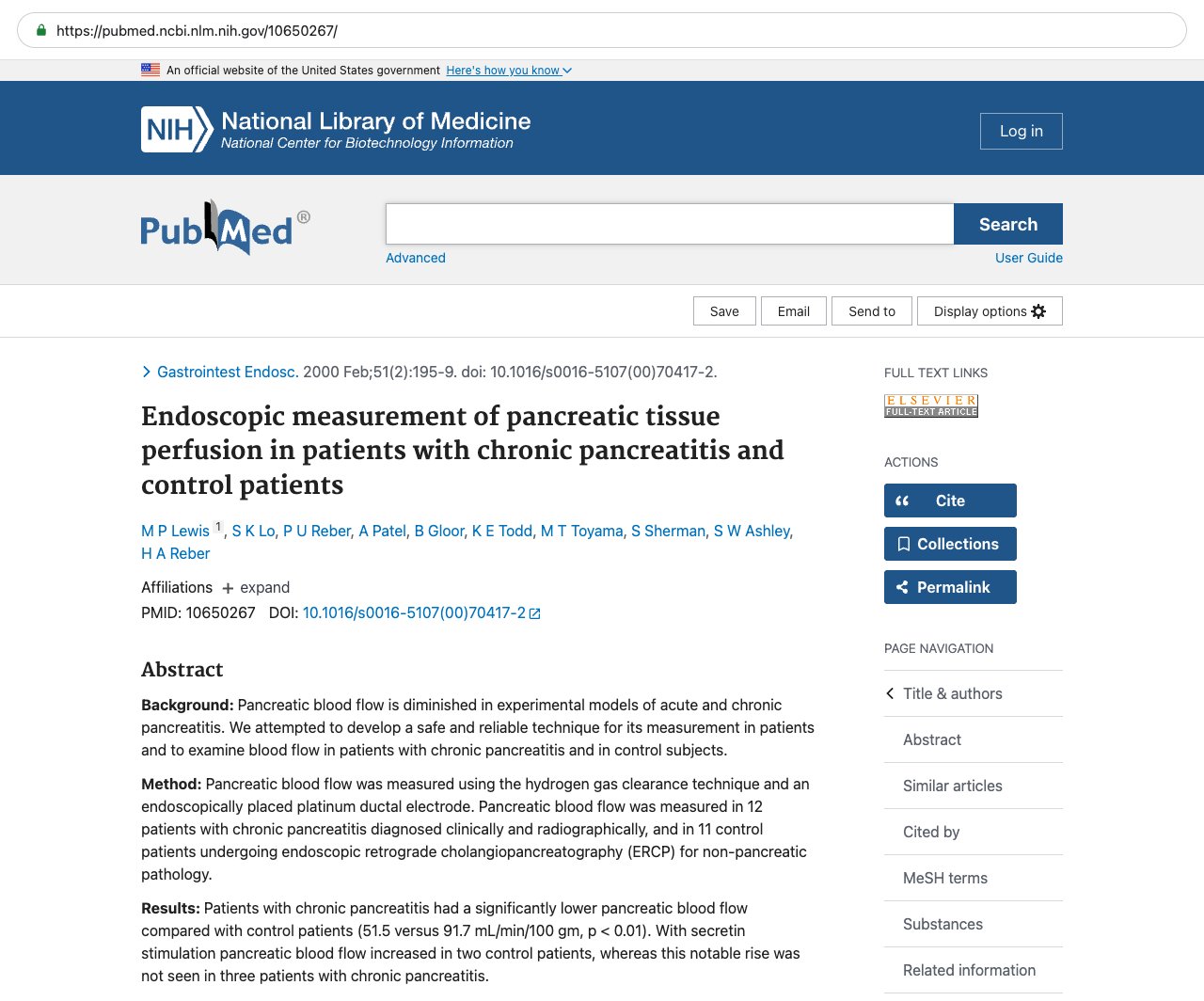
This page mirrors the published abstract (© the authors / publisher) for reference and citation. The canonical source is the PubMed record linked above. This is not medical advice.