2007 · Maev et al. — Blood Flow and Morphofunctional Status of Gastroduodenal Mucosa in Different Phases of Peptic Ulcer
Super-Abstract
This gastroenterology study uses the hydrogen gas clearance technique to measure gastric and duodenal mucosal blood flow in peptic ulcer disease — it is not an H₂ therapy study. H₂ gas is used here as a physiological measurement tracer, not as a therapeutic agent. The study focuses on how Helicobacter pylori infection and mucosal inflammation affect blood flow during ulcer healing and relapse. (Terapevticheskii arkhiv, 2007.)
Commentary
The hydrogen gas clearance method is a classical physiological technique where a small amount of H₂ gas is inhaled or delivered locally and its clearance rate is used to calculate organ or tissue blood flow. In this study, it was used to measure the mucosal blood flow (MBF) in the stomach and duodenum of peptic ulcer patients at different disease phases. This technique is used in clinical physiology as a measurement tool — it is not a therapeutic intervention. The clinical findings about MBF thresholds in ulcer healing and relapse are relevant to gastroenterology but have no connection to molecular hydrogen therapy.
Key quotes
- „The MBF level of 30 ml/min/100 g was assessed as crucial in ulcerogenesis.“ — H₂ clearance used to define a critical blood flow threshold for ulcer formation — purely a measurement application
- „Gastric and duodenal MBF were assessed by the hydrogen gas clearance technique in 102 DU and 95 GU patients.“ — explicitly states H₂ clearance as the measurement method, not a therapy
Our assessment
Off-topic for H₂ therapy. The hydrogen gas clearance technique is used here exclusively as a blood-flow measurement tool. No H₂ therapeutic intervention was applied to patients. This peptic ulcer study belongs to gastroenterology and clinical physiology research, not to molecular hydrogen medicine. The indication tags in the source metadata (immune-system) appear to be a classification error.
Study design
- Type: observational clinical study · n: 197 peptic ulcer patients (102 duodenal, 95 gastric ulcer) + 407 patients for endoscopy/histology · H₂ delivery: none — H₂ clearance used only as mucosal blood flow measurement technique
- Result: mucosal blood flow of 30 mL/min/100 g identified as critical threshold for ulcerogenesis; MBF changes correlated with HP infection grade and healing phase; no H₂ therapeutic outcomes
Abstract
AIM: To investigate gastric and duodenal mucosal blood flow (MBF) in different phases of gastric ulcer (GU) and duodenal ulcer (DU) and its relation both to Helicobacter pylori (HP) infection and mucosal disorders. MATERIAL AND METHODS: Upper endoscopy and histological examinations (score of inflammation, atrophy, metaplasy) were performed in 407 patients with DU and 103 with GU. Gastric and duodenal MBF were assessed by the hydrogen gas clearance technique in 102 DU and 95 GU patients. HP was detected by histology. Gastric secretion was measured in the interdigestive period and after stimulation by pentagastrin. RESULTS: Lowering of MBF in gastric antrum and duodenum was observed in DU and GU patients only with score 3 of HP infection. DU healing is accompanied with a decrease of HP value and improvement of mucosal histology. At the same time MBF exhibits a significant rise: in the duodenum (by 45%) at the stage of white scar; in gastric antrum (by 26%) and body (by 40%) at healing stage, but a decrease in white scar. During healing of GU gastric MBF reached maximum in active ulcer but in white scar MBF was significantly lower. MBF at ulcer margin and MBF in ulcer crater was the same (30 ml/min/100 g) with MBF in the region of white scar with enhanced inflammation (score 2.1) before GU relapse. CONCLUSION: Changes of MBF in different phases of ulcer are, in part, determined both by HP and by mucosal morphological disorders. The ratio MBF increase in ulcer healing/MBF reduction in ulcer relapse is the same (30% from optimal) and it is restitution entity. The MBF level of 30 ml/min/100 g was assessed as crucial in ulcerogenesis. Lowering MBF in mucosa with remaining inflammation in the scar region may predict GU relapse.
Source & links
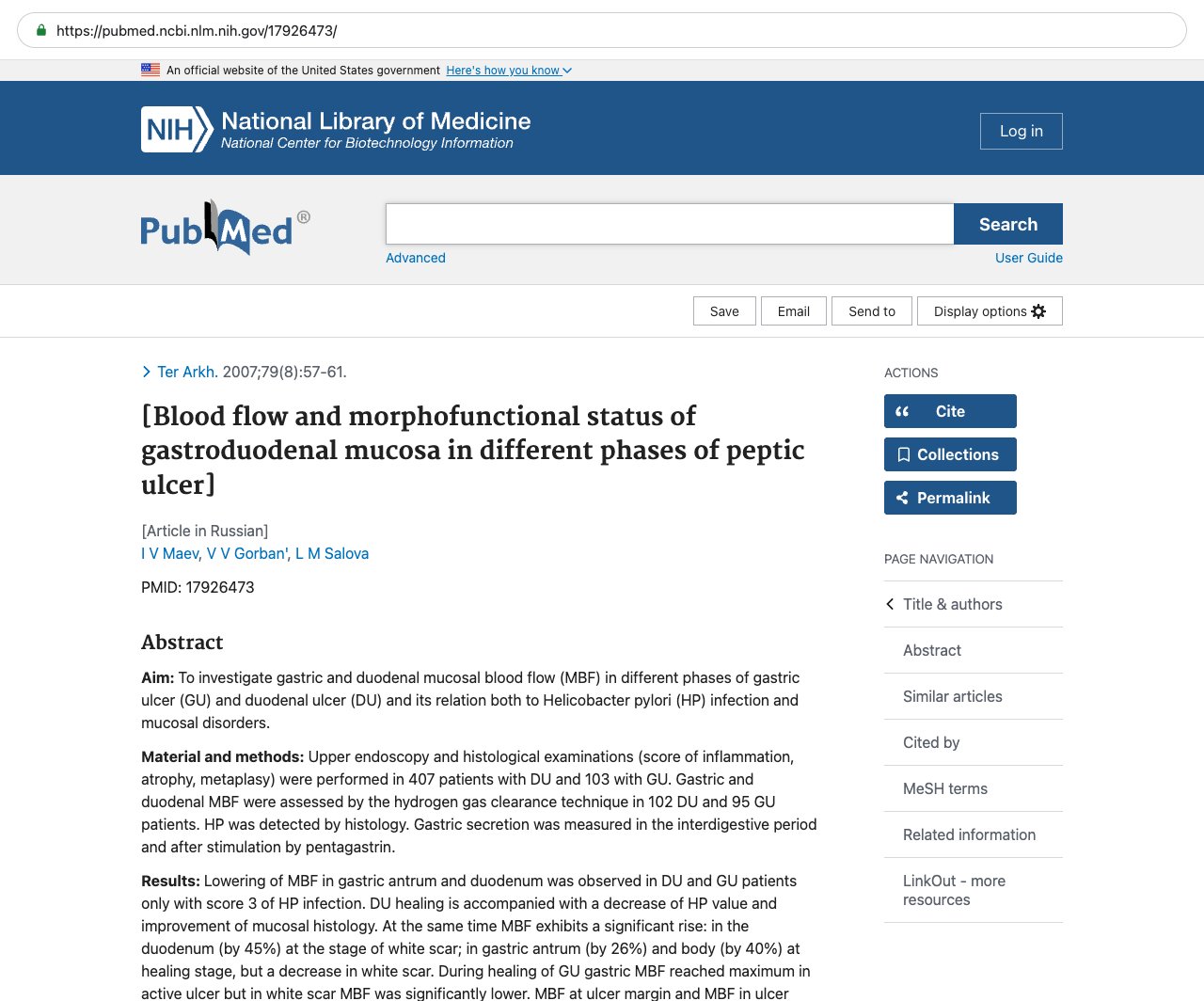
Screenshot of the PubMed page
This page mirrors the published abstract (© the authors / publisher) for reference and citation. The canonical source is the PubMed record linked above. This is not medical advice.