2016 · Maity et al. — Molecular hydrogen in human breath: a new strategy for selectively diagnosing peptic ulcer disease, non-ulcerous dyspepsia and Helicobacter pylori infection.
Super-Abstract
This study shows that breath H₂ excretion profiles are distinctly altered by H. pylori activity and can non-invasively differentiate between peptic ulcer disease and non-ulcerous dyspepsia — even after H. pylori eradication — where the standard ¹³C-urea breath test fails to distinguish disease states. (Journal of Breath Research, 2016.)
Commentary
This paper addresses H₂ in a completely different role from therapeutic applications: here, H₂ is a diagnostic biomarker, not a therapeutic agent. H. pylori uses molecular H₂ as an energy substrate during gastric mucosal colonization, and this metabolic activity alters the H₂ profile in exhaled breath in disease-specific ways. The study unravels the mechanism behind these breath H₂ signature differences and shows they can track disease state (PUD vs. NUD) in real-time, non-invasively. Crucially, this works even after H. pylori eradication — a clinically important window where ¹³C-UBT fails. This is a diagnostic utility study, not a therapeutic H₂ intervention trial, and should be positioned accordingly on a website about H₂ research.
Key quotes
- „breath H2 excretion profiles are distinctly altered by the enzymatic activity of H. pylori for individuals with NUD and PUD.“ — core finding: H₂ breath profile distinguishes disease states driven by H. pylori activity
- „our findings illuminate the unusual molecular H2 in breath that can track the precise evolution of PUD and NUD, even after the eradication of H. pylori infection.“ — key advantage over ¹³C-UBT: diagnostic utility persists post-eradication
- „carbon-isotopic fractionations in the acid-mediated bacterial environment regulated by bacterial urease activity cannot discriminate the actual disease state i.e. whether it is peptic ulcer or NUD.“ — limitation of current ¹³C-UBT standard: cannot tell PUD from NUD
Our assessment
An innovative diagnostic study using H₂ breath analysis as a disease classifier — not a therapeutic intervention. The clinical implications are real: a non-invasive breath test that distinguishes PUD from NUD and works post-eradication fills a diagnostic gap. Limitations: the study is mechanistic/proof-of-concept in nature; sample sizes per disease category are not clearly reported in the abstract; validation in larger independent cohorts is needed before clinical adoption. This paper fits a research overview website, but its framing must be clearly diagnostic, not therapeutic.
Study design
- Type: Diagnostic biomarker study (mechanistic + clinical) · n: Not specified in abstract (multiple disease categories: PUD, NUD, H. pylori-positive/-negative) · H₂ measurement: Exhaled breath H₂ profiling (continuous monitoring)
- Comparator: ¹³C-urea breath test (¹³C-UBT) and carbon-isotopic fractionation analysis
- Result: Breath H₂ profiles differ significantly between PUD and NUD; diagnostic signal persists post-H. pylori eradication; ¹³C-UBT cannot make this distinction
Abstract
The gastric pathogen Helicobacter pylori utilizes molecular hydrogen (H2) as a respiratory substrate during colonization in the gastric mucosa. However, the link between molecular H2 and the pathogenesis of peptic-ulcer disease (PUD) and non-ulcerous dyspepsia (NUD) by the enzymatic activity of H. pylori still remains mostly unknown. Here we provide evidence that breath H2 excretion profiles are distinctly altered by the enzymatic activity of H. pylori for individuals with NUD and PUD. We subsequently unravelled the potential molecular mechanisms responsible for the alteration of H2 in exhaled breath in association with peptic ulcers, encompassing both gastric and duodenal ulcers, along with NUD. We also established that carbon-isotopic fractionations in the acid-mediated bacterial environment regulated by bacterial urease activity cannot discriminate the actual disease state i.e. whether it is peptic ulcer or NUD. However, our findings illuminate the unusual molecular H2 in breath that can track the precise evolution of PUD and NUD, even after the eradication of H. pylori infection. This deepens our understanding of the pathophysiology of PUD and NUD, reveals non-invasively the actual disease state in real-time and thus offers a novel and robust new-generation strategy for treating peptic-ulcer disease together with non-ulcer related complications even when the existing (13)C-urea breath test ((13)C-UBT) fails to diagnose.
Source & links
Screenshot of the PubMed page
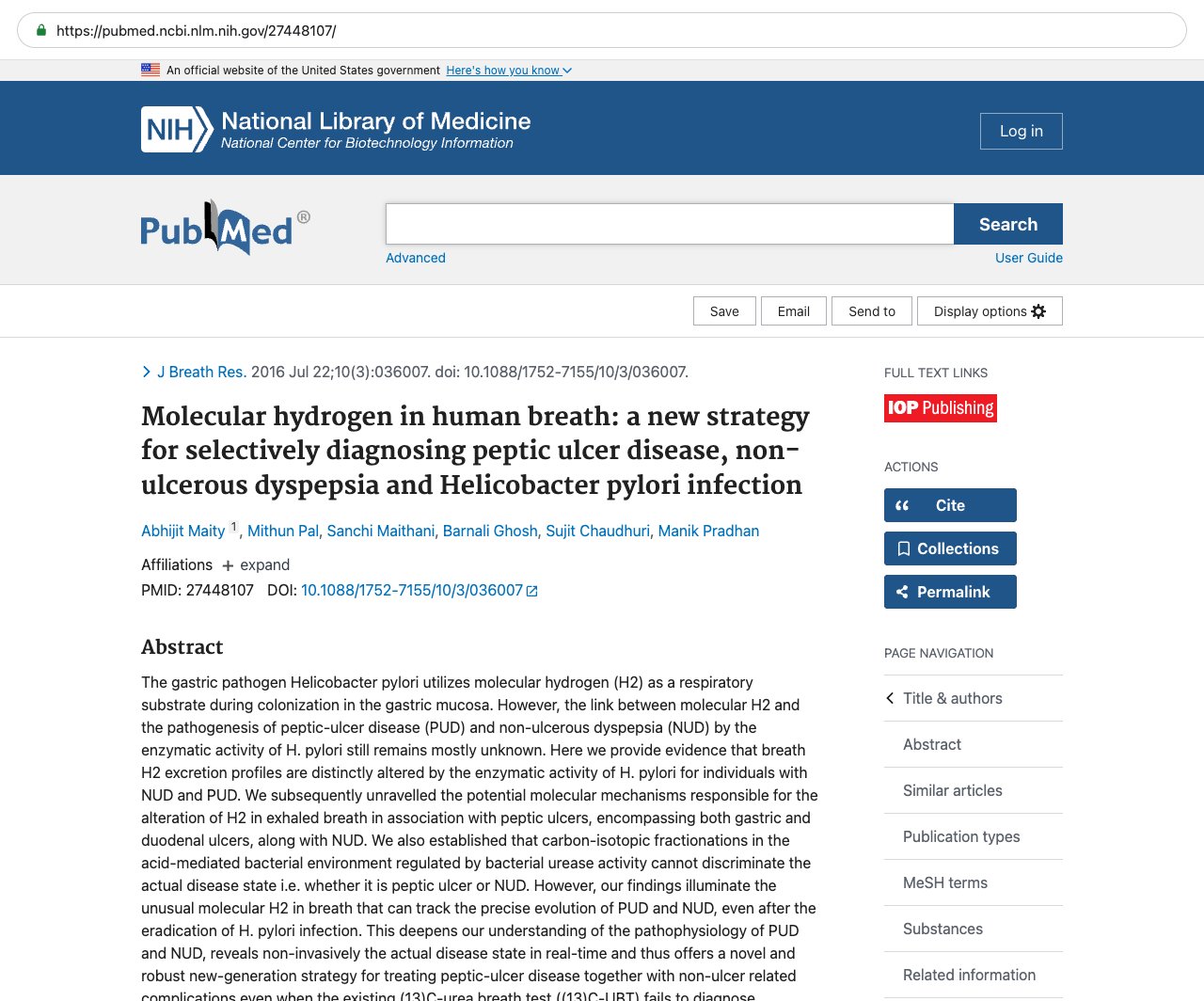
This page mirrors the published abstract (© the authors / publisher) for reference and citation. The canonical source is the PubMed record linked above. This is not medical advice.