2014 · Makiyama et al. — Do alpha-glucosidase inhibitors have the potential to induce portal venous gas? — Two clinical case reports.
Super-Abstract
This case report describes two diabetic patients who developed portal venous gas after starting alpha-glucosidase inhibitor (α-GI) therapy. The authors propose that α-GI drugs increase intestinal gas pressure — including H₂ gas produced by gut fermentation — which may cause pneumatosis cystoides intestinalis or portal venous gas. Important: H₂ here is a gut fermentation byproduct, not a therapeutic intervention. (Internal Medicine, 2014.)
Commentary
Alpha-glucosidase inhibitors (e.g. voglibose, miglitol) are diabetes medications that slow carbohydrate digestion in the gut. An unintended consequence is increased fermentation by colonic bacteria, which produces CO₂ and H₂ gas. This excess gas can raise intestinal pressure, occasionally leading to pneumatosis cystoides intestinalis (gas bubbles in the bowel wall) or — in these two cases — portal venous gas (PVG), visible on CT as gas bubbles in the liver's portal vein. Both patients recovered after stopping the medication, without invasive treatment. This paper is relevant to the H₂ research context only tangentially: it documents endogenous H₂ gas production as a physiological reality, and illustrates a rare adverse effect at extreme gas pressures. It is not a study of therapeutic molecular hydrogen.
Key quotes
- „α-GI medications may increase internal intestinal tract pressure by releasing carbon dioxide and hydrogen gas, potentially causing pneumatosis cystoides intestinalis (PCI) or PVG.“ — the proposed mechanism: gut fermentation → excess CO₂ and H₂ → pressure-related complication
- „Both patients recovered without intensive treatment after discontinuing the α-GI therapy.“ — benign course: stopping the drug was sufficient
- „α-GI therapy is an important potential cause of portal venous gas that can be treated conservatively.“ — clinical take-away for diabetologists
Our assessment
This is not a therapeutic H₂ study. H₂ in this paper is an unwanted endogenous byproduct of drug-induced gut fermentation, not an administered therapeutic agent. The paper is a case report (n=2), the lowest level of clinical evidence. Its relevance to the H₂ medicine field is limited to: (1) illustrating that H₂ is indeed produced in the human gut, and (2) documenting that extreme gas accumulation can have rare adverse effects. It should not be cited as evidence for or against therapeutic H₂. Evidence level is very low by design.
Study design
- Type: case report (n=2) · H₂ context: endogenous H₂ gas produced by gut fermentation — NOT administered as therapy
- Setting: diabetic patients on alpha-glucosidase inhibitors (voglibose / miglitol) who developed portal venous gas
- Result: both patients recovered after stopping medication; no H₂ therapy administered or evaluated
Abstract
We herein report two cases of portal venous gas (PVG) following alpha-glucosidase inhibitor (α-GI) therapy for diabetes mellitus. Anti-diabetic treatment with voglibose was commenced in the first case, while the second case was treated with miglitol. Both patients recovered without intensive treatment after discontinuing the α-GI therapy. α-GI medications may increase internal intestinal tract pressure by releasing carbon dioxide and hydrogen gas, potentially causing pneumatosis cystoides intestinalis (PCI) or PVG. Our experience suggests that α-GI therapy is an important potential cause of portal venous gas that can be treated conservatively.
Source & links
Screenshot of the PubMed page
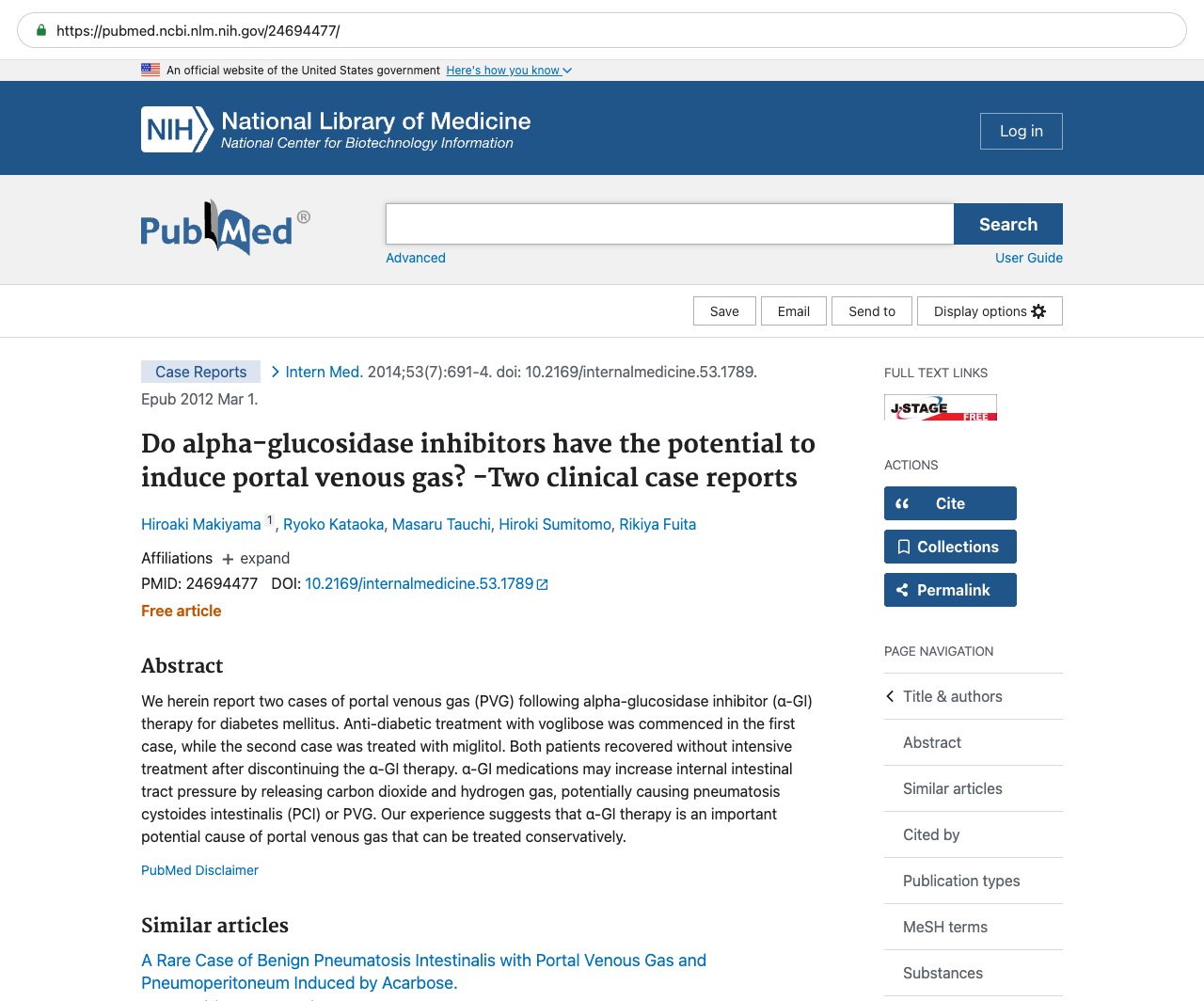
This page mirrors the published abstract (© the authors / publisher) for reference and citation. The canonical source is the PubMed record linked above. This is not medical advice.