1994 · Mizushima et al. — Experimental and clinical studies on ischemic lesions of the large intestine
Super-Abstract
Thrombi in peripheral small arteries appear to play a key role in causing ischemic lesions of the colon, based on both animal experiments and clinical observations in post-surgical human cases. Hydrogen gas clearance is used here as a blood flow measurement method — a standard research technique — not as a therapeutic agent. (Japanese Journal of Geriatrics, 1994.)
Commentary
This study combines animal experiments (dogs) with clinical observation in human patients following arterial surgery. The use of hydrogen gas is strictly methodological: the hydrogen gas clearance technique measures tissue blood flow by monitoring the washout rate of inhaled or locally injected hydrogen from the tissue — a well-established research tool in vascular physiology. The clinical finding that peripheral small-artery thrombi, rather than main artery ligation, underlie most ischemic colon lesions has implications for understanding ischemic colitis. However, this study is not a therapeutic H₂ study.
Key quotes
- „These results suggest that thrombi in peripheral small arteries may play a major role in the pathogenesis of ischemic lesions of the large intestine.“ — main pathophysiological finding from combined human and dog data
- „Mucosal blood flow measured by the hydrogen gas clearance method was significantly decreased at 1 hr and 4 hr after gelfoam injection compared with those after arterial ligation.“ — H₂ clearance used as a blood flow measurement tool — not therapy
- „In human cases of ischemia following arterial surgery, endoscopic features were similar to those lesions of the experimental ischemia induced by gelfoam injection.“ — experimental model validated against clinical human observation
Our assessment
Important context: this study does not investigate molecular hydrogen (H₂) as a therapeutic intervention. The hydrogen gas clearance technique is a vascular physiology research method used to measure mucosal blood flow — completely unrelated to H₂ therapy. Additionally, this study is substantially animal-based (dog experiments) with only clinical observational data from human patients added for comparison. Limitations: animal model (dog) dominates the experimental data; human component is observational only; small cohort. Not relevant to H₂ therapy.
Study design
- Type: mixed animal experiment + clinical observation · n (human): not specified (ischemic colitis cases post-arterial surgery) · H₂ delivery: none — H₂ gas clearance used as a vascular blood-flow measurement technique
- Result: gelfoam-induced thrombi caused more severe mucosal ischemia than arterial ligation; human endoscopic findings mirrored the gelfoam model; peripheral small-artery thrombosis proposed as primary pathogenetic mechanism
Abstract
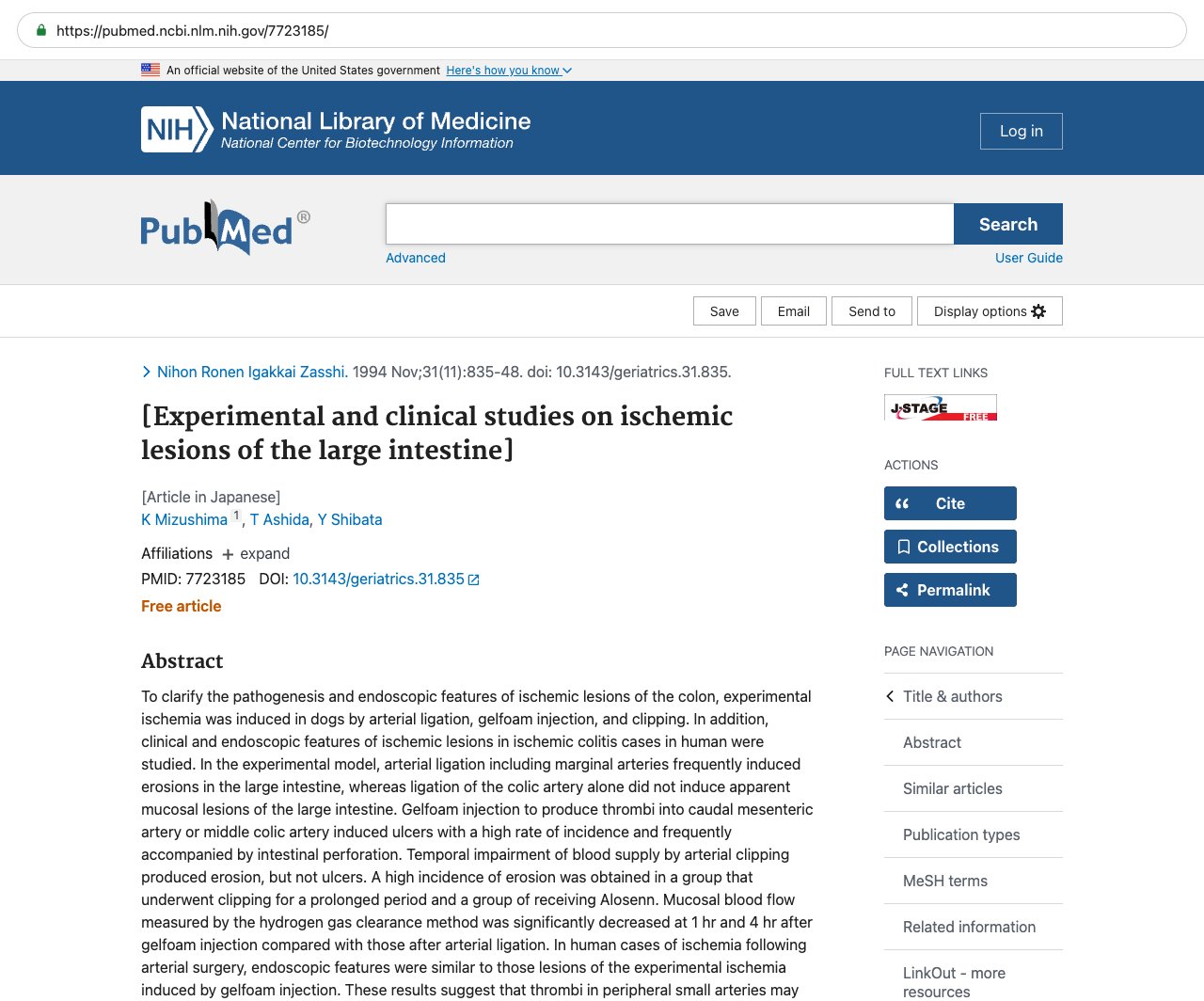
To clarify the pathogenesis and endoscopic features of ischemic lesions of the colon, experimental ischemia was induced in dogs by arterial ligation, gelfoam injection, and clipping. In addition, clinical and endoscopic features of ischemic lesions in ischemic colitis cases in human were studied. In the experimental model, arterial ligation including marginal arteries frequently induced erosions in the large intestine, whereas ligation of the colic artery alone did not induce apparent mucosal lesions of the large intestine. Gelfoam injection to produce thrombi into caudal mesenteric artery or middle colic artery induced ulcers with a high rate of incidence and frequently accompanied by intestinal perforation. Temporal impairment of blood supply by arterial clipping produced erosion, but not ulcers. A high incidence of erosion was obtained in a group that underwent clipping for a prolonged period and a group of receiving Alosenn. Mucosal blood flow measured by the hydrogen gas clearance method was significantly decreased at 1 hr and 4 hr after gelfoam injection compared with those after arterial ligation. In human cases of ischemia following arterial surgery, endoscopic features were similar to those lesions of the experimental ischemia induced by gelfoam injection. These results suggest that thrombi in peripheral small arteries may play a major role in the pathogenesis of ischemic lesions of the large intestine.
Source & links
Screenshot of the PubMed page
This page mirrors the published abstract (© the authors / publisher) for reference and citation. The canonical source is the PubMed record linked above. This is not medical advice.