2004 · Nakamura et al. — Bioavailability of Cellobiose by Tolerance Test and Breath Hydrogen Excretion in Humans
Super-Abstract
This nutrition study uses breath hydrogen excretion to assess how cellobiose (a disaccharide) is fermented in the large intestine — it is not an H₂ therapy study. Breath H₂ is used as a standard clinical marker for detecting undigested carbohydrate reaching the colon, estimating the available energy from cellobiose at approximately 2 kcal/g. (Nutrition, 2004.)
Commentary
Cellobiose is a disaccharide composed of two glucose units linked by a beta-1,4 bond — the same bond found in cellulose, which humans cannot digest. This study used breath hydrogen testing (a standard clinical nutrition tool) alongside blood glucose and insulin measurements to assess whether cellobiose is digested in the small intestine (answer: no, blood glucose did not rise) or fermented in the colon (answer: yes, significantly, confirmed by breath H₂). The study contributes to understanding prebiotics and dietary fiber energy values. Breath H₂ here is purely a fermentation indicator produced by gut bacteria — not administered molecular hydrogen therapy.
Key quotes
- „The excretion of breath hydrogen gas after cellobiose ingestion was significantly greater than that after glucose ingestion.“ — breath H₂ shows that cellobiose reaches the colon undigested and is fermented by bacteria — no therapeutic H₂ context
- „Orally ingested cellobiose was well fermented in human large intestine, and its available energy was estimated to be about 2 kcal/g.“ — the nutritional conclusion: cellobiose functions as a prebiotic fiber with ~2 kcal/g energy value
Our assessment
Off-topic for H₂ therapy. This is a clinical nutrition study measuring fermentation of a dietary disaccharide using breath hydrogen as a standard metabolic assessment tool. No H₂ was administered therapeutically. The breath H₂ measured is produced by colonic bacteria fermenting undigested cellobiose. The source metadata classification (methods: „inhalation, drinking-hrw“) is a clear error. This study belongs to dietary fiber and prebiotic research.
Study design
- Type: crossover nutrition study · n: 10 healthy young women · H₂ delivery: none — breath H₂ used as colonic fermentation marker after cellobiose or glucose ingestion
- Result: cellobiose ingestion caused no blood glucose or insulin rise; breath H₂ significantly elevated vs. glucose control; estimated energy value ~2 kcal/g; colonic fermentability confirmed
Abstract
OBJECTIVE: Prebiotic substances have the property of intestinal fermentation. Cellobiose has a beta-1,4 linkage, so it is resistant to hydrolysis by human small intestinal disaccharidase and, hence, reaches the colon undigested. Until this study, it was unclear whether cellobiose has fermentability or bioavailability. The objectives of this study were to clarify whether cellobiose is fermented in the large intestine and to estimate the available energy from cellobiose intake by using tolerance tests and breath hydrogen tests in healthy female subjects. METHODS: Ten healthy young women (20.5 +/- 2.1 y) who did not develop diarrhea after ingesting 30 g of cellobiose in a previous experiment were recruited. Tolerance tests and breath hydrogen tests for 25 g of cellobiose or glucose were carried out at least 2 wk apart. Blood samples were collected before and at 30-min intervals up to 3 h after ingestion. Breath gas samples were collected simultaneously before and at 30-min intervals up to 6 h after ingestion of cellobiose or glucose. Blood glucose and insulin levels and the concentration of breath hydrogen were analyzed. RESULTS: When 25 g of cellobiose was ingested, there was no increase in blood glucose or insulin secretion, but these markers increased remarkably with glucose ingestion. The excretion of breath hydrogen gas after cellobiose ingestion was significantly greater than that after glucose ingestion. CONCLUSIONS: Orally ingested cellobiose was well fermented in human large intestine, and its available energy was estimated to be about 2 kcal/g.
Source & links
Screenshot of the PubMed page
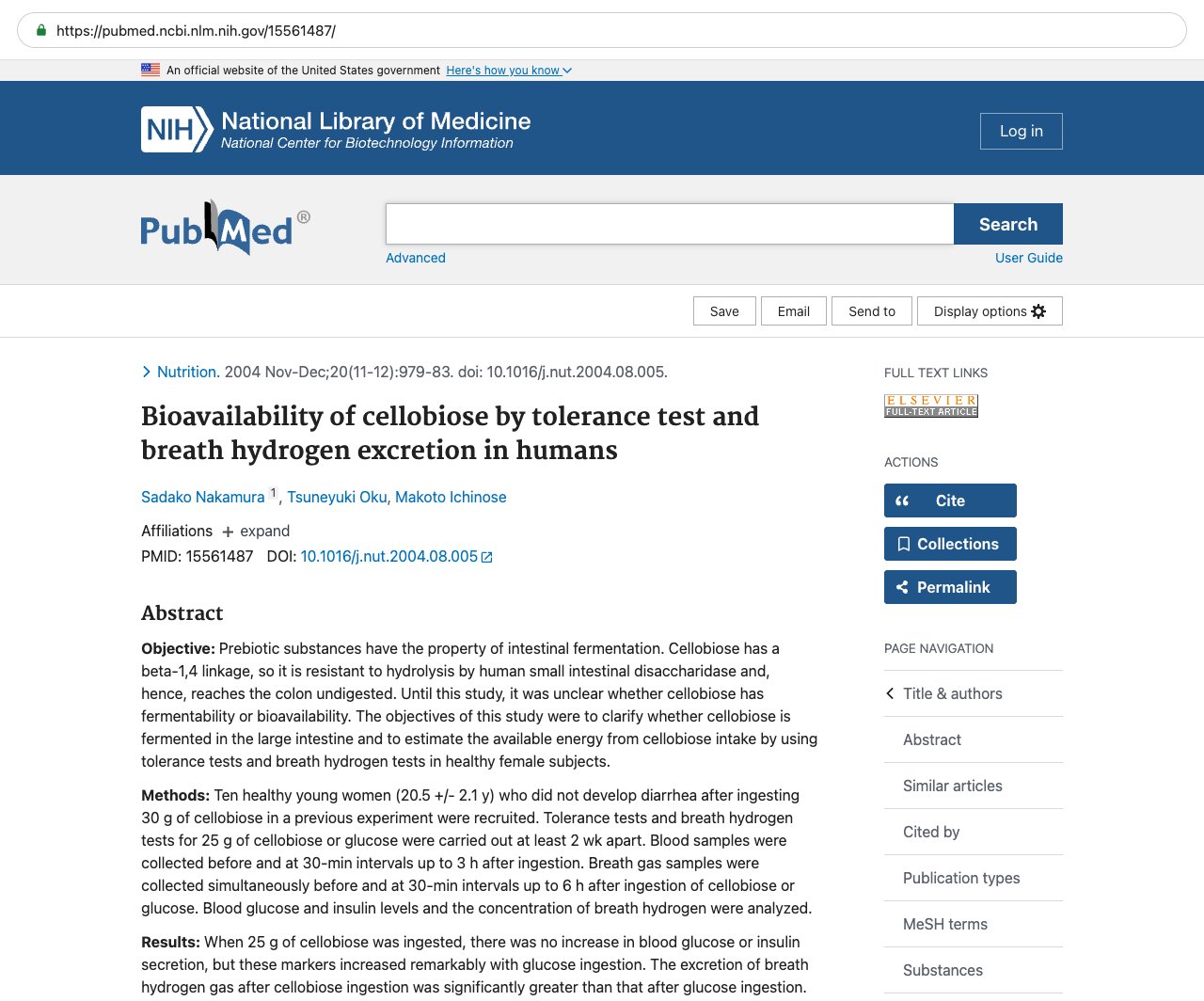
This page mirrors the published abstract (© the authors / publisher) for reference and citation. The canonical source is the PubMed record linked above. This is not medical advice.