1984 Nihon Shokakibyo Gakkai zasshi = The Japanese journal of gastro-enterology Pilot / Observational
1984 · Nishiwaki et al. — Endoscopic Measurement of Gastric Mucosal Blood Flow by Hydrogen Gas Generated by Electrolysis — Comparison with H₂ Inhalation Method
Super-Abstract
This 1984 study compared two methods for measuring gastric mucosal blood flow during endoscopy: generating H₂ locally via electrolysis versus the conventional inhaled H₂ gas clearance method. This is a diagnostic methodology paper — H₂ serves as a physiological tracer, not a therapeutic agent. (Nihon Shokakibyo Gakkai Zasshi, 1984.)
Commentary
The hydrogen gas clearance method for measuring mucosal blood flow was a standard clinical technique in the 1980s. This study compares two variants: the classical method requiring the patient to inhale hydrogen gas (systemically loading the blood with H₂), versus a newer endoscopic approach generating H₂ locally by electrolysis directly at the tissue site. The comparison is purely methodological — which technique is more practical, accurate, or safe for clinical use. No therapeutic H₂ outcome is studied. The abstract was not retrievable from the database.
Our assessment
This is a diagnostic methodology comparison, not a therapeutic H₂ study. Both methods use H₂ as a non-therapeutic tracer to quantify blood flow. The abstract is unavailable (no DOI, Japanese-language journal from 1984). The database categorization includes „inhalation“ which accurately reflects the measurement method used — but this is diagnostic, not therapeutic inhalation. Limitations: no abstract available; historical study (1984); Japanese-language publication; methodology paper only.
Study design
- Type: diagnostic methodology comparison study · n: not available (abstract absent) · H₂ delivery: inhaled H₂ gas (conventional clearance method) vs. locally generated H₂ via electrolysis (endoscopic method)
- Result: abstract unavailable — no data extractable; study compares two diagnostic techniques for measuring gastric mucosal blood flow during endoscopy
Source & links
Screenshot of the PubMed page
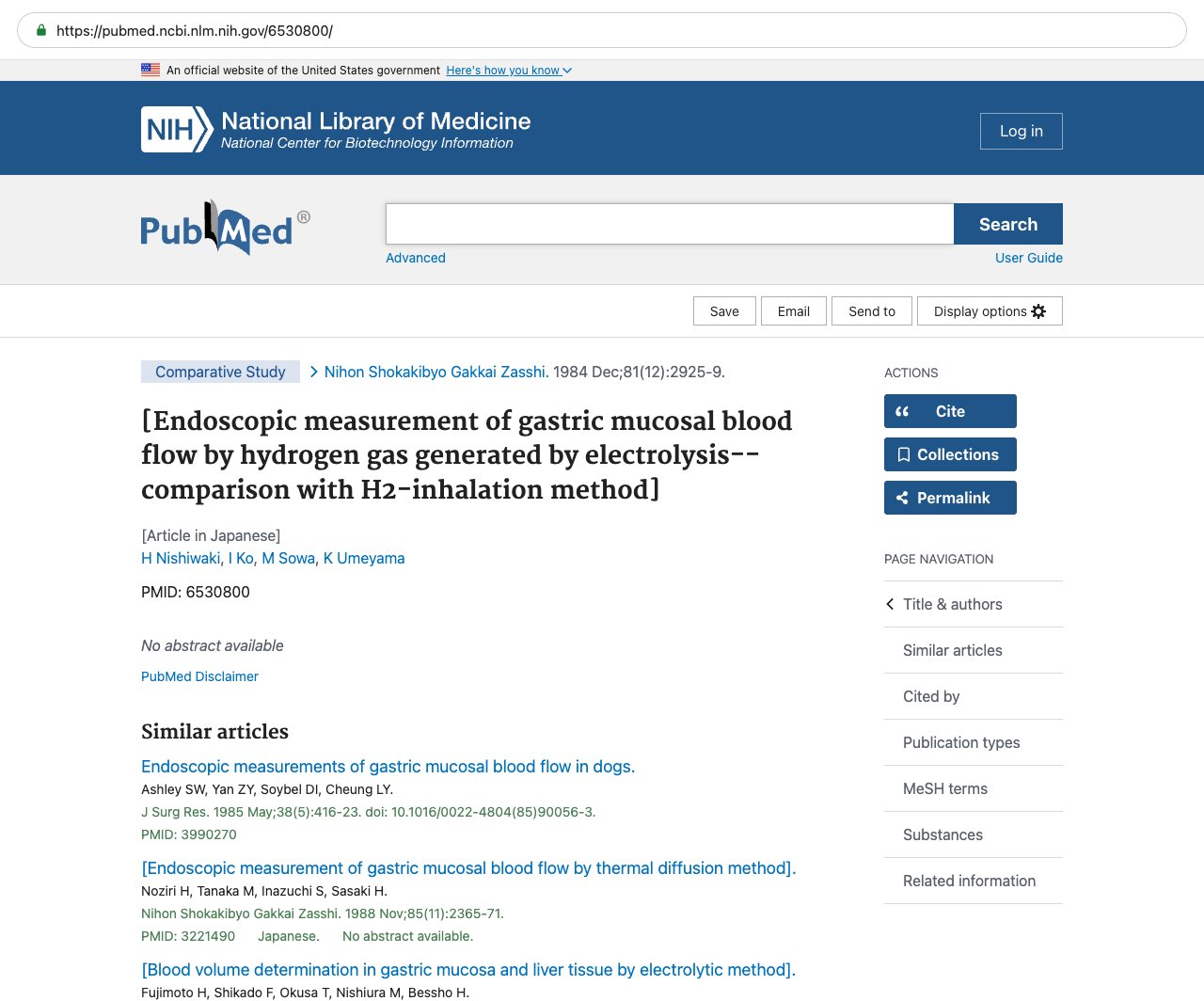
This page mirrors the published abstract (© the authors / publisher) for reference and citation. The canonical source is the PubMed record linked above. This is not medical advice.