1986 · Nohara et al. — Measurement of Skin Blood Flow Using Inhaled Hydrogen Gas Clearance Method
Super-Abstract
This study from 1986 used inhaled hydrogen gas as a diagnostic tracer to measure skin blood flow — not as a therapeutic agent. The hydrogen gas clearance method tracks how quickly inhaled H₂ is washed out of tissue, which reflects local perfusion. This is a methodological paper, not a therapeutic H₂ study. (Kokyu to Junkan, 1986.)
Commentary
This publication belongs to a body of 1980s medical research that used hydrogen gas inhalation purely as a measurement tool — the so-called „hydrogen gas clearance method.“ Inhaled H₂ diffuses into the bloodstream and is cleared from tissue at a rate proportional to local blood flow. By detecting this washout, clinicians could non-invasively assess perfusion. This is unrelated to modern therapeutic H₂ medicine, where dissolved or inhaled H₂ is given to reduce oxidative stress or inflammation. The abstract for this article was not retrievable; the classification is based on title and method data in the database.
Our assessment
Important caveat: this is not a therapeutic H₂ study. Hydrogen gas is used here as an inert diagnostic tracer to quantify skin blood flow — the same principle as a dye-dilution measurement. No therapeutic H₂ dose is administered, and no health outcome is studied. The abstract is unavailable (no DOI, Japanese-language journal from 1986). Limitations: no abstract retrievable; methodology paper only; not applicable to H₂ therapeutic efficacy; very old study (1986) with no modern replication context.
Study design
- Type: diagnostic methodology study · n: not stated (abstract unavailable) · H₂ delivery: inhaled H₂ gas as tracer for blood flow measurement
- Result: abstract unavailable — no efficacy data extractable; study describes a diagnostic technique, not a therapeutic intervention
Source & links
Screenshot of the PubMed page
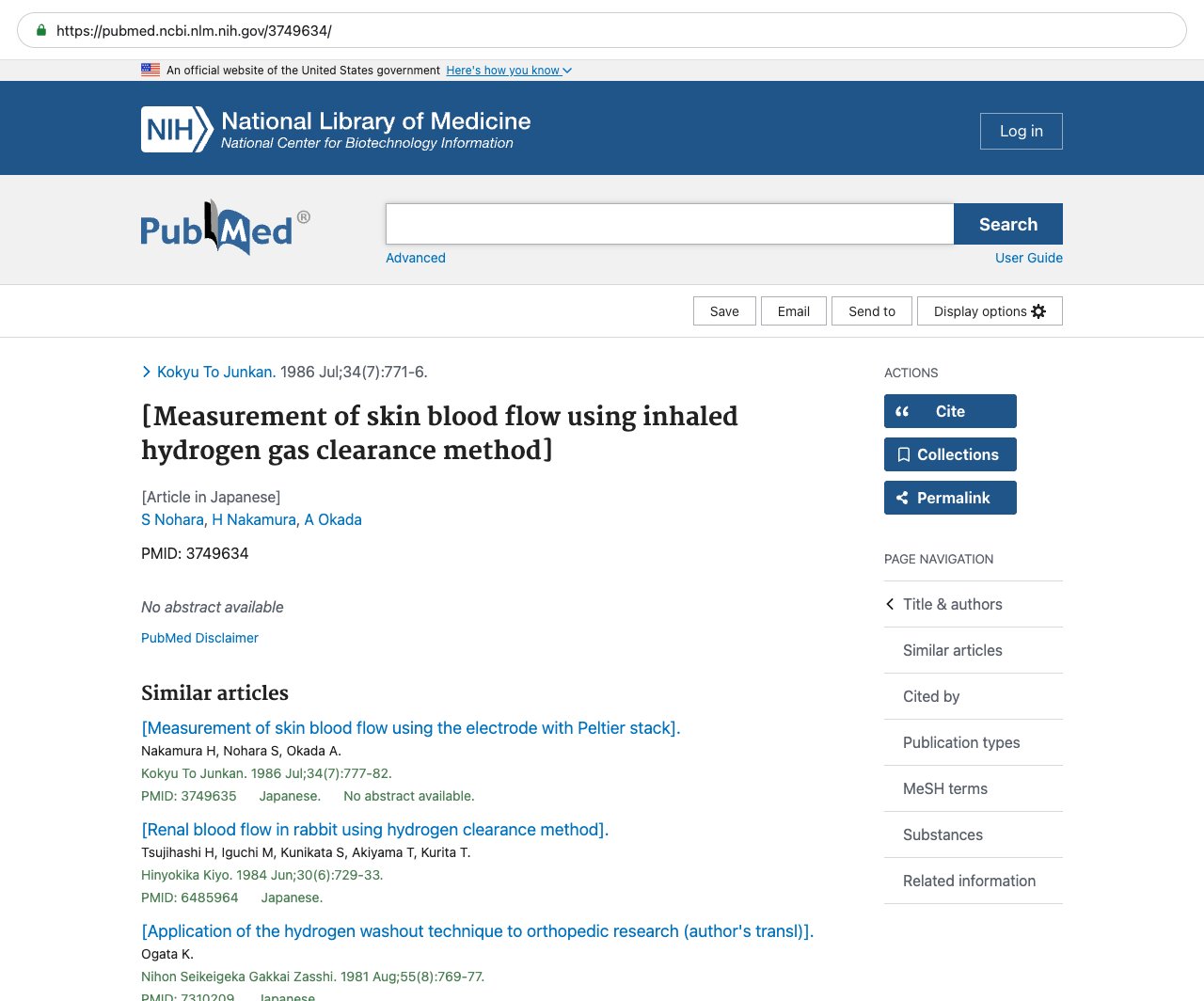
This page mirrors the published abstract (© the authors / publisher) for reference and citation. The canonical source is the PubMed record linked above. This is not medical advice.