2003 · Oku — Comparison of digestibility and breath hydrogen gas excretion of fructo-oligosaccharide, galactosyl-sucrose, and isomalto-oligosaccharide in healthy human subjects.
Super-Abstract
Breath hydrogen excretion was used as a diagnostic marker to compare how well three different dietary oligosaccharides (FOS, GS, IMO) are digested in the small intestine versus fermented in the large intestine of healthy adults. H₂ here is an endogenous fermentation product measured in breath — not a therapeutic agent. (European Journal of Clinical Nutrition, 2003.)
Commentary
The breath hydrogen test is a well-established non-invasive method to assess carbohydrate malabsorption. When sugars reach the large intestine undigested, gut bacteria ferment them and produce hydrogen, which is absorbed and exhaled. This paper uses that principle to compare three oligosaccharides: FOS (not hydrolyzed → high H₂), GS (partially hydrolyzed → medium H₂), and IMO (readily hydrolyzed → minimal H₂). The study provides useful dietary-fiber characterization data. However, it has no connection to H₂ therapy: no hydrogen was administered to the subjects, and H₂ is solely a byproduct being measured.
Key quotes
- „Breath hydrogen of FOS was more remarkably excreted than that of GS; that of IMO was slight.“ — key finding on relative fermentability of the three oligosaccharides
- „H(2) gas reflected fermentability in the large intestine.“ — confirms that exhaled H₂ is a reliable marker of colonic fermentation
Our assessment
Assessment note: This study is not an H₂ therapy trial. H₂ is measured as an endogenous breath biomarker of gut fermentation, not administered as a therapeutic agent. The finding that FOS and GS are not fully digested in the small intestine (and thus fermented in the colon) is relevant for prebiotic dietary fiber research, but not for H₂ medicine. Limitations: the cohort is small (9 males, 29 females) and entirely healthy; no clinical endpoints assessed. No therapeutic claims can be derived.
Study design
- Type: crossover dietary intervention study · n: 38 healthy adults (9 male, 29 female; ages ~23–26 years) · H₂ delivery: none — H₂ measured as endogenous breath biomarker after ingestion of oligosaccharides
- Result: breath H₂ AUC (10 g dose): FOS 9768 ± 3253 ppm, GS 3662 ± 2632 ppm, IMO 831 ± 1154 ppm; FOS = poorly digested, IMO = readily digested by small intestinal enzymes; dose-dependence observed for FOS and GS at 10 vs. 20 g
Abstract
OBJECTIVES: To clarify the difference of digestibility in the small intestine among fructo-oligosaccharide (FOS), galactosyl-sucrose (GS), and isomalto-oligosaccharide (IMO) using breath hydrogen test. DESIGN: The first step: screening test of breath hydrogen excretion and FOS tolerance test to select the subjects. The second step: breath hydrogen test of three kinds of oligosaccharides, carried out using precautionary regulations. The ingestion order was 10 g of FOS, GS, and IMO, with increases, at 1-week interval, up to 20 g, respectively. Breath gas was collected before, at 20 min intervals from 40 to 120 min after, and at 30 min intervals from 120 min to 7 h after ingestion of test substance. SETTING: Laboratory of Public Health Nutrition, Department of Nutrition and Health Sciences, Siebold University of Nagasaki, Nagasaki, Japan. SUBJECTS: A total of nine males (average: age 25.7+/-3.5 y, weight 61.9+/-8.8 kg, height 170.0+/-6.0 cm) and 29 females (average: 23.1+/-7.2 y, 52.9+/-5.3 kg, 157.5+/-5.1 cm) from the University of Tokyo and Siebold University of Nagasaki. MAIN OUTCOME MEASURES: Breath hydrogen excretion from end-expiratory gas. RESULT: : Breath hydrogen of FOS was more remarkably excreted than that of GS; that of IMO was slight; and that of AUC (10 g) was significantly different. FOS was 9768+/-3253 ppm, GS was 3662+/-2632 ppm, and IMO was 831+/-1154 ppm. A dose dependence was observed at doses between 10 and 20 g of FOS and GS, and the initial time of 20 g was earlier than that of 10 g. CONCLUSIONS: FOS was not hydrolyzed, GS was slightly hydrolyzed, and IMO was readily hydrolyzed by small intestinal enzymes. H(2) gas reflected fermentability in the large intestine. SPONSORSHIP: Siebold University of Nagasaki.
Source & links
Screenshot of the PubMed page
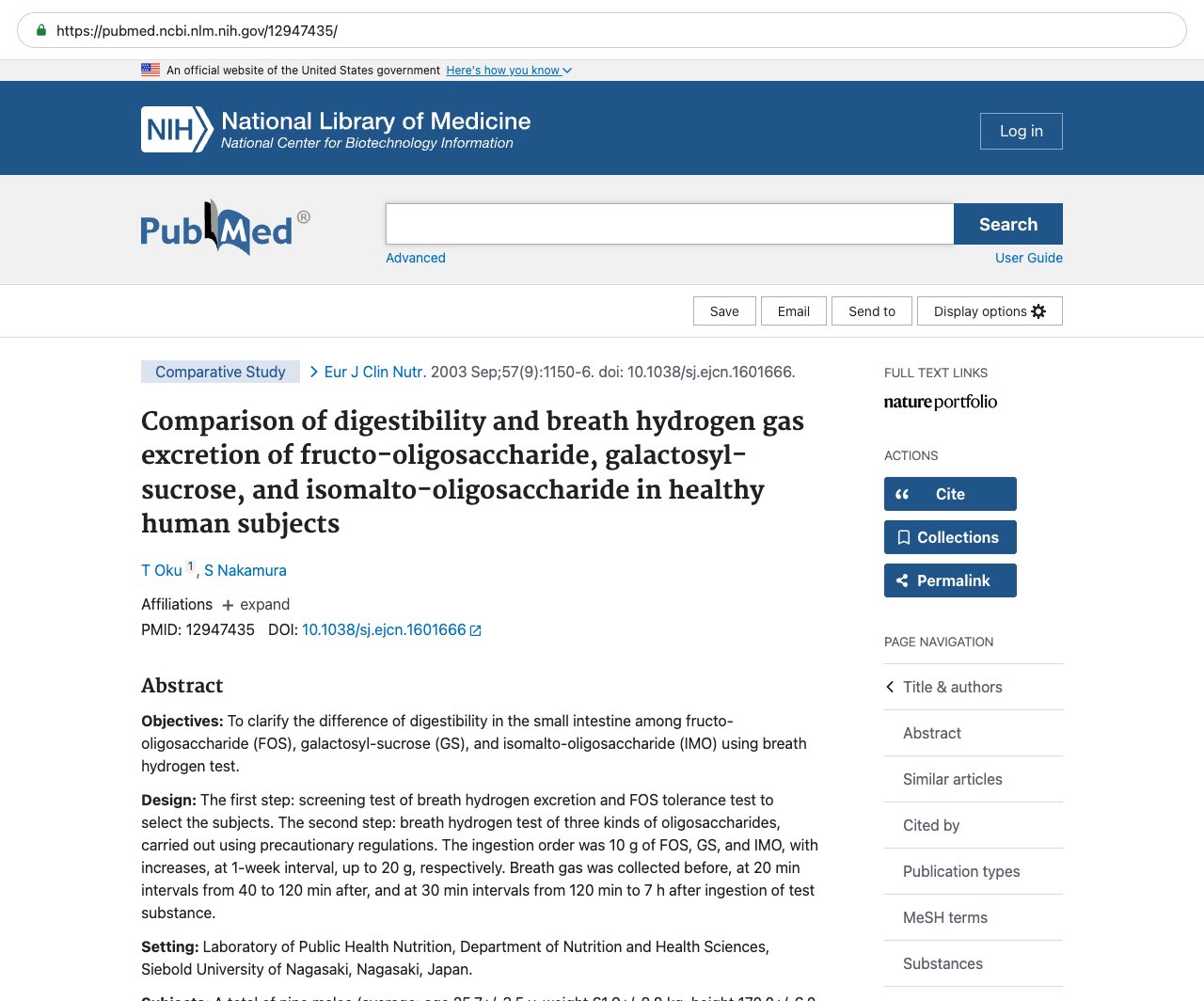
This page mirrors the published abstract (© the authors / publisher) for reference and citation. The canonical source is the PubMed record linked above. This is not medical advice.