2000 · Pribila — Improved lactose digestion and intolerance among African-American adolescent girls fed a dairy-rich diet.
Super-Abstract
After 21 days on a dairy-rich diet, African-American adolescent girls with lactose maldigestion showed significantly reduced breath hydrogen excretion and negligible gastrointestinal symptoms, suggesting colonic adaptation to lactose. Breath H₂ serves here as a diagnostic marker, not as a therapeutic agent. (Journal of the American Dietetic Association, 2000.)
Commentary
This dietary intervention study used the breath hydrogen test to assess carbohydrate malabsorption in 17 African-American adolescent girls, a population known to have high rates of lactase deficiency. Breath H₂ — produced by colonic fermentation of unabsorbed lactose — was measured at the beginning and end of a 21-day dairy feeding period. Excretion decreased significantly over time (from 148 to 101 ppm·hours), suggesting the gut microbiome adapted to handle the increased lactose load. The finding is relevant for calcium nutrition policy in this demographic. H₂ here is purely a diagnostic breath biomarker, not a therapeutic intervention.
Key quotes
- „Breath hydrogen excretion decreased significantly (P < .03) from the beginning (148.3 ± 27.0 ppm × hours) to the end (100.7 ± 19.3 ppm × hours) of the 21-day period.“ — key quantitative finding: breath H₂ fell after colonic adaptation to the dairy diet
- „The decrease in breath hydrogen suggests colonic adaptation to the high-lactose diet.“ — interpretation: reduced fermentation reflects microbiome adaptation, not H₂ therapy
Our assessment
Assessment note: This study is not an H₂ therapy trial. H₂ is measured as a breath biomarker of gut fermentation/malabsorption — it is not administered to subjects. The dietary intervention is a high-lactose diet, and H₂ measurement is the outcome measure for assessing colonic fermentation. This is a nutritional and gut-physiology study. No therapeutic H₂ endpoints. Should not be presented in an H₂ therapy context.
Study design
- Type: 21-day dietary intervention study · n: 17 African-American adolescent girls (age 11–15 years), 14 with confirmed lactose maldigestion · H₂ delivery: none — breath H₂ measured as diagnostic fermentation marker
- Result: breath H₂ AUC decreased significantly from 148.3 to 100.7 ppm × hours (P < .03); gastrointestinal symptoms negligible throughout; study supports dairy consumption despite lactose maldigestion in this population
Abstract
OBJECTIVE: To determine whether African-American adolescent girls who were fed a dairy-rich diet for 21 days could adapt to lactose, experiencing an overall improvement in lactose tolerance as well as a decrease in hydrogen gas production. DESIGN: Twenty-one-day dietary intervention study. SUBJECTS/SETTING: Seventeen of 21 African-American girls (aged 11 to 15 years) enrolled in a calcium metabolism study chose to participate in the lactose tolerance study. Subjects were screened for any diseases, conditions, or medications that might alter calcium metabolism or colonic fermentation. Subjects were housed in a fraternity on the Purdue University, West Lafayette, Ind, campus, and were supervised 24 hours a day. INTERVENTION: Subjects consumed a dairy-based diet averaging 1,200 mg calcium and 33 g lactose per day for 21 days. Lactose digestion was assessed by an 8-hour breath hydrogen test on days 1 and 21, and symptoms of intolerance (abdominal pain, bloating, flatulence, and diarrhea) were evaluated hourly on a ranked scale during the breath hydrogen tests and once each evening during the 21-day feeding period. MAIN OUTCOME MEASURES: A comparison of breath hydrogen production and gastrointestinal symptoms at the beginning and end of the study. STATISTICAL ANALYSES PERFORMED: The Wilcoxon signed ranks test was used to compare the area under the curve for the 2 breath hydrogen tests. Spearman's p test for trend was used to determine whether there was a change in symptoms. All statistical analyses were 2-tailed and significance was set at P = .05. RESULTS: Fourteen of the 17 subjects had lactose maldigestion. Breath hydrogen excretion decreased significantly (P < .03) from the beginning (148.3 +/- 27.0 ppm x hours) to the end (100.7 +/- 19.3 ppm x hours) of the 21-day period. Gastrointestinal symptoms were negligible during both the breath hydrogen tests as were symptoms during the 21-day period. APPLICATIONS/CONCLUSIONS: The diet was well tolerated by the subjects. Furthermore, the decrease in breath hydrogen suggests colonic adaptation to the high-lactose diet. The results indicate that lactose maldigestion should not be a restricting factor in developing adequate calcium diets for this population. The existence of lactose maldigestion does not result in lactose intolerance in this population when it is fed a dairy-rich diet.
Source & links
Screenshot of the PubMed page
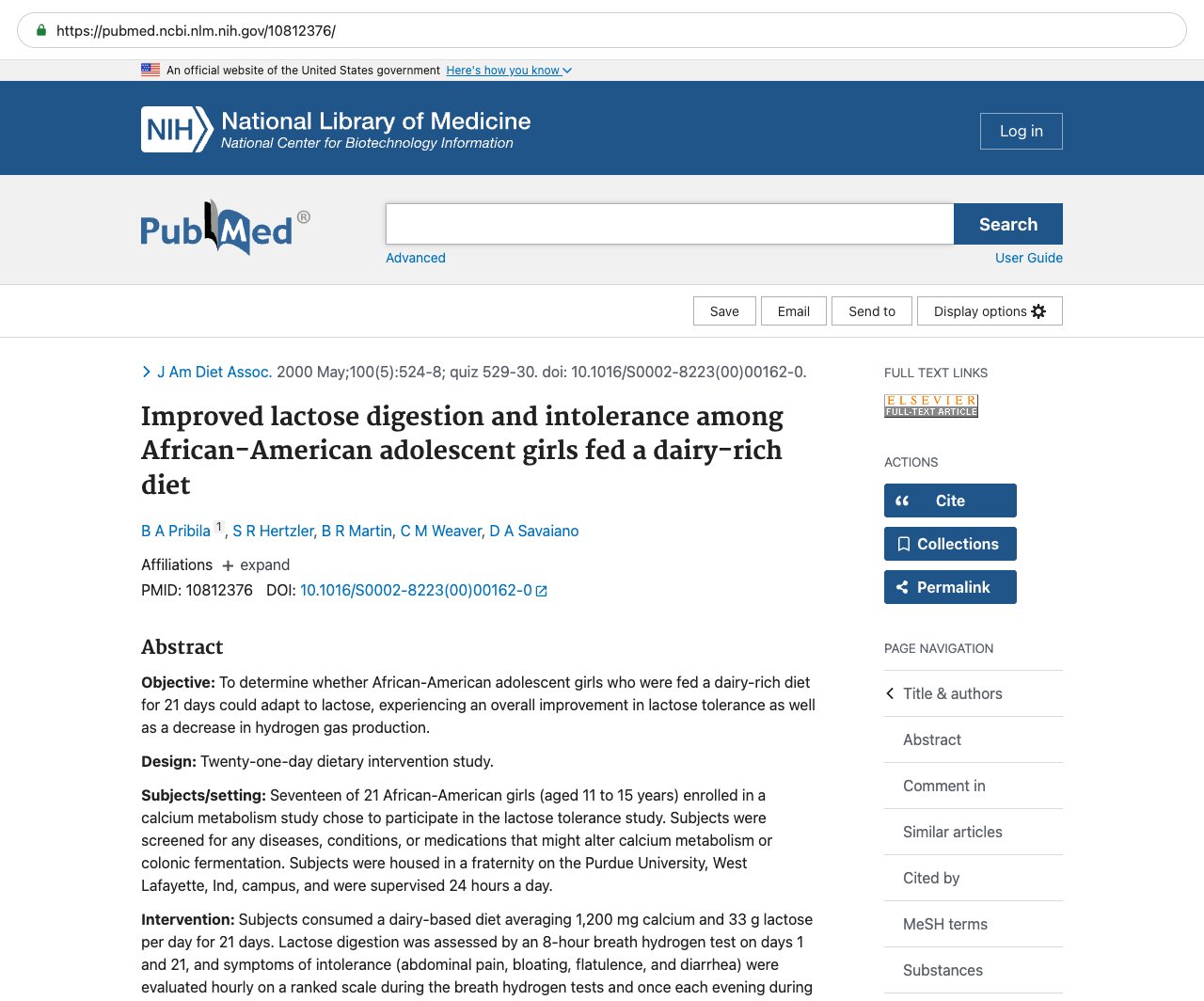
This page mirrors the published abstract (© the authors / publisher) for reference and citation. The canonical source is the PubMed record linked above. This is not medical advice.