1984 · Read et al. — Is Raised Breath Hydrogen Related to the Pathogenesis of Pneumatosis Coli?
Super-Abstract
This 1984 study investigated five patients with pneumatosis coli — a rare condition where gas-filled cysts form in the colon wall — finding that all had abnormally high fasting breath hydrogen, and that the cysts themselves contained 2–8% hydrogen gas. The data point toward bacterial overgrowth and anaerobic infection as contributors to cyst formation, rather than a simple mechanical gas accumulation. This is a pathophysiology investigation, not a therapeutic H₂ study. (Gut, 1984.)
Commentary
Pneumatosis coli is a puzzling condition: cysts containing gas appear in the submucosa or subserosa of the colon. This study elegantly combined clinical and physiological approaches — breath H₂ measurement, colonic washout, cyst deflation by oxygen or antibiotics, radiolabelled meal transit, and 14C glycocholate testing — to probe the origin of the high breath H₂ and its possible role in cyst formation. The key insight is that high breath H₂ did not normalize completely after colonic washout, and cyst deflation only partially reduced breath H₂ — suggesting multiple sources of H₂ (bacterial overgrowth in the small intestine plus possible colonic mucus fermentation). The hypothesis that anaerobic bacteria invade the submucosa is supported but not conclusively proven. H₂ here is a diagnostic readout, not a therapy.
Key quotes
- „All five patients excreted abnormally high fasting concentrations of hydrogen in their breath (69 +/- 9 ppm, mean +/- SEM).“ — markedly elevated breath H₂ as a defining feature of these patients
- „analysis of the contents of the gas filled cysts revealed between 2% and 8% of hydrogen gas.“ — H₂ is directly present inside the colonic cysts — a key clue about their origin
- „the data favour the hypothesis that these are produced by invasion of the colonic submucosa with anaerobic bacteria.“ — the proposed mechanism: bacterial infection, not mechanical gas trapping
Our assessment
This is a pathophysiology investigation of a rare gastrointestinal condition — not a therapeutic H₂ study. Breath H₂ and cyst gas composition are outcomes measured to understand disease mechanism. No H₂ is administered. The study's strength is its multi-method approach in a highly unusual patient group. Limitations: extremely small n (5 patients); no control group for most measurements; mechanistic hypotheses not definitively proven (competing explanations for H₂ source remain); the 14C glycocholate tests being normal is unexpected and not fully explained. Interesting for understanding H₂ biology in the gut, but provides no evidence for therapeutic H₂ use.
Study design
- Type: observational case series with physiological measurements · n: 5 patients with pneumatosis coli · H₂ measurement: fasting breath H₂, cyst gas analysis (diagnostic only, no H₂ administered)
- Interventions studied: colonic washout, cyst deflation with O₂ or antibiotics, radiolabelled meal transit, 14C glycocholate breath test
- Results: fasting breath H₂ 69 ± 9 ppm (very elevated); cysts contained 2–8% H₂; washout reduced breath H₂ to 9 ppm but did not abolish cysts; cyst deflation reduced breath H₂ only ~34%; early post-meal breath H₂ rise suggests small intestinal bacterial overgrowth
Abstract
Clinical and physiological studies were carried out in five patients with pneumatosis coli in order to investigate the origin of the high fasting breath hydrogen concentration in this condition and to determine its possible significance in the pathogenesis of the disease. All five patients excreted abnormally high fasting concentrations of hydrogen in their breath (69 +/- 9 ppm, mean +/- SEM). Moreover, analysis of the contents of the gas filled cysts revealed between 2% and 8% of hydrogen gas. Colonic washout significantly reduced breath hydrogen concentrations to 9 +/- 6 ppm, but did not abolish the cysts. Conversely, deflation of the cysts was achieved with oxygen or antibiotics, though this only reduced breath hydrogen concentrations to about 66% of their original value. After feeding a radiolabelled meal, breath hydrogen concentrations rose before the meal appeared to reach the colon, suggesting overgrowth of anaerobic bacteria in the small intestine. Despite this, 14C glycocholate breath tests were within normal limits. An alternative possibility is that the high levels of hydrogen excreted in the breath may be produced in the intestinal lumen possibly from the fermentation of copious amounts of colonic mucus. Finally, measurement of whole gut transit time and stool weight suggested that patients were constipated despite passing mucus and blood. The relevance of our observations to the pathogenesis of submucosal cysts is unclear, but the data favour the hypothesis that these are produced by invasion of the colonic submucosa with anaerobic bacteria.
Source & links
Screenshot of the PubMed page
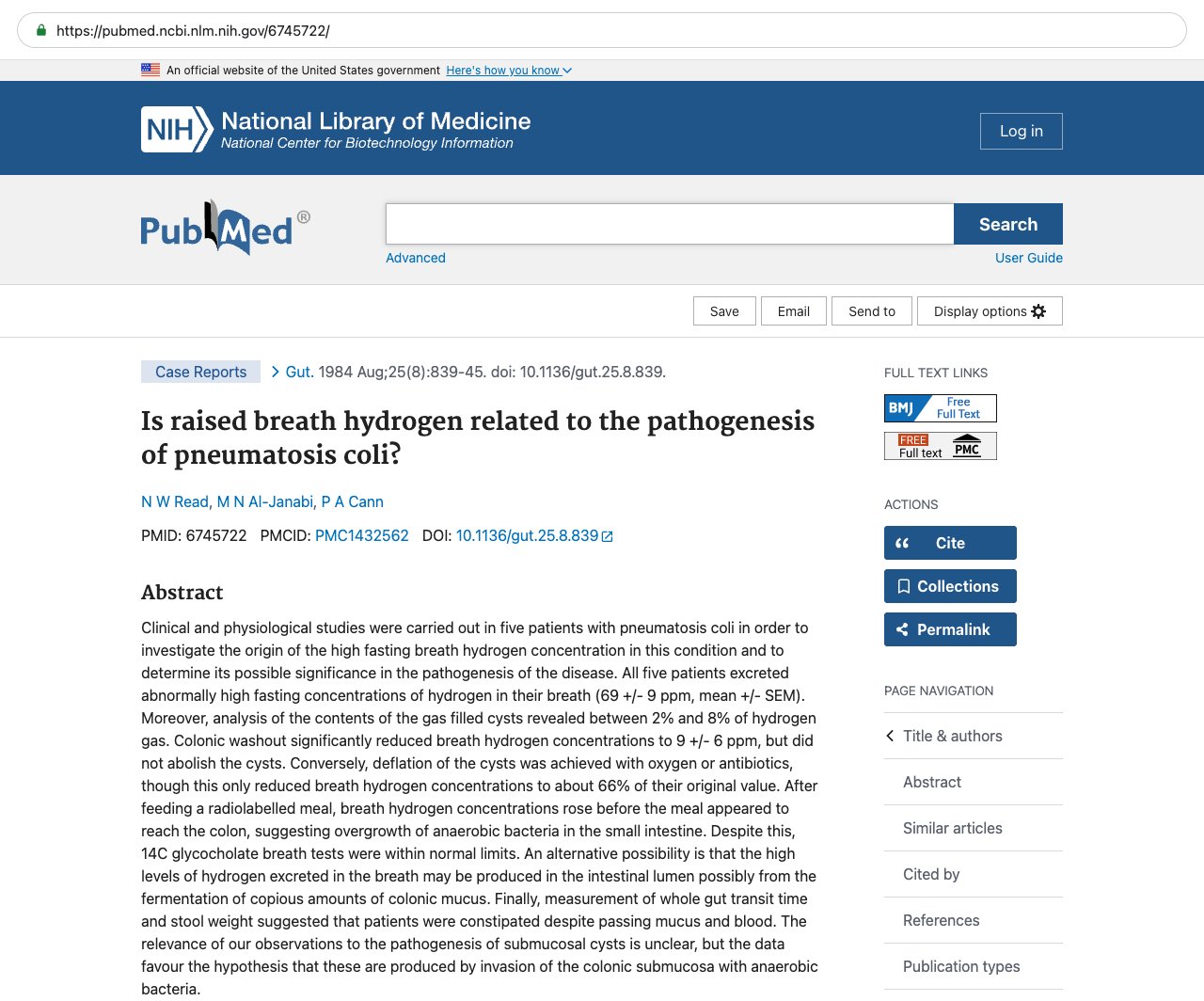
This page mirrors the published abstract (© the authors / publisher) for reference and citation. The canonical source is the PubMed record linked above. This is not medical advice.