1986 · Satani — Etiopathogenesis of Hemorrhagic Gastritis after Esophageal Transection and Extended Devascularization in Variceal Patients
Super-Abstract
This surgical study from 1986 investigated why some cirrhotic patients develop hemorrhagic gastritis after esophageal variceal surgery — using hydrogen gas clearance as a tool to measure gastric blood flow, not as a therapy. The findings point to progressive gastric tissue hypoxia despite maintained blood flow as the key mechanism. (Nihon Geka Gakkai Zasshi, 1986.)
Commentary
This paper is a classic hemodynamic investigation from the era before modern variceal management. Ten cirrhotic patients with esophageal varices underwent esophageal transection with extended devascularization. The researchers used the hydrogen gas clearance method as a clinical measurement tool — not therapeutically — to track gastric mucosal perfusion before and after surgery, combined with Swan-Ganz catheter hemodynamics and tissue oxygen tension sensors. The finding that gastric blood flow temporarily normalized while tissue oxygen tension (PtO₂) continued to fall is clinically important: it uncouples flow from oxygenation, pointing to a microcirculatory or oxygen-dissociation-curve problem. This is not a study about H₂ therapy; the database categorization as „cardiovascular“ and „drinking-hrw“ appears to be an artifact of indexing.
Key quotes
- „Gastric blood flow showed moderate reduction immediately after surgery and returned to the previous value by the 7th postoperative day. But the value of PtO2 dropped gradually for 7 days after surgery.“ — the key dissociation: blood flow recovers, but tissue oxygenation does not
- „progressive gastric tissue hypoxia without reduction of blood flows may result in hemorrhagic gastritis.“ — the proposed mechanism for postoperative bleeding complication
Our assessment
Important caveat: H₂ is used here as a diagnostic tracer only, not as a therapeutic agent. The hydrogen gas clearance method is employed to measure gastric mucosal perfusion — this is standard clinical physiology methodology from the 1980s, entirely unrelated to H₂ medicine. The „drinking-hrw“ categorization in the source database appears erroneous. Limitations: very small sample (n = 10); no control group; historical study (1986) without modern imaging or endoscopic correlation; the hydrogen inhalation serves only a measurement purpose. Clinically interesting for its physiology of post-surgical hypoxia, but not evidence for H₂ therapy.
Study design
- Type: prospective observational surgical study · n: 10 cirrhotic patients with esophageal varices · H₂ delivery: inhaled H₂ gas as diagnostic tracer only (clearance method)
- Outcome measured: gastric mucosal blood flow (H₂ clearance), tissue PtO₂, Swan-Ganz hemodynamics, oxygen dissociation parameters
- Result: gastric blood flow normalized by day 7 post-surgery, but tissue PtO₂ fell progressively for 7 days; oxygen dissociation curve shifted left; conclusion: extended devascularization impairs systemic oxygen demand/supply leading to gastric tissue hypoxia
Abstract
Postoperative hemorrhagic gastritis is often observed in cirrhotic patients with esophageal varices. We studied gastric and systemic hemodynamics including oxygen demand and supply before and after surgery to demonstrate the etiology of this entity. Ten cirrhotic patients with esophageal varices were examined in this study. In hemodynamic studies, gastric blood flow and tissue oxygen tension (PtO2) of cardia portion were measured by hydrogen gas clearance method and PtO2 sensor. And systemic hemodynamics were measured by Swan-Ganz catheter including O2 availability, O2 extraction rate, O2 consumption, A-VCDO2, and shunt rate. Moreover blood temperature, pH, Hb, P50, and 2,3-DPG, and oxygenic dissociation curve, were also monitored. Gastric blood flow showed moderate reduction immediately after surgery and returned to the previous value by the 7th postoperative day. But the value of PtO2 dropped gradually for 7 days after surgery. Marked systemic hyperdynamic circuration was observed before surgery and it was accelerated after surgery. In oxygen demand and supply, moderate to marked reduction was seen postoperatively. Oxygen dissociation curve was shifted to the left after surgery due to significant decrease in P50 and 2,3-DPG. These results suggest extended devascularization causes severe damage of system oxygenic demand and supply, and progressive gastric tissue hypoxia without reduction of blood flows may result in hemorrhagic gastritis.
Source & links
Screenshot of the PubMed page
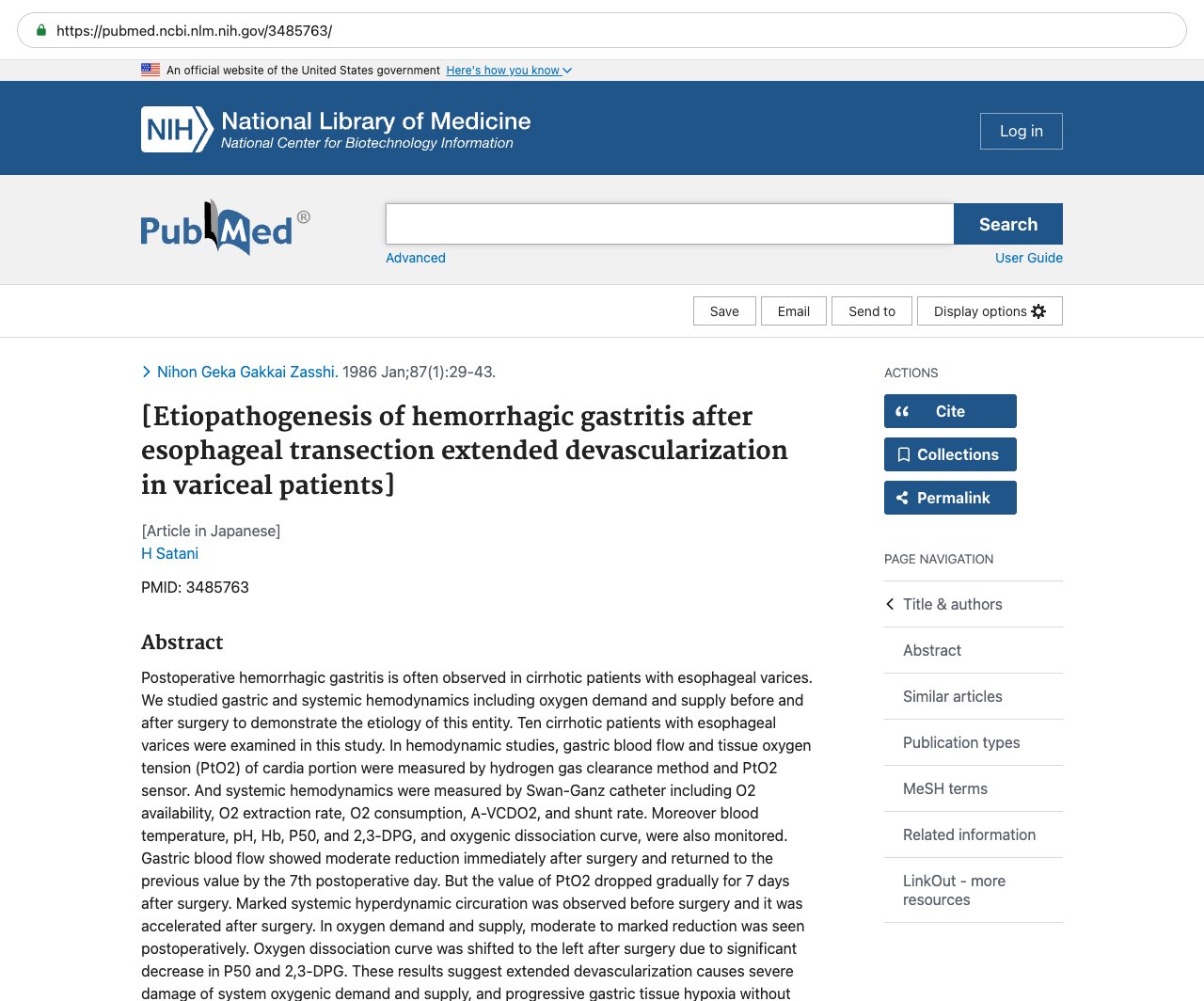
This page mirrors the published abstract (© the authors / publisher) for reference and citation. The canonical source is the PubMed record linked above. This is not medical advice.