1972 · Sem-Jacobsen — Measurements in man of focal intracerebral blood flow around depth-electrodes with hydrogen gas.
Super-Abstract
Using depth electrodes and inhaled hydrogen gas as a vascular tracer, researchers measured regional cerebral blood flow directly at specific brain sites in humans. The hydrogen clearance technique allowed focal, quantitative perfusion data to be obtained from depth-electrode implant sites — a capability not achievable with earlier global methods. (Progress in Brain Research, 1972.)
Commentary
This study is a methodological contribution to the measurement of regional cerebral blood flow (rCBF) in humans. Depth electrodes — implanted for diagnostic purposes (typically epilepsy evaluation) — were used as detection sites for the hydrogen clearance technique. Inhaled H₂ gas acts as a freely diffusible indicator: after inhalation, it reaches the cerebral vasculature, and the local washout curve measured at the electrode tip can be converted to a local blood flow value. This is a purely diagnostic/physiological study. H₂ is the tracer, not the therapy. No abstract text was available for this article.
Key quotes
- „Measurements in man of focal intracerebral blood flow around depth-electrodes with hydrogen gas.“ — title-level summary — no abstract available; hydrogen used as perfusion tracer at depth-electrode sites
Our assessment
This study has no relevance to H₂ therapy. Hydrogen gas serves as an inert vascular tracer for measuring regional cerebral blood flow via the clearance technique. The clinical context is diagnostic neurology/neurosurgery (depth-electrode implantation, likely for epilepsy evaluation), not H₂ medicine. No abstract was available; assessment based on title, journal context (Progress in Brain Research), and DOI metadata. Off-topic for a therapeutic H₂ database.
Study design
- Type: diagnostic methodology study, observational · n: not stated · H₂ delivery: inhaled H₂ as vascular tracer (clearance method at depth-electrode sites) — NOT therapeutic
- Result: focal cerebral perfusion values obtained at depth-electrode implant sites; no abstract available — see DOI 10.1016/s0079-6123(08)60090-4
Source & links
Screenshot of the PubMed page
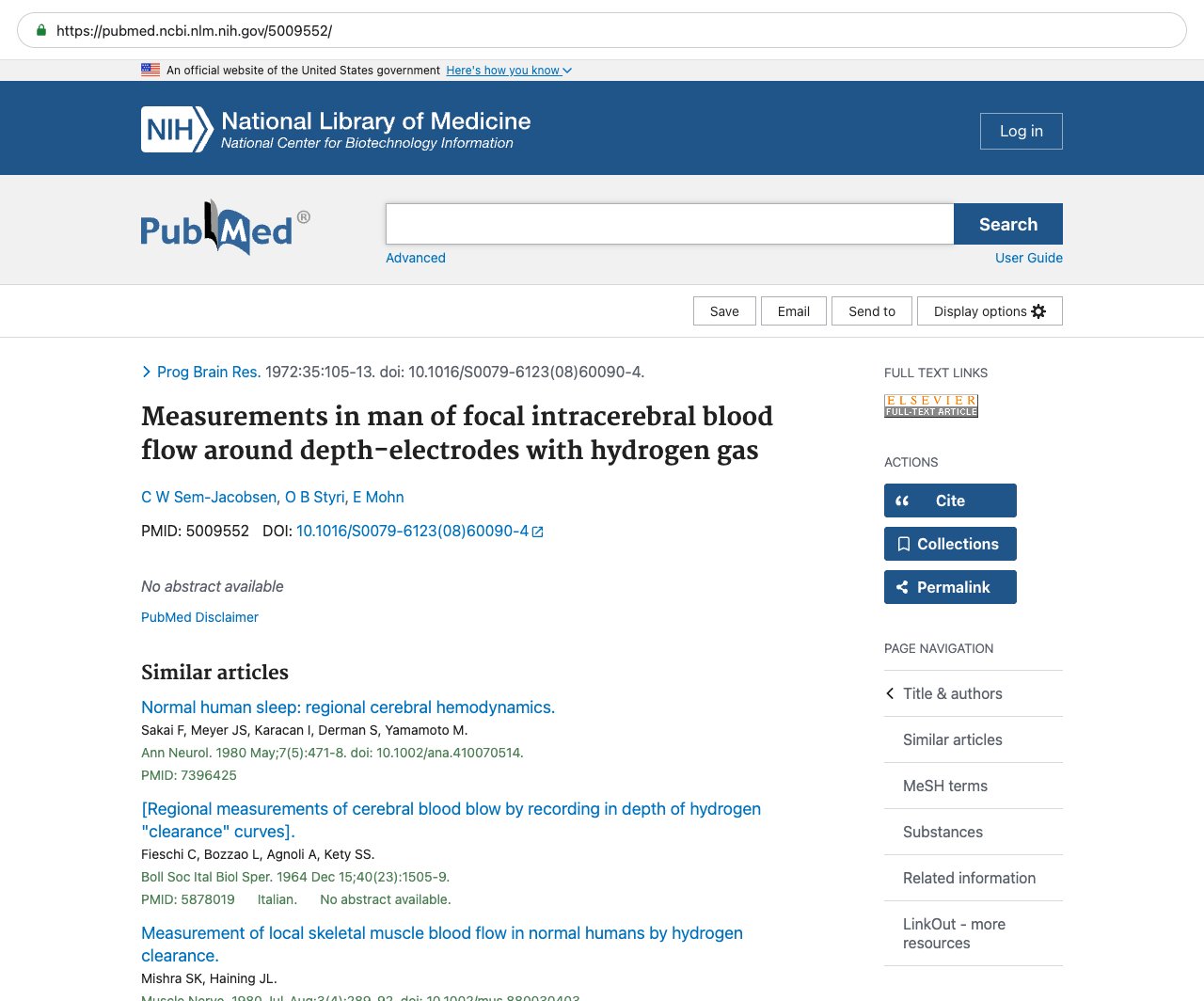
This page mirrors the published abstract (© the authors / publisher) for reference and citation. The canonical source is the PubMed record linked above. This is not medical advice.