1993 · Suzuki — Effect of endogenous opioids on gastric functions in man
Super-Abstract
Blocking endogenous opioids with naloxone reduced blood flow specifically in the gastric antrum — but not in the corpus — suggesting opioids regulate mucosal perfusion in a region-specific way. Hydrogen gas clearance was the blood flow measurement method, not a therapeutic agent. (Hokkaido Journal of Medical Science, 1993.)
Commentary
This gastric physiology study explores the role of the body's own opioid system in regulating stomach blood flow and acid secretion. Inhaled hydrogen gas clearance is used here as a precise regional blood flow monitor inside the stomach — two separate probes track the antrum and corpus independently. This is a well-established research technique in gastrointestinal vascular physiology and has no therapeutic dimension. The key finding — that opioids regulate antral blood flow but not corpus flow, and not acid secretion — contributes to understanding gastric mucosal protection mechanisms.
Key quotes
- „Intravenous naloxone (40 micrograms/kg/hr) over 30 min caused a significant decline in the antral mucosal blood flow from 55.4 ± 3.4 ml/min/100 g before infusion to 44.8 ± 3.0 ml/min/100 g after 30 min (P < 0.05).“ — opioid blockade reduces antral perfusion — suggesting endogenous opioids maintain it
- „Corresponding corpus mucosal blood flow did not change after infusion of naloxone.“ — region-specific effect — opioids regulate antrum, not corpus
- „Endogenous opioids may be involved in the physiological regulation and augmentation of mucosal blood flow for the antrum.“ — proposed physiological role — cautiously stated as a possibility
Our assessment
Important context: this study does not investigate molecular hydrogen (H₂) as a therapeutic intervention. Inhaled hydrogen gas clearance is used as an intramucosal blood flow measurement technique — the standard regional vascular physiology tool of its era. The study topic is gastric neuroendocrine physiology. Design: controlled intravenous infusion protocol in healthy men with intramucosal hydrogen probes (n = 8–12 per endpoint). Limitations: small sample, single-site healthy male volunteers, pharmacological (not physiological) opioid blockade, mechanism conclusions are inferential. Not relevant to H₂ therapy.
Study design
- Type: controlled pharmacological intervention study · n: 8–12 healthy men (varies by endpoint) · H₂ delivery: inhalation as intramucosal blood flow measurement — not therapeutic
- Result: IV naloxone reduced antral mucosal blood flow (55 → 45 ml/min/100 g, p < 0.05); corpus unaffected; no effect on gastric acid secretion or serum gastrin/secretin; opioid receptor involvement uncertain
Abstract
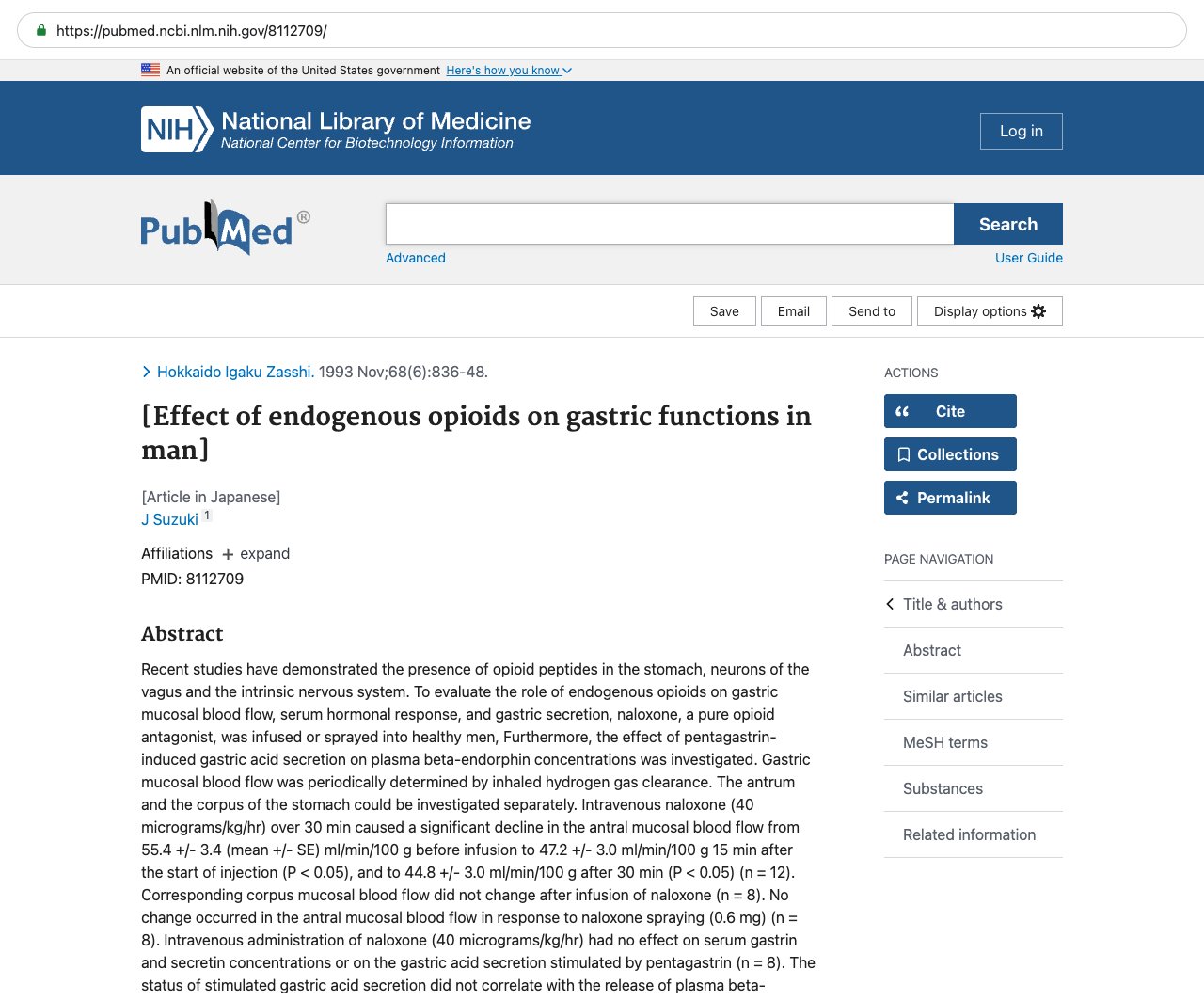
Recent studies have demonstrated the presence of opioid peptides in the stomach, neurons of the vagus and the intrinsic nervous system. To evaluate the role of endogenous opioids on gastric mucosal blood flow, serum hormonal response, and gastric secretion, naloxone, a pure opioid antagonist, was infused or sprayed into healthy men, Furthermore, the effect of pentagastrin-induced gastric acid secretion on plasma beta-endorphin concentrations was investigated. Gastric mucosal blood flow was periodically determined by inhaled hydrogen gas clearance. The antrum and the corpus of the stomach could be investigated separately. Intravenous naloxone (40 micrograms/kg/hr) over 30 min caused a significant decline in the antral mucosal blood flow from 55.4 +/- 3.4 (mean +/- SE) ml/min/100 g before infusion to 47.2 +/- 3.0 ml/min/100 g 15 min after the start of injection (P < 0.05), and to 44.8 +/- 3.0 ml/min/100 g after 30 min (P < 0.05) (n = 12). Corresponding corpus mucosal blood flow did not change after infusion of naloxone (n = 8). No change occurred in the antral mucosal blood flow in response to naloxone spraying (0.6 mg) (n = 8). Intravenous administration of naloxone (40 micrograms/kg/hr) had no effect on serum gastrin and secretin concentrations or on the gastric acid secretion stimulated by pentagastrin (n = 8). The status of stimulated gastric acid secretion did not correlate with the release of plasma beta-endorphin. Since naloxone probably mirrors the action of endogenous opioids, these results indicate in humans that (1) endogenous opioids may be involved in the physiological regulation and augmentation of mucosal blood flow for the antrum, (2) the inhibitory effect of naloxone on gastric mucosal blood flow in the antrum does not seem to be mediated via opioid receptors of the mucosa, (3) endogenous opioids have no effect on basal acid secretion and acid secretion stimulated by pentagastrin, and (4) there is no interplay between acid secretion and plasma beta-endorphin.
Source & links
Screenshot of the PubMed page
This page mirrors the published abstract (© the authors / publisher) for reference and citation. The canonical source is the PubMed record linked above. This is not medical advice.