2018 · Suzuki — Quantification of Hydrogen Production by Intestinal Bacteria That Are Specifically Dysregulated in Parkinson's Disease
Super-Abstract
Parkinson's disease patients have significantly reduced intestinal hydrogen production — approximately 2.2-fold less than healthy controls — due to a specific dysbiosis of hydrogen-producing gut bacteria. This mechanistic study bridges gut microbiome research with H₂ neurology, suggesting that endogenous H₂ deficiency may contribute to PD progression. (PLOS ONE, 2018.)
Commentary
This study does not administer H₂ therapeutically — instead, it investigates why Parkinson's disease patients might benefit less from exogenous H₂ water and, more fundamentally, whether a deficiency in endogenously produced gut H₂ could be part of the disease pathology itself. The research team quantified H₂ production from seven bacterial strains representing major intestinal groups. Key findings: Blautia coccoides and Clostridium leptum are the dominant H₂ producers in the gut, while Lactobacillus casei produces none. By mapping these production rates onto the known microbiome composition of PD patients (previously characterized as having reduced hydrogen-producing bacteria), the researchers calculated that PD patients produce roughly 2.2 times less intestinal H₂ than controls. This finding was consistent across cohorts from multiple countries. The implication is significant: if endogenous gut H₂ has neuroprotective effects, then a dysbiosis that reduces H₂-producing bacteria could be a contributing factor to PD development or progression — not just an association.
Key quotes
- „PD patients produce a 2.2-fold lower amount of intestinal hydrogen compared to controls.“ — the core quantitative finding — substantial endogenous H₂ deficit in Parkinson's patients
- „Blautia coccoides and Clostridium leptum produced the largest amount of hydrogen.“ — identifying the key hydrogen-producing bacterial species in the human gut
- „The number of hydrogen-producing intestinal bacteria may be associated with the development and progression of PD. Further studies are required to prove its beneficial effect.“ — cautious conclusion — mechanistic hypothesis, not proven causation
Our assessment
A well-executed mechanistic study with an important hypothesis for the H₂-Parkinson's field. The computational simulation approach — using measured bacterial H₂ production rates applied to known PD microbiome data — is methodologically clever. Limitations: this is a simulation/calculation study, not a direct measurement of H₂ production in PD patients in vivo; causality cannot be established — reduced H₂-producing bacteria could be a consequence of PD pathology rather than a cause; the connection between gut H₂ levels and brain neuroprotection requires further mechanistic support; the study confirms an association, not a therapeutic effect. This work provides important biological rationale for why some PD patients might respond better to exogenous H₂ supplementation than others.
Study design
- Type: ex vivo bacterial gas measurement + computational simulation study · n: bacterial strain measurements (7 strains); PD microbiome data from prior human cohort studies
- Method: gas chromatography measurement of H₂ production by isolated bacterial strains; simulation of gut H₂ output using known PD vs. control microbiome composition
- Result: simulated H₂ production 2.2-fold lower in PD patients vs. controls; consistent across cohorts from multiple countries; Blautia coccoides and Clostridium leptum identified as dominant gut H₂ producers
Abstract
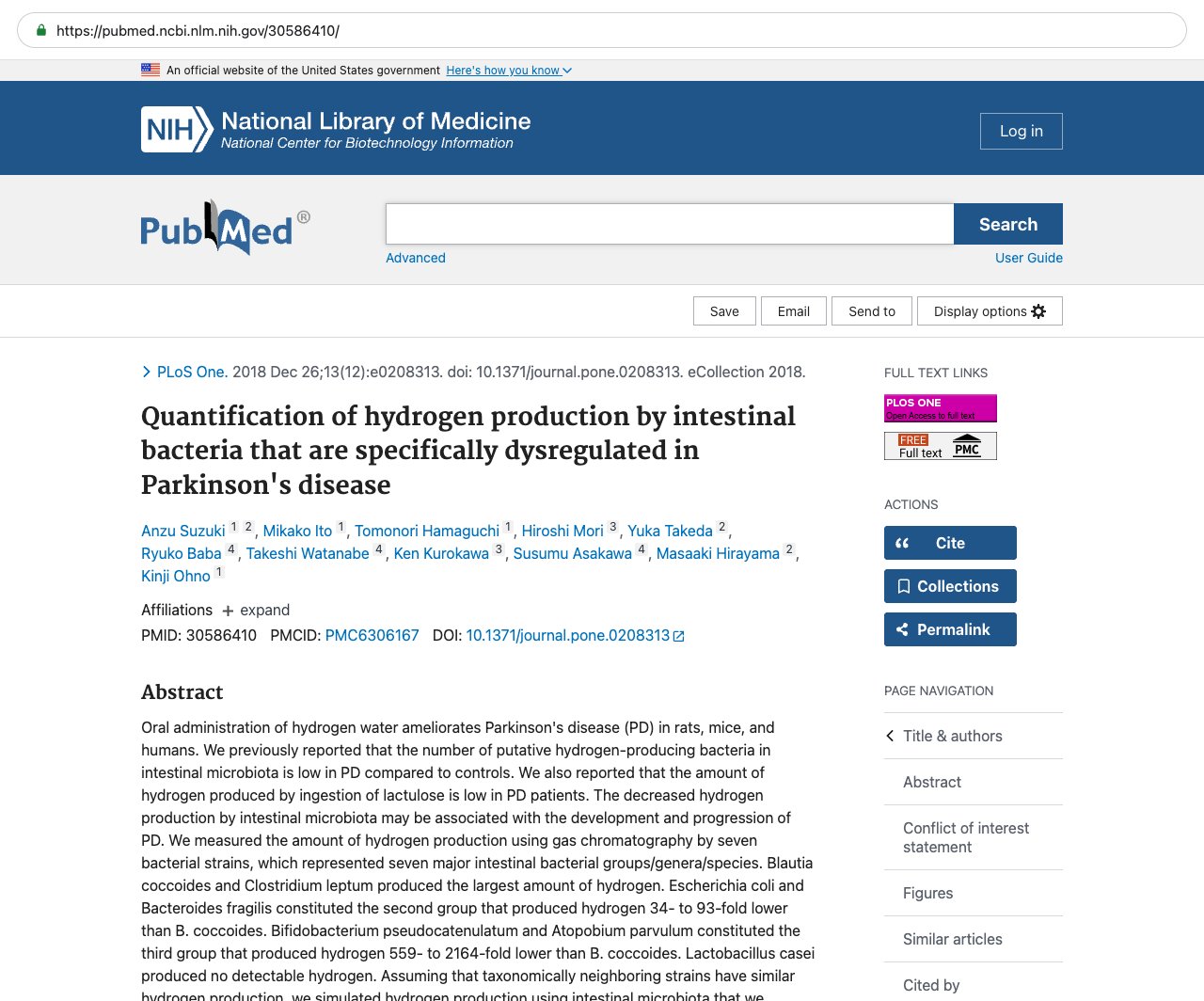
Oral administration of hydrogen water ameliorates Parkinson's disease (PD) in rats, mice, and humans. We previously reported that the number of putative hydrogen-producing bacteria in intestinal microbiota is low in PD compared to controls. We also reported that the amount of hydrogen produced by ingestion of lactulose is low in PD patients. The decreased hydrogen production by intestinal microbiota may be associated with the development and progression of PD. We measured the amount of hydrogen production using gas chromatography by seven bacterial strains, which represented seven major intestinal bacterial groups/genera/species. Blautia coccoides and Clostridium leptum produced the largest amount of hydrogen. Escherichia coli and Bacteroides fragilis constituted the second group that produced hydrogen 34- to 93-fold lower than B. coccoides. Bifidobacterium pseudocatenulatum and Atopobium parvulum constituted the third group that produced hydrogen 559- to 2164-fold lower than B. coccoides. Lactobacillus casei produced no detectable hydrogen. Assuming that taxonomically neighboring strains have similar hydrogen production, we simulated hydrogen production using intestinal microbiota that we previously reported, and found that PD patients produce a 2.2-fold lower amount of intestinal hydrogen compared to controls. The lower amount of intestinal hydrogen production in PD was also simulated in cohorts of two other countries. The number of hydrogen-producing intestinal bacteria may be associated with the development and progression of PD. Further studies are required to prove its beneficial effect.
Source & links
Screenshot of the PubMed page
This page mirrors the published abstract (© the authors / publisher) for reference and citation. The canonical source is the PubMed record linked above. This is not medical advice.