2011 · Tsushima et al. — Feasibility of Measuring Human Pancreatic Perfusion In Vivo Using Imaging Techniques
Super-Abstract
This study evaluates methods for measuring pancreatic blood flow using CT and other imaging modalities — not H₂ therapy. Hydrogen gas appears only as a reference measurement technique (the „hydrogen clearance method“) used historically for organ perfusion measurement. This paper is a methodology comparison for pancreatic imaging and has no clinical H₂ therapeutic intervention. (Pancreas, 2011.)
Commentary
This study is a methodological comparison of pancreatic perfusion measurement techniques. The „hydrogen gas clearance method“ cited here is an old physiological measurement technique that uses inhaled H₂ gas as a tracer to calculate organ blood flow — it is entirely unrelated to molecular hydrogen therapy. The study's subject is imaging-based perfusion CT vs. MRI vs. PET for diagnosing pancreatic blood flow disorders. It contains no H₂ therapeutic intervention, no hydrogen-rich water, and no assessment of H₂ as a therapeutic agent.
Key quotes
- „In the literature review, 15 studies that reported the absolute values of normal pancreatic perfusion, by using perfusion CT, dynamic magnetic resonance imaging, hydrogen gas clearance method, and 15O-H2O-positron emission tomography were found.“ — H₂ appears here only as a historical blood-flow measurement tracer — not as a therapeutic agent
Our assessment
Off-topic for H₂ therapy. This paper uses hydrogen gas exclusively as a perfusion measurement tracer (the H₂-clearance technique), which is a diagnostic tool unrelated to hydrogen therapy. The study does not investigate H₂ as a therapeutic intervention. It should not be interpreted as evidence for H₂ therapeutic effects on the pancreas or any other organ. Its inclusion in an H₂ therapy database appears to be a metadata error — likely triggered by the word „hydrogen“ in the methods section.
Study design
- Type: retrospective analysis + literature review of pancreatic perfusion imaging · n: 8 patients (CT analysis); 15 literature studies reviewed · H₂ delivery: none — H₂ cited only as a historical blood-flow measurement technique
- Result: normal pancreatic perfusion estimated at ~100 mL/min per 100 mL; no H₂ therapeutic outcomes measured
Abstract
OBJECTIVE: The objective of this study was to demonstrate the feasibility of pancreatic perfusion computed tomography (CT) and review pancreatic perfusion measurements by various imaging modalities. METHODS: Dynamic CT data from 8 patients (4 men; mean age, 64.8 [SD, 12.1] years; range, 40-80 years) with normal pancreas were analyzed using 2 analytical models: the maximum-slope and compartment-model methods. Literature search was also performed. RESULTS: Although the perfusion value estimated by the maximum-slope method (88.1 [SD, 42.1] mL/min per 100 mL) was significantly smaller than that of the compartment-model method (127.0 [SD, 70.5]; P < 0.001), there was a linear correlation between them (r = 0.97, P < 0.001). In the literature review, 15 studies that reported the absolute values of normal pancreatic perfusion, by using perfusion CT, dynamic magnetic resonance imaging, hydrogen gas clearance method, and 15O-H2O-positron emission tomography were found. The reported mean values of normal pancreatic perfusion ranged from 38.4 to 356 mL/min per 100 mL, and there was a great deal of individual variation. CONCLUSIONS: Perfusion CT may provide reliable perfusion measurements of the pancreas, and the normal value was estimated at around 100 mL/min per 100 mL with a great deal of individual variation. The maximum-slope method may provide a lower perfusion value compared with the compartment-model method.
Source & links
Screenshot of the PubMed page
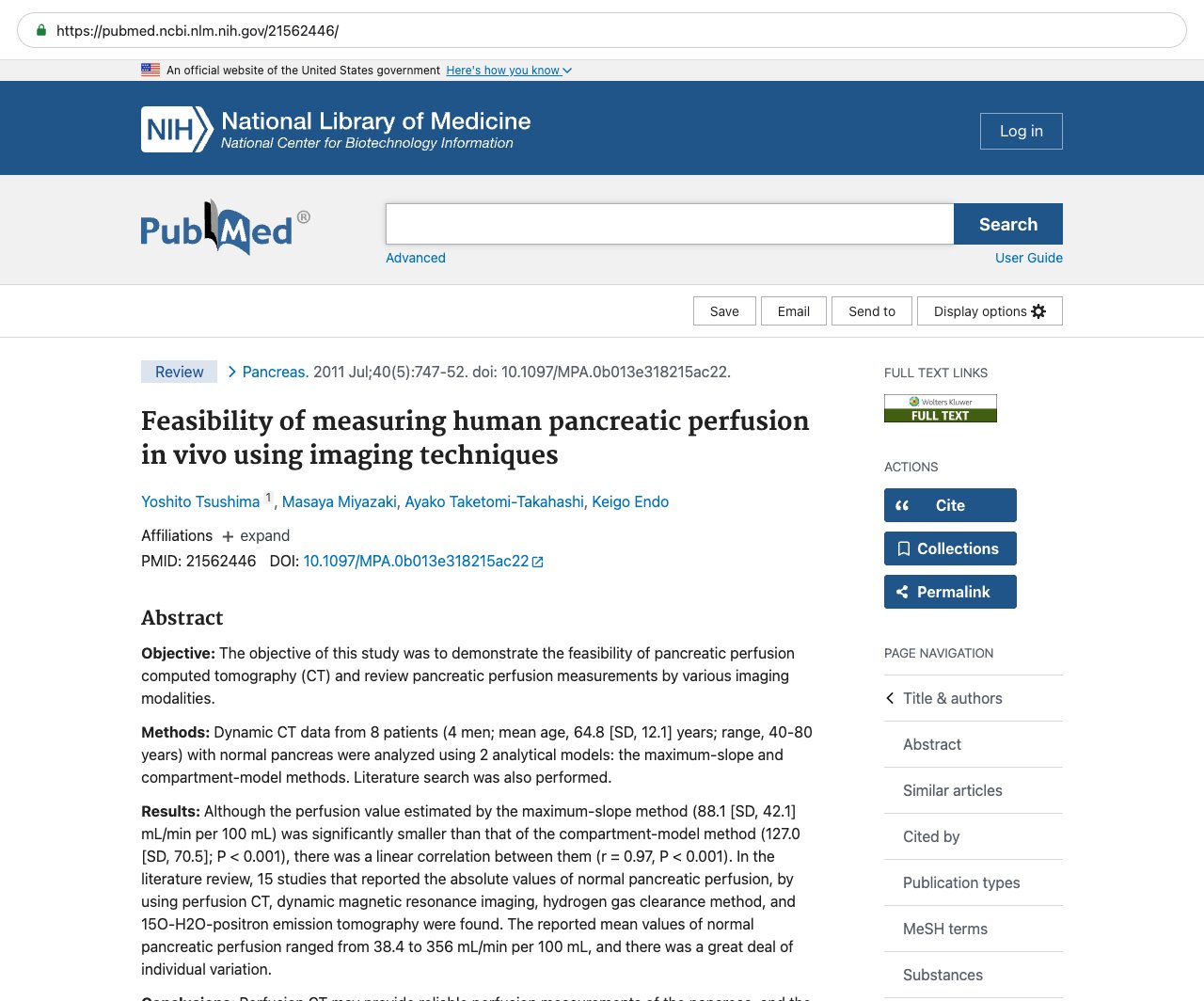
This page mirrors the published abstract (© the authors / publisher) for reference and citation. The canonical source is the PubMed record linked above. This is not medical advice.