2008 · Urita et al. — Extensive Atrophic Gastritis Linked to Increased Levels of Intraluminal Hydrogen Gas
Super-Abstract
This gastroenterology study measures hydrogen gas produced naturally by gut bacteria in 647 patients undergoing upper endoscopy — it is not an H₂ therapy study. The finding is that intraduodenal H₂ levels rise with the progression of atrophic gastritis, suggesting a link between gastric acid deficiency, bacterial overgrowth, and endogenous H₂ production. (Hepato-Gastroenterology, 2008.)
Commentary
In the gastrointestinal tract, bacteria ferment undigested substrates and produce hydrogen gas as a byproduct — this is entirely endogenous H₂, not administered molecular hydrogen therapy. This study used intraluminal gas sampling during endoscopy to measure these naturally occurring H₂ levels, finding that atrophic gastritis (associated with reduced gastric acid) creates conditions favoring bacterial overgrowth and higher H₂ production in the duodenum. The study contributes to understanding gut microbiota ecology and the consequences of hypochlorhydria. It has no relevance to administered H₂ as a therapeutic agent.
Key quotes
- „The intraduodenal H2 level was increased with the progression of atrophic gastritis, whereas the intragastric H2 level was the highest in patients without atrophic gastritis.“ — endogenous bacterial H₂ varies with gastric pathology — no therapeutic H₂ involved
- „the influence of hypochlorhydria on bacterial overgrowth in the proximal small intestine is more pronounced, compared to that in the stomach.“ — mechanism: reduced gastric acid → bacterial overgrowth → more fermentation H₂
Our assessment
Off-topic for H₂ therapy. This study investigates endogenous intraluminal hydrogen gas produced by gut bacteria — not therapeutic molecular hydrogen. No H₂ was administered. The study contributes to gastroenterology knowledge about the relationship between gastric acid, bacterial overgrowth, and microbiome-derived H₂. It is not evidence for or against H₂ therapeutic effects.
Study design
- Type: observational cross-sectional study during upper endoscopy · n: 647 patients · H₂ delivery: none — endogenous intraluminal H₂ measured by gas chromatography
- Result: intragastric H₂ detected in 87.5% of patients, intraduodenal in 81.0%; intraduodenal H₂ increased with atrophic gastritis progression; no therapeutic intervention
Abstract
BACKGROUND/AIMS: Gastric acid plays an important part in the prevention of bacterial colonization of the gastrointestinal tract. If these bacteria have an ability of hydrogen (H2) fermentation, intraluminal H2 gas might be detected. We attempted to measure the intraluminal H2 concentrations to determine the bacterial overgrowth in the gastrointestinal tract. METHODOLOGY: Studies were performed in 647 consecutive patients undergoing upper endoscopy. At the time of endoscopic examination, we intubated the stomach and the descending part of the duodenum without inflation by air, and 20 ml of intraluminal gas samples of both sites was collected through the biopsy channel. Intraluminal H2 concentrations were measured by gas chromatography. RESULTS: Over all, intragastric and intraduodenal H2 gas was detected in 566 (87.5%) and 524 (81.0%), respectively. The mean values of intragastric and intraduodenal H2 gas were 8.5 +/- 15.9 and 13.2 +/- 58.0 ppm, respectively. The intraduodenal H2 level was increased with the progression of atrophic gastritis, whereas the intragastric H2 level was the highest in patients without atrophic gastritis. CONCLUSIONS: The intraduodenal hydrogen levels were increased with the progression of atrophic gastritis. It is likely that the influence of hypochlorhydria on bacterial overgrowth in the proximal small intestine is more pronounced, compared to that in the stomach.
Source & links
Screenshot of the PubMed page
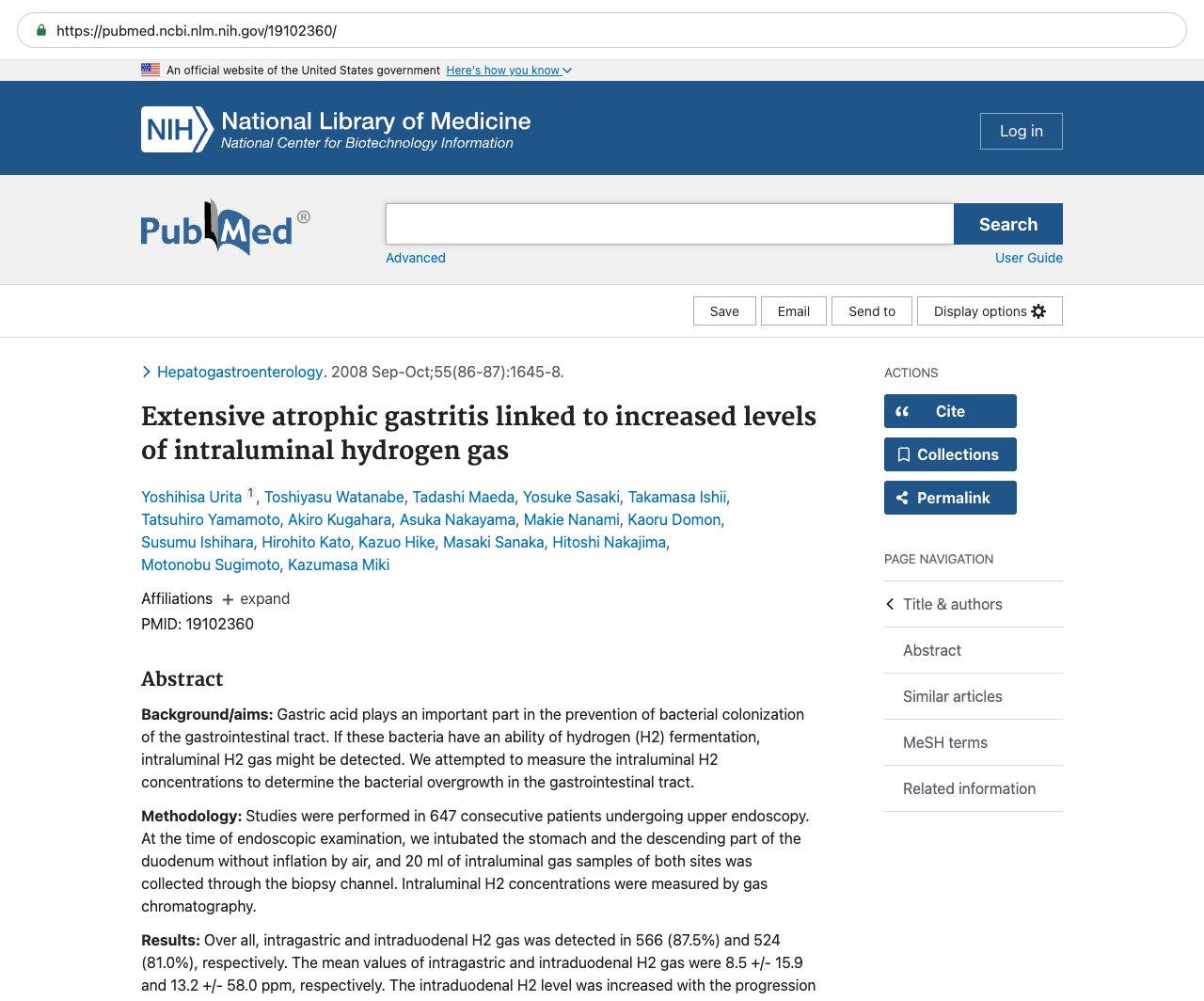
This page mirrors the published abstract (© the authors / publisher) for reference and citation. The canonical source is the PubMed record linked above. This is not medical advice.