2022 · Waelti — Radiographic features of magnesium-based bioabsorbable screw resorption in paediatric fractures
Super-Abstract
When magnesium-based screws dissolve in bone, they release hydrogen gas — and that gas is perfectly normal, not a sign of infection. This retrospective radiographic study in 35 children maps how gas bubbles appear, where they travel, and when they disappear, helping radiologists and surgeons avoid misdiagnosis. (Pediatric Radiology, 2022.)
Commentary
This study sits at an unusual intersection: H₂ as a by-product of a medical implant rather than a deliberately administered therapy. Magnesium screws are increasingly used in paediatric orthopaedics because they dissolve over time and spare children a second surgery for hardware removal. The dissolution reaction produces hydrogen gas, which accumulates in bone and surrounding soft tissue. Without knowing this, a radiologist could easily read the gas pockets as osteomyelitis or soft-tissue infection — a serious misdiagnosis. The study provides clear temporal reference data: gas peaks around week 5, stabilises to week 16, then resolves. The complication rates (11.4% bone fragment breakage within six weeks, 45.7% screw breakage by ~300 days) are clinically relevant and should be communicated to families. For the broader H₂ field, this paper is a reminder that H₂ is produced endogenously in the body under specific conditions — and is well tolerated.
Key quotes
- „Gas bubbles in bone and soft tissue are normal findings in the context of screw resorption and should not be confused with soft-tissue infection or osteomyelitis.“ — the key clinical message: do not misinterpret H₂ gas as infection
- „Gas in the bone increases up to week 5, remains constant up to week 16 and then decreases.“ — the temporal pattern of gas appearance — useful for follow-up planning
- „Screw breakage was observed in 16/35 (45.7%) patients, with a median time to first detection of 300 days.“ — a notable complication rate that patients and surgeons should be aware of
Our assessment
This is a well-executed retrospective imaging study with a clear and clinically useful message. Its contribution to the H₂ field is indirect: it documents that locally produced H₂ gas from implant resorption is safe and self-resolving in paediatric bone. Limitations: retrospective design, single-centre, no control group (by definition — all patients had magnesium screws), and the study cannot speak to therapeutic H₂ effects. The high screw breakage rate (45.7%) is a limitation of the implant technology itself and not H₂-related. Not a therapeutic efficacy study.
Study design
- Type: retrospective radiographic analysis · n: 35 paediatric patients (103 radiographs) · H₂ source: endogenous — produced by resorption of magnesium-alloy orthopaedic screws
- Follow-up: 1–730 days · Key finding: gas in bone peaks at week 5, resolves after week 16; gas in soft tissue and joints reduces gradually; screw breakage in 45.7% at median 300 days
- Result: no therapeutic H₂ endpoint — study purpose is radiographic characterisation and misdiagnosis prevention
Abstract
BACKGROUND: Resorption of magnesium-based alloy bioabsorbable screws produces hydrogen gas, which can be mistaken as a sign of infection and may affect the physis or fixed bone fragment. OBJECTIVE: We evaluated the temporal and spatial occurrence of gas and the occurrence of a breakage of the fixed bone fragment or screw following magnesium screw fixation. MATERIALS AND METHODS: Radiographs of paediatric patients treated with magnesium screws were retrospectively reviewed. Temporal occurrence and distribution of gas in the bone, the physis and soft tissues, breakage of the screw or fixed bone fragment and joint effusion were assessed. RESULTS: One hundred and three radiographs in 35 paediatric patients were reviewed (mean age: 10.6 years). Follow-up ranged from 1 to 730 days. Gas in the bone increases up to week 5, remains constant up to week 16 and then decreases. Gas in soft tissues, intra-articular gas and joint effusions gradually reduce over time. In 1/23 (4.3%) patients with an open physis, gas intrusion into the physis occurred. Breakage of the bone fragment fixated by the screw was observed in 4/35 (11.4%) patients within the first 6 weeks. Screw breakage was observed in 16/35 (45.7%) patients, with a median time to first detection of 300 days. CONCLUSION: Gas bubbles in bone and soft tissue are normal findings in the context of screw resorption and should not be confused with soft-tissue infection or osteomyelitis. Gas is rarely visible in the physis. Breakage of the fixed bone fragment and/or screw can occur.
Source & links
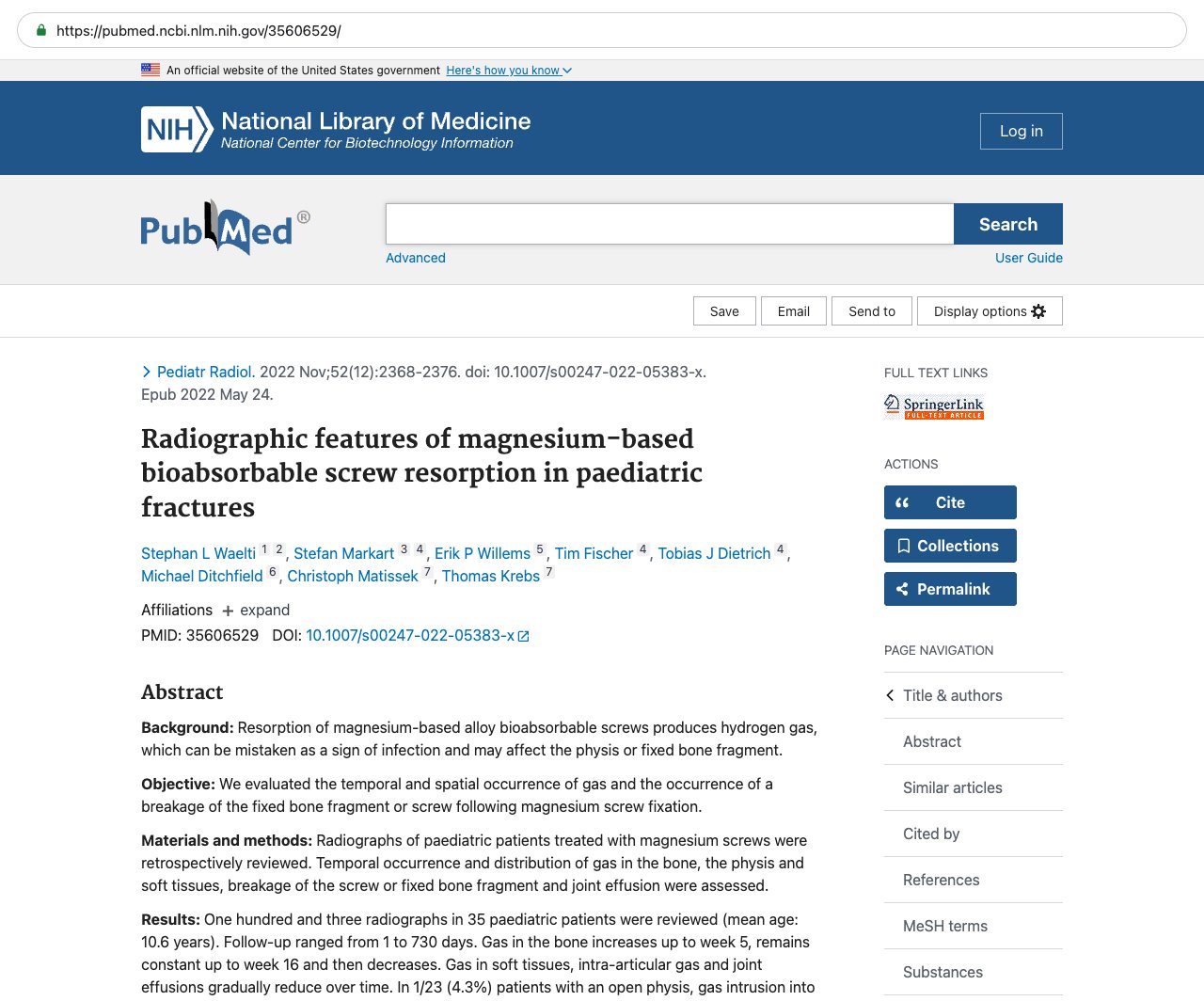
Screenshot of the PubMed page
This page mirrors the published abstract (© the authors / publisher) for reference and citation. The canonical source is the PubMed record linked above. This is not medical advice.