1985 · Mobassaleh et al. — Development of Carbohydrate Absorption in the Fetus and Neonate
Super-Abstract
This 1985 review describes how carbohydrate digestion enzymes and absorption mechanisms mature during fetal development and the neonatal period — and how breath hydrogen testing can non-invasively assess carbohydrate absorption status in young infants. Hydrogen here is a diagnostic marker produced by gut bacteria from unabsorbed carbohydrates, not a therapeutic agent. (Pediatrics, 1985.)
Commentary
This is a developmental physiology review covering intestinal enzyme maturation (lactase, sucrase, maltase, isomaltase, glucoamylase, pancreatic amylase) and glucose transport in fetuses and neonates. The key insight is that most enzymes reach mature levels in the term fetus, but pancreatic amylase and glucose transport only mature postnatally. Unabsorbed carbohydrates that reach the colon are fermented by bacteria into H₂ and short-chain fatty acids — an adaptive salvage mechanism. Breath H₂ measurement is highlighted as a clinically useful, non-invasive way to assess this in young infants. No H₂ is administered therapeutically. The database categorization as „sports-exercise“ and „pregnancy“ reflects the developmental biology scope but has no bearing on H₂ therapy.
Key quotes
- „Inadequately absorbed carbohydrates are salvaged by colonic flora through fermentation of carbohydrates to hydrogen gas and short-chain fatty acids; the latter are readily absorbed by the colon.“ — the physiological basis for breath H₂ as a diagnostic marker
- „Noninvasive reflection of the status of carbohydrate absorption may be obtained from breath hydrogen testing, a technique of particular value in young infants.“ — clinical recommendation: breath H₂ testing for neonatal carbohydrate malabsorption
Our assessment
This is a developmental pediatrics review — not a therapeutic H₂ study. H₂ appears in the context of gut fermentation physiology and breath testing methodology; it is neither administered nor studied as a therapeutic agent. The database fields „methods: inhalation, drinking-hrw“ appear to be erroneous indexing for this article. Limitations: this is a narrative review from 1985; no primary data, no control groups, no effect sizes; some enzyme maturation data may have been updated by subsequent research. Relevant for understanding endogenous H₂ biology, but provides no evidence for therapeutic H₂ use.
Study design
- Type: narrative review (developmental physiology) · n: n/a (no primary data) · H₂ relevance: breath H₂ as diagnostic marker of carbohydrate fermentation in neonates
- Topic: maturation of intestinal enzymes, glucose transport, pancreatic amylase in fetuses and neonates; colonic salvage fermentation
- Result: most intestinal enzymes mature in utero; pancreatic amylase and glucose transport mature postnatally; unabsorbed carbohydrates fermented to H₂ + short-chain fatty acids; breath H₂ testing recommended as non-invasive clinical tool in infants
Abstract
Maturation of mechanisms for carbohydrate absorption occurs in a defined sequence during human fetal development. The intestinal enzymes, lactase, sucrase, maltase, isomaltase, and glucoamylase, are at mature levels in the term fetus. Mature levels of pancreatic amylase activity and glucose transport occur postnatally, and levels are low in both the term and preterm neonate. In the preterm infant, sucrase, maltase, and isomaltase are usually fully active, but lactase activity, which increases markedly from 24 to 40 weeks, may be low depending upon fetal age. Despite these developmental patterns, clinical lactose intolerance is uncommon. Postnatal adaptive responses to ingested carbohydrates lead to competent carbohydrate absorption. Inadequately absorbed carbohydrates are salvaged by colonic flora through fermentation of carbohydrates to hydrogen gas and short-chain fatty acids; the latter are readily absorbed by the colon. In this setting, carbohydrate tends to be absent from the stool. Noninvasive reflection of the status of carbohydrate absorption may be obtained from breath hydrogen testing, a technique of particular value in young infants.
Source & links
Screenshot of the PubMed page
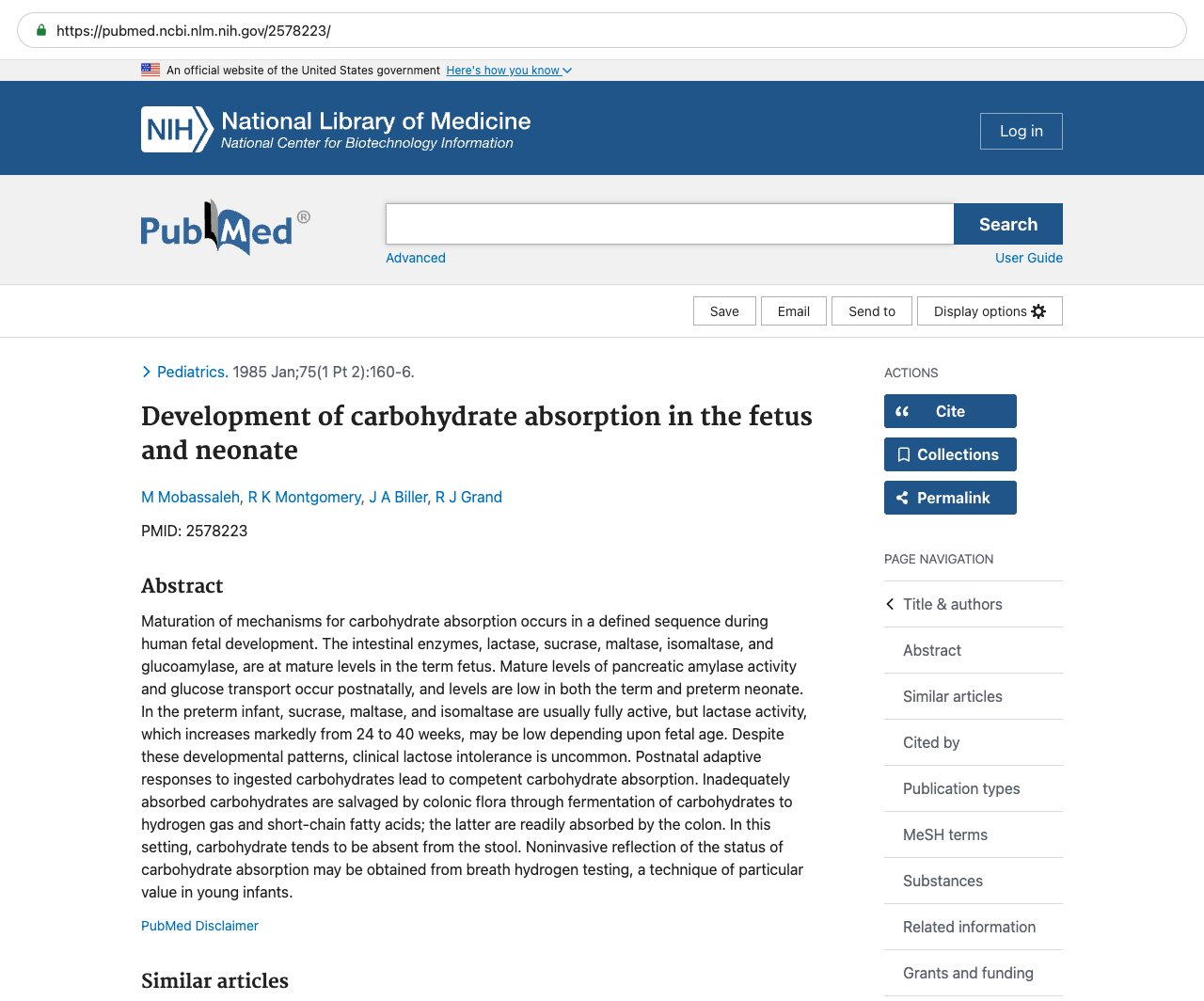
This page mirrors the published abstract (© the authors / publisher) for reference and citation. The canonical source is the PubMed record linked above. This is not medical advice.