1984 · Sakiyama — The Cervical Blood Flow Using Hydrogen Gas Clearance Method
Super-Abstract
This 1984 Japanese study measured cervical blood flow across the menstrual cycle and various stages of pregnancy using inhaled hydrogen gas clearance — a diagnostic technique, not a therapy. Cervical blood flow was highest in early pregnancy (6–7 weeks) and declined significantly toward term, possibly reflecting cervical ripening. (Nihon Sanka Fujinka Gakkai Zasshi, 1984.)
Commentary
This is an obstetrics and gynecology physiological measurement study. The hydrogen gas clearance method — inhaling a known concentration of H₂ and measuring how quickly it clears from a specific tissue via a local electrode — was applied to measure blood flow in the cervix across reproductive cycle phases and pregnancy stages. The findings contribute to understanding cervical physiology: blood flow varies with hormonal status, peaks in early pregnancy, and falls sharply at term (where the decrease may reflect circulatory changes associated with cervical ripening and preparation for labor). Molar pregnancy showed higher cervical blood flow than normal pregnancy. This is not H₂ therapy — H₂ serves purely as the tracer gas enabling non-invasive blood flow quantification.
Key quotes
- „CxBF was 96.8 +/- 11.3 in 6-7, 48.6 +/- 26.4 in 8, 55.5 +/- 9.8 in 9-13 gestational weeks, that is it was highest in the early stages and gradually decreased with the advance of pregnancy.“ — cervical blood flow peaks in early pregnancy then progressively declines
- „The decrease in the terminal stage is supposed to reflect the circulatory insufficiency, that is, cervical ripening.“ — the physiological interpretation: low blood flow at term may signal cervical ripening
Our assessment
This is a gynecological physiology measurement study — not a therapeutic H₂ investigation. Hydrogen gas clearance is used purely as a diagnostic technique to quantify tissue blood flow. No therapeutic H₂ is administered. Limitations: small sample sizes (exact n per subgroup not always stated: 19 non-pregnant; 6–7 early pregnancy cases; single-site measurements); historical study (1984) with no modern imaging comparison; no clinical outcomes beyond the hemodynamic measurements; the physiological significance of the molar pregnancy finding is not explored in depth. Not applicable to H₂ medicine.
Study design
- Type: observational physiology study · n: 19 non-pregnant + various pregnant groups (gestational stages) · H₂ delivery: inhaled H₂ gas as diagnostic tracer for cervical blood flow measurement only
- Measurements: cervical blood flow (CxBF) across menstrual phases and gestational weeks 6-7, 8, 9-13, and ≥37 weeks; also molar pregnancy
- Result: non-pregnant CxBF 54.1 ml/min/100g; highest in gestational week 6-7 (96.8); gradual decline through pregnancy; significantly low at ≥37 weeks (22.5) — interpreted as cervical ripening signal; molar pregnancy: higher CxBF than normal pregnancy
Abstract
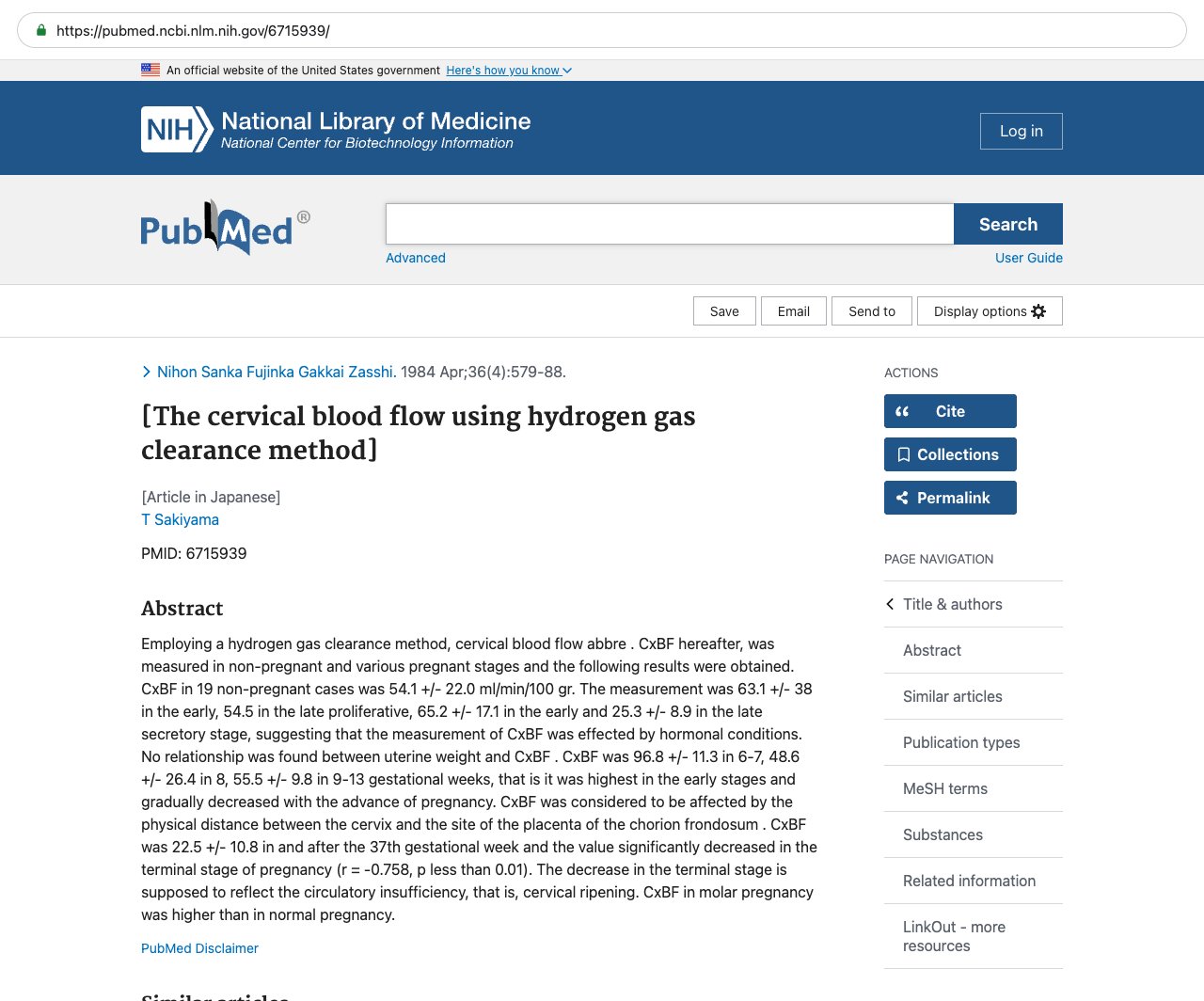
Employing a hydrogen gas clearance method, cervical blood flow abbre . CxBF hereafter, was measured in non-pregnant and various pregnant stages and the following results were obtained. CxBF in 19 non-pregnant cases was 54.1 +/- 22.0 ml/min/100 gr. The measurement was 63.1 +/- 38 in the early, 54.5 in the late proliferative, 65.2 +/- 17.1 in the early and 25.3 +/- 8.9 in the late secretory stage, suggesting that the measurement of CxBF was effected by hormonal conditions. No relationship was found between uterine weight and CxBF . CxBF was 96.8 +/- 11.3 in 6-7, 48.6 +/- 26.4 in 8, 55.5 +/- 9.8 in 9-13 gestational weeks, that is it was highest in the early stages and gradually decreased with the advance of pregnancy. CxBF was considered to be affected by the physical distance between the cervix and the site of the placenta of the chorion frondosum . CxBF was 22.5 +/- 10.8 in and after the 37th gestational week and the value significantly decreased in the terminal stage of pregnancy (r = -0.758, p less than 0.01). The decrease in the terminal stage is supposed to reflect the circulatory insufficiency, that is, cervical ripening. CxBF in molar pregnancy was higher than in normal pregnancy.
Source & links
Screenshot of the PubMed page
This page mirrors the published abstract (© the authors / publisher) for reference and citation. The canonical source is the PubMed record linked above. This is not medical advice.