2019 Chemphyschem : a European journal of chemical physics and physical chemistry Mechanism / Preclinical Unspecified
2019 · Schmidt — Lifetime of Parahydrogen in Aqueous Solutions and Human Blood
Super-Abstract
Parahydrogen (pH₂) — a nuclear spin isomer of molecular hydrogen — survives for unexpectedly long periods in water and even in human blood, with lifetimes of 10 to 300 minutes. This in-vitro physics study characterises the relaxation behaviour of pH₂ in biological media, which is essential for designing parahydrogen-based MRI signal-enhancement techniques (PHIP). Therapeutic effects of H₂ are not investigated here. (ChemPhysChem, 2019.)
Commentary
Parahydrogen-induced polarization (PHIP) is a technique that exploits the quantum spin state of pH₂ to dramatically boost NMR/MRI signals — potentially enabling real-time metabolic imaging in living organisms. For PHIP to work in vivo, pH₂ must survive long enough in biological fluids. Schmidt et al. measure both the longitudinal relaxation time (T₁) and the specific pH₂ lifetime (τ_POC) across multiple media: methanol, water (with and without O₂, NaCl, rhodium catalyst), and human blood. Remarkably, τ_POC values ranged from 10 to 300 minutes — sufficiently long for in-vivo applications. The study is fundamental physics/analytical chemistry; it does not involve H₂ administration as a health intervention. Its relevance to H₂ medicine is in the biophysical characterisation of how H₂ spin states behave in body fluids.
Key quotes
- „All measured T1 values were in the range of 1.4-2 s and τPOC values were of the order of 10-300 minutes.“ — surprisingly long lifetimes — pH₂ spin order persists in biological fluids for hours
- „These relatively long lifetimes hold great promise for emerging in vivo implementations and applications of PHIP.“ — implication: PHIP-based MRI enhancement is feasible in living systems
- „pH2-induced polarization (PHIP) is based on the survival of pH2 spin order in solution, yet its lifetime has not been investigated in aqueous or biological media required for in vivo applications.“ — gap the study fills: nobody had measured this in relevant biological media before
Our assessment
This is a rigorous in-vitro biophysics study relevant to MRI/NMR methodology, not to H₂ as a health intervention. The finding that pH₂ persists for 10–300 minutes in aqueous and blood media is important for PHIP-based imaging development. No therapeutic claims for H₂ can be derived from this paper. The „molecular hydrogen“ here refers to a quantum spin state used as a physics tool, not to dissolved H₂ ingestion or inhalation. The work is methodologically sound; it advances the instrumental basis for future in-vivo imaging but does not bear on the clinical H₂ literature.
Study design
- Type: in-vitro analytical/biophysics study · Media: methanol, water (±O₂, ±NaCl, ±rhodium catalyst), human blood · H₂ intervention: none — parahydrogen used as a quantum spin probe
- Parameters measured: longitudinal relaxation time (T₁), parahydrogen lifetime (τ_POC) by NMR
- Result: T₁ values 1.4–2 s across all media; τ_POC 10–300 min; long lifetimes support viability of PHIP-based in-vivo MRI applications
Abstract
Molecular hydrogen has unique nuclear spin properties. Its nuclear spin isomer, parahydrogen (pH2 ), was instrumental in the early days of quantum mechanics and allows to boost the NMR signal by several orders of magnitude. pH2- induced polarization (PHIP) is based on the survival of pH2 spin order in solution, yet its lifetime has not been investigated in aqueous or biological media required for in vivo applications. Herein, we report longitudinal relaxation times (T1 ) and lifetimes of pH2 ( τPOC ) in methanol and water, with or without O2 , NaCl, rhodium-catalyst or human blood. Furthermore, we present a relaxation model that uses T1 and τPOC for more precise theoretical predictions of the H2 spin state in PHIP experiments. All measured T1 values were in the range of 1.4-2 s and τPOC values were of the order of 10-300 minutes. These relatively long lifetimes hold great promise for emerging in vivo implementations and applications of PHIP.
Source & links
Screenshot of the PubMed page
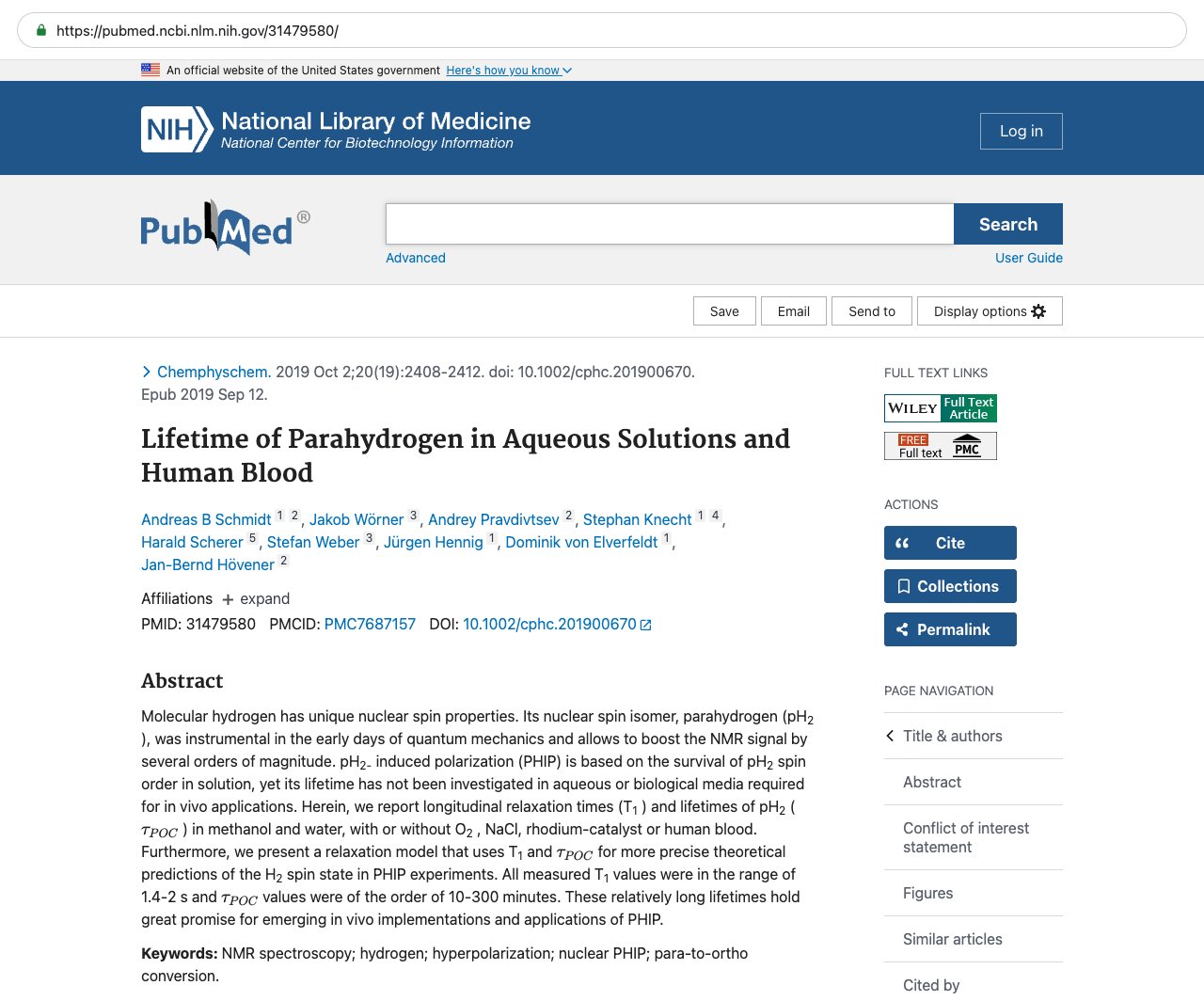
This page mirrors the published abstract (© the authors / publisher) for reference and citation. The canonical source is the PubMed record linked above. This is not medical advice.