2022 · Wang — Regulation of chlorothalonil degradation by molecular hydrogen
Super-Abstract
This in-vitro and plant study shows that molecular hydrogen accelerates the breakdown of the fungicide chlorothalonil in several crop plants — including tomato, rice, and cabbage — without reducing the pesticide's antifungal effectiveness. The mechanism involves H₂-stimulated brassinosteroid hormones that upregulate detoxification enzymes. This is a plant biology study with no direct relevance to human health therapy. (Journal of Hazardous Materials, 2022.)
Commentary
Chlorothalonil (CHT) is a broad-spectrum organochlorine fungicide widely used in agriculture; it accumulates in plants and the food chain, raising regulatory and consumer safety concerns. This study explores whether molecular hydrogen — already known to influence plant growth signaling — can enhance CHT detoxification in plants without compromising crop protection. The study uses both pharmacological manipulation (external H₂ treatment) and genetic engineering (overexpression of hydrogenase from Chlamydomonas reinhardtii in Arabidopsis) to increase H₂ levels, confirming that the observed effects are H₂-specific. The identified mechanism runs through brassinosteroids (BRs) — plant steroid hormones — which, when stimulated by H₂, upregulate genes encoding detoxification enzymes. An important nuance: the antifungal activity of CHT was not reduced by H₂ treatment, meaning the fungicide still works while the plant degrades it more efficiently. Seven crop species were tested, suggesting the mechanism is broadly applicable. This study is firmly within plant physiology and agricultural chemistry — it does not investigate any human health endpoint.
Key quotes
- „H2 enhances the degradation of the fungicide chlorothalonil (CHT) in plants, but does not reduce its antifungal efficacy.“ — the practical finding: faster pesticide breakdown without losing crop protection
- „both exogenously and endogenously applied with H2 could stimulate degradation of CHT partially via BR-dependent detoxification.“ — mechanism confirmed via brassinosteroid pathway
- „These results may open a new window for environmental-friendly hydrogen-based agriculture.“ — authors' broader implication for sustainable farming
Our assessment
This is a plant biology and agricultural chemistry study — not a hydrogen-medicine or human health study. Its relevance is to sustainable agriculture and pesticide safety in the food chain. No human health endpoints are assessed. The scientific contribution lies in identifying H₂ as a potential tool to reduce pesticide residues in crops without compromising fungicidal protection, which is a valid and interesting applied finding.
Study design
- Type: in-vitro plant study (in-vivo plant experiments + pharmacological/genetic manipulation) · Model: multiple crop species (tomato, Arabidopsis, Chinese cabbage, cucumber, radish, alfalfa, rice, rapeseed) · H₂ delivery: exogenous H₂ gas exposure to plants + genetic hydrogenase overexpression (CrHYD1)
- Result: H₂ enhanced CHT degradation in all tested species; antifungal efficacy of CHT preserved; brassinosteroid (BR) pathway identified as mediator; endogenous H₂ elevation via CrHYD1 overexpression confirmed effect; opposite results after BR removal
Abstract
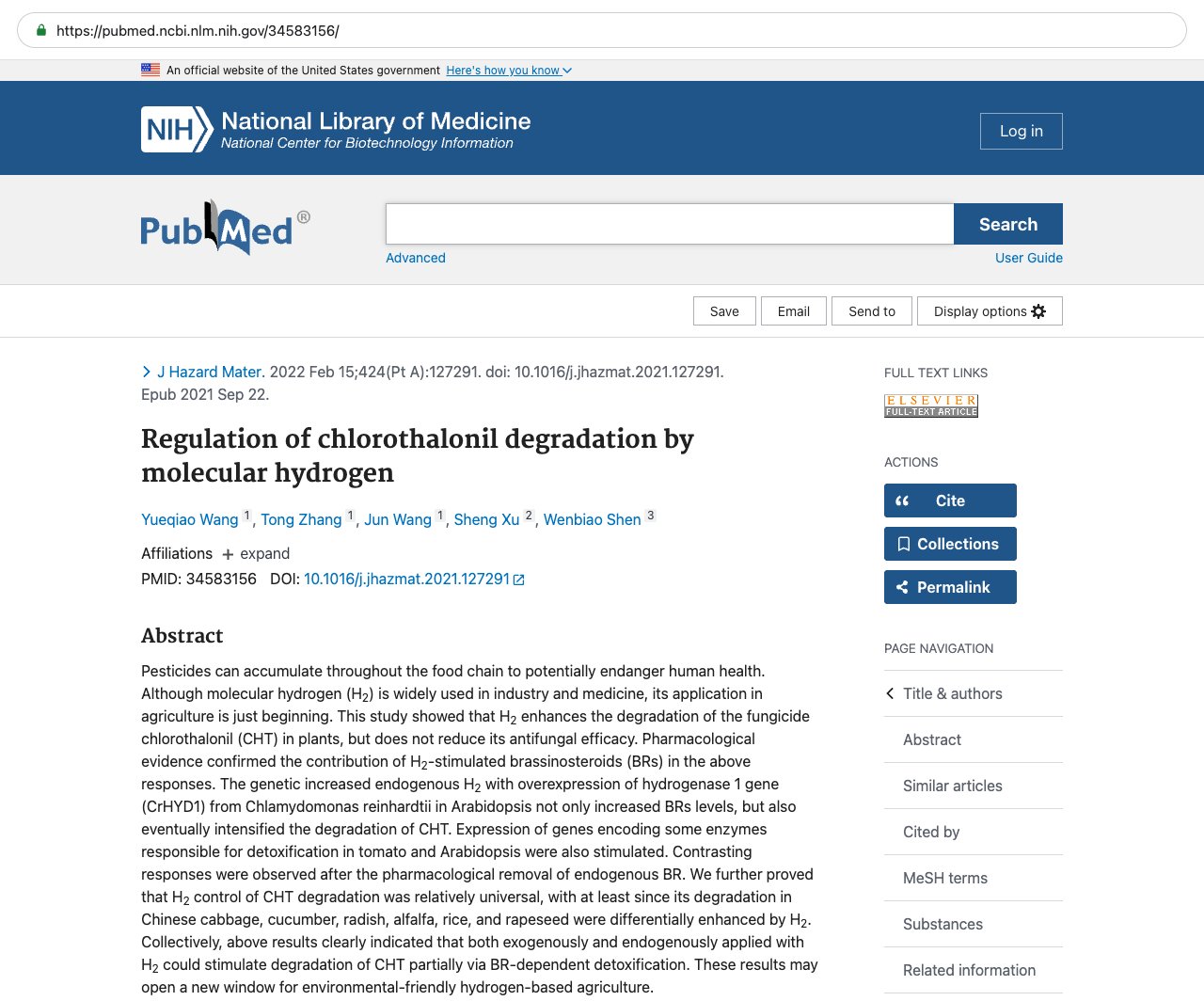
Pesticides can accumulate throughout the food chain to potentially endanger human health. Although molecular hydrogen (H2) is widely used in industry and medicine, its application in agriculture is just beginning. This study showed that H2 enhances the degradation of the fungicide chlorothalonil (CHT) in plants, but does not reduce its antifungal efficacy. Pharmacological evidence confirmed the contribution of H2-stimulated brassinosteroids (BRs) in the above responses. The genetic increased endogenous H2 with overexpression of hydrogenase 1 gene (CrHYD1) from Chlamydomonas reinhardtii in Arabidopsis not only increased BRs levels, but also eventually intensified the degradation of CHT. Expression of genes encoding some enzymes responsible for detoxification in tomato and Arabidopsis were also stimulated. Contrasting responses were observed after the pharmacological removal of endogenous BR. We further proved that H2 control of CHT degradation was relatively universal, with at least since its degradation in Chinese cabbage, cucumber, radish, alfalfa, rice, and rapeseed were differentially enhanced by H2. Collectively, above results clearly indicated that both exogenously and endogenously applied with H2 could stimulate degradation of CHT partially via BR-dependent detoxification. These results may open a new window for environmental-friendly hydrogen-based agriculture.
Source & links
Screenshot of the PubMed page
This page mirrors the published abstract (© the authors / publisher) for reference and citation. The canonical source is the PubMed record linked above. This is not medical advice.