1991 Journal of bone and mineral research : the official journal of the American Society for Bone and Mineral Research Pilot / Observational
1991 · Slemenda et al. — No evidence for an effect of lactase deficiency on bone mass in pre- or postmenopausal women
Super-Abstract
In 342 adult female twins, lactase deficiency showed no detectable negative effect on bone mass at any skeletal site. Interestingly, baseline exhaled hydrogen — a marker of gut bacterial activity — was positively associated with bone mass, independent of age. Breath hydrogen serves here as a diagnostic lactase-activity marker, not as a therapeutic agent. (Journal of Bone and Mineral Research, 1991.)
Commentary
This twin study addresses the hypothesis that lactase deficiency — common in adults — contributes to low bone mass through reduced calcium absorption from milk. The answer is clearly no: bone mass was virtually identical between lactase-deficient and lactase-sufficient women, even in a large twin-pair analysis that controls for genetics. The unexpected secondary finding — higher resting breath hydrogen linked to higher bone mass — is intriguing and may point to a role of colonic bacteria in bone metabolism, though this is speculative. Breath hydrogen throughout is a fermentation diagnostic tool, entirely unrelated to H₂ therapy.
Key quotes
- „In this large sample we could find no evidence of a detrimental effect of lactase deficiency on adult bone mass.“ — clear null finding — the main hypothesis is rejected
- „Baseline expired hydrogen was consistently and positively associated with bone mass at all sites, independently of age.“ — unexpected secondary finding — possible gut microbiome link to bone metabolism
- „The correlations between the increase in expired hydrogen and bone mass at various sites were between -0.02 (femoral neck) and 0.11 (midshaft radius), suggesting no association between these variables.“ — no relationship between lactase-induced hydrogen rise and bone mass
Our assessment
Important context: this study does not investigate molecular hydrogen (H₂) as a therapeutic intervention. Breath hydrogen is used as a diagnostic marker of lactase deficiency via the lactose breath hydrogen test — a standard gastroenterological screening tool. The study topic is bone metabolism and lactase genetics. Design: large twin study (n = 342), well-controlled for confounders. Limitations: cross-sectional design cannot establish causality; DZ twins only for discordant-pair analysis; the intriguing gut-bacteria/bone-mass association is exploratory and requires independent replication. Not relevant to H₂ therapy.
Study design
- Type: cross-sectional twin study · n: 342 adult female twins (pre- and postmenopausal) · H₂ delivery: none — lactose breath hydrogen test used as diagnostic lactase-deficiency marker
- Result: no difference in bone mass between lactase-deficient and normal women at any site; differences ≤ 1%; unexpected positive association between baseline breath hydrogen and bone mass at all sites (independent of age)
Abstract
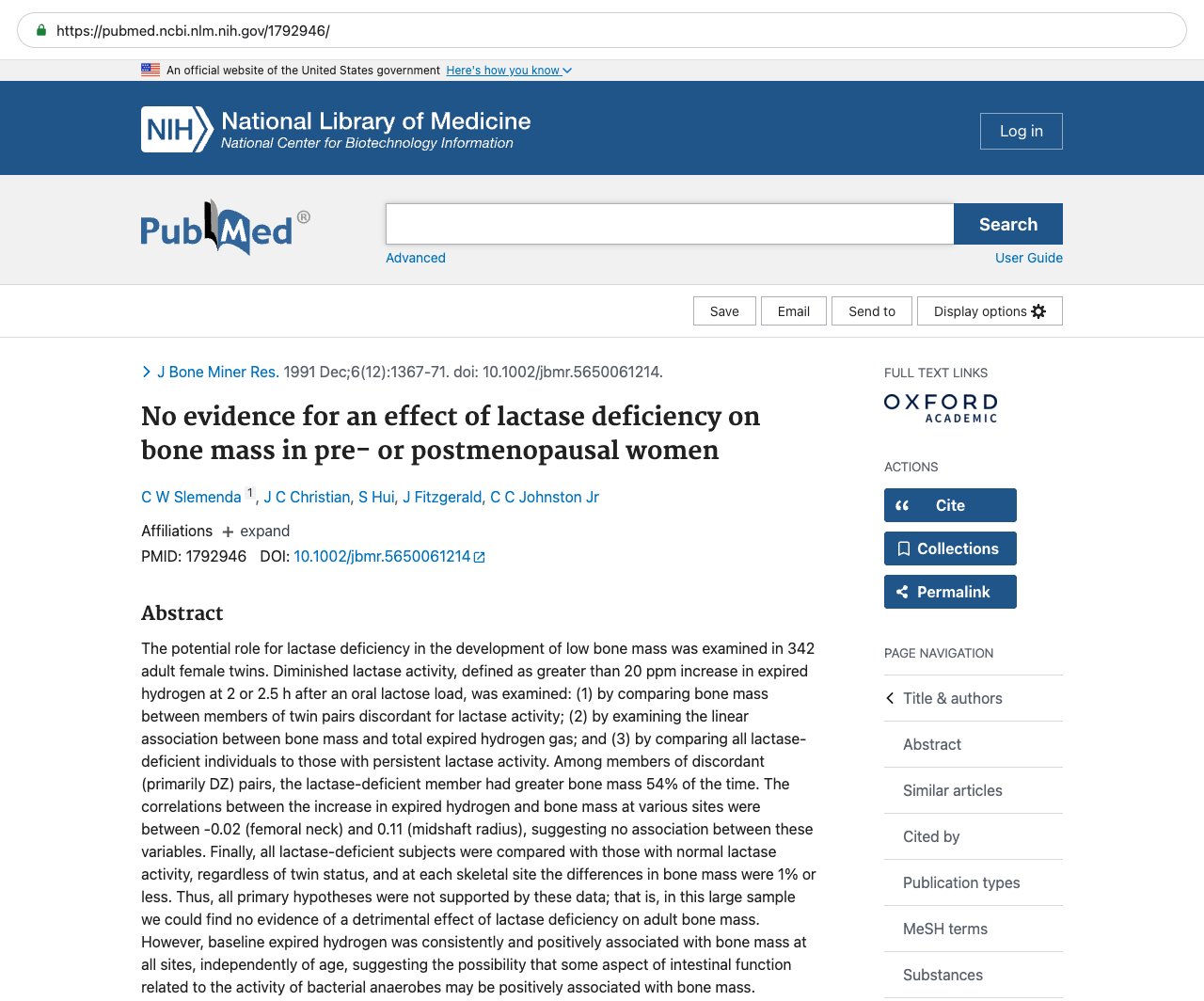
The potential role for lactase deficiency in the development of low bone mass was examined in 342 adult female twins. Diminished lactase activity, defined as greater than 20 ppm increase in expired hydrogen at 2 or 2.5 h after an oral lactose load, was examined: (1) by comparing bone mass between members of twin pairs discordant for lactase activity; (2) by examining the linear association between bone mass and total expired hydrogen gas; and (3) by comparing all lactase-deficient individuals to those with persistent lactase activity. Among members of discordant (primarily DZ) pairs, the lactase-deficient member had greater bone mass 54% of the time. The correlations between the increase in expired hydrogen and bone mass at various sites were between -0.02 (femoral neck) and 0.11 (midshaft radius), suggesting no association between these variables. Finally, all lactase-deficient subjects were compared with those with normal lactase activity, regardless of twin status, and at each skeletal site the differences in bone mass were 1% or less. Thus, all primary hypotheses were not supported by these data; that is, in this large sample we could find no evidence of a detrimental effect of lactase deficiency on adult bone mass. However, baseline expired hydrogen was consistently and positively associated with bone mass at all sites, independently of age, suggesting the possibility that some aspect of intestinal function related to the activity of bacterial anaerobes may be positively associated with bone mass.
Source & links
Screenshot of the PubMed page
This page mirrors the published abstract (© the authors / publisher) for reference and citation. The canonical source is the PubMed record linked above. This is not medical advice.