2020 · Benoit — Molecular Hydrogen Metabolism: a Widespread Trait of Pathogenic Bacteria and Protists
Super-Abstract
Over 200 known pathogens carry genes for hydrogenases — enzymes that let bacteria consume or produce H₂ gas as part of their energy metabolism. This comprehensive review shows that several major human pathogens, including Salmonella, Campylobacter, and Helicobacter pylori, exploit the large amounts of H₂ produced by the gut microbiome as a respiratory energy source — a trait that supports their growth and virulence. The authors also explore H₂ metabolism as a potential drug target. (Microbiology and Molecular Biology Reviews, 2020.)
Commentary
This is a landmark survey of a largely overlooked dimension of H₂ biology: not the therapeutic use of molecular hydrogen for the human host, but rather how pathogenic microorganisms themselves use H₂ as an energy currency in the gut. The review is broad and evidence-based, covering biochemistry, phylogeny, and physiology of hydrogenases across bacteria and protists. The practical implication for H₂ research is double-edged: colonic H₂ is a substrate that pathogens may exploit, which raises interesting questions about the interplay between dietary hydrogen production, gut microbiome composition, and infectious disease. The proposal to target hydrogenase pathways pharmacologically is speculative at this stage but scientifically sound as a hypothesis.
Key quotes
- „Several major human pathogens use the large amounts of H2 produced by colonic microbiota as an energy source for aerobic or anaerobic respiration.“ — the key mechanistic finding: pathogens harvest gut-derived H₂
- „This process has been shown to be critical for growth and virulence of the gastrointestinal bacteria Salmonella enterica serovar Typhimurium, Campylobacter jejuni, Campylobacter concisus, and Helicobacter pylori.“ — specific pathogens for which H₂ oxidation is virulence-relevant
- „We also evaluate H2 metabolism as a possible target for drug development or other therapies.“ — the forward-looking conclusion: hydrogenases as drug targets
Our assessment
This is a review article, not a clinical study. It synthesises existing literature on microbial H₂ metabolism — it does not test therapeutic hydrogen in humans or animals. The coverage is impressive in breadth, but the authors openly acknowledge that detailed mechanistic understanding is still lacking for most pathogens, especially obligate anaerobes. The proposal to use H₂ metabolism as a drug target is an early-stage hypothesis, not an established therapeutic avenue. Readers looking for evidence of H₂ supplementation benefits in humans will not find that here — the focus is on pathogen biology, not on therapeutic hydrogen for the host.
Study design
- Type: comprehensive narrative review · n: n/a (literature synthesis of >200 pathogen species) · H₂ context: endogenous microbial H₂ production and consumption (hydrogenase biochemistry)
- Result: >200 pathogens carry hydrogenase genes; ≥46 species experimentally shown to consume/produce H₂; H₂ oxidation critical for virulence in S. Typhimurium, C. jejuni, C. concisus, H. pylori; H₂ metabolism proposed as a pharmacological target
Abstract
Pathogenic microorganisms use various mechanisms to conserve energy in host tissues and environmental reservoirs. One widespread but often overlooked means of energy conservation is through the consumption or production of molecular hydrogen (H2). Here, we comprehensively review the distribution, biochemistry, and physiology of H2 metabolism in pathogens. Over 200 pathogens and pathobionts carry genes for hydrogenases, the enzymes responsible for H2 oxidation and/or production. Furthermore, at least 46 of these species have been experimentally shown to consume or produce H2 Several major human pathogens use the large amounts of H2 produced by colonic microbiota as an energy source for aerobic or anaerobic respiration. This process has been shown to be critical for growth and virulence of the gastrointestinal bacteria Salmonella enterica serovar Typhimurium, Campylobacter jejuni, Campylobacter concisus, and Helicobacter pylori (including carcinogenic strains). H2 oxidation is generally a facultative trait controlled by central regulators in response to energy and oxidant availability. Other bacterial and protist pathogens produce H2 as a diffusible end product of fermentation processes. These include facultative anaerobes such as Escherichia coli, S Typhimurium, and Giardia intestinalis, which persist by fermentation when limited for respiratory electron acceptors, as well as obligate anaerobes, such as Clostridium perfringens, Clostridioides difficile, and Trichomonas vaginalis, that produce large amounts of H2 during growth. Overall, there is a rich literature on hydrogenases in growth, survival, and virulence in some pathogens. However, we lack a detailed understanding of H2 metabolism in most pathogens, especially obligately anaerobic bacteria, as well as a holistic understanding of gastrointestinal H2 transactions overall. Based on these findings, we also evaluate H2 metabolism as a possible target for drug development or other therapies.
Source & links
Screenshot of the PubMed page
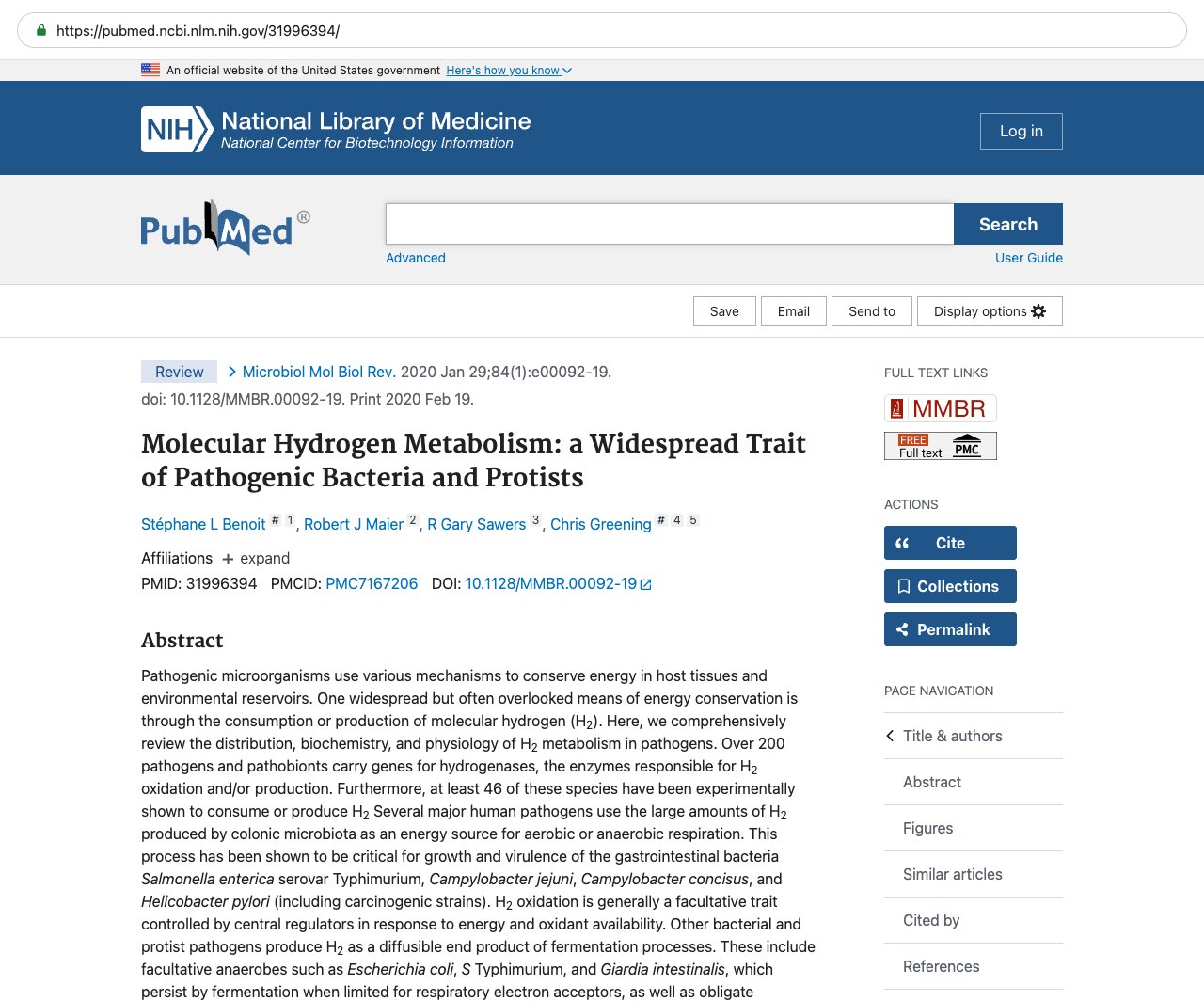
This page mirrors the published abstract (© the authors / publisher) for reference and citation. The canonical source is the PubMed record linked above. This is not medical advice.