2015 · Bhakat — Effect of T68A/N126Y mutations on the conformational and ligand binding landscape of Coxsackievirus B3 3C protease.
Super-Abstract
Computational modelling reveals how two point mutations in the Coxsackievirus B3 (CVB3) 3C protease weaken the enzyme's grip on its antiviral inhibitor — a structural basis for drug resistance. Molecular dynamics simulations show that the double mutation T68A/N126Y increases conformational flexibility and reduces binding free energy by approximately 3 kcal/mol. This is a purely computational, cell-free study with no animal or human data.
Commentary
This in-silico study uses molecular dynamics simulation and several post-dynamics analyses (PCA, hydrogen-bond occupancy, SASA, radius of gyration, RMSF) to characterise how the T68A/N126Y double mutation alters the CVB3 3C protease. The protease is essential for viral replication and is an established drug target. The study's value lies in mapping the structural basis of resistance: the mutations disrupt intra- and inter-molecular hydrogen bonds and lower van der Waals and electrostatic contributions at residues 68 and 126. Note that this paper has no direct connection to molecular hydrogen (H₂) biology — the term „hydrogen“ appears only in the context of conventional biochemical hydrogen bonds. The work is relevant to antiviral drug design against enteroviruses such as Coxsackievirus.
Key quotes
- „T68A/N126Y instigated an increased conformational flexibility due to the loss of intra- and inter-molecular hydrogen bond interactions and other prominent binding forces, which led to a decreased protease grip on the ligand (3CPI).“ — core mechanistic finding: how the mutations weaken inhibitor binding
- „The double mutations triggered a distortion orientation of 3CPI in the active site and decreases the binding energy, ΔG(bind) (∼3 kcal mol(-1)), compared to the wild type.“ — quantification of the binding-energy loss
- „The comprehensive molecular insight gained from this study should be of great importance in understanding the drug resistance against CVB3 3C protease; also, it will assist in the designing of novel Coxsackievirus B3 inhibitors with high ligand efficacy on resistant strains.“ — stated significance: structural roadmap for future antiviral drug design
Our assessment
This is a computational in-silico study — no cells, no animals, no humans were involved. Its results cannot be transferred directly to human biology or therapy. The study contributes to structural virology and antiviral drug design, not to molecular hydrogen (H₂) medicine. It appears in an H₂ research database solely because of keyword overlap with „hydrogen bonds,“ which are ubiquitous in biochemistry and unrelated to dissolved molecular H₂. The methodology is sound for its purpose, but the relevance to H₂ therapeutics is nil.
Study design
- Type: computational in-silico study · Model: molecular dynamics simulation of CVB3 3C protease (wild-type vs. T68A/N126Y double mutant) · H₂ relevance: none (only conventional hydrogen bonds discussed)
- Key analyses: MD simulation, post-dynamics binding free energy (MM-GBSA), PCA, hydrogen-bond occupancy, SASA, Rg, RMSF · Result: double mutant shows ~3 kcal/mol lower binding energy, increased flexibility, distorted inhibitor orientation in active site
Abstract
3C protease of Coxsackievirus B3 (CVB3) plays an essential role in the viral replication cycle, and therefore, emerged as an attractive therapeutic target for the treatment of human diseases caused by CVB3 infection. In this study, we report the first account of the molecular impact of the T68A/N126Y double mutant (Mutant(Bound)) using an integrated computational approach. Molecular dynamics simulation and post-dynamics binding free energy, principal component analysis (PCA), hydrogen bond occupancy, SASA, R(g) and RMSF confirm that T68A/N126Y instigated an increased conformational flexibility due to the loss of intra- and inter-molecular hydrogen bond interactions and other prominent binding forces, which led to a decreased protease grip on the ligand (3CPI). The double mutations triggered a distortion orientation of 3CPI in the active site and decreases the binding energy, ΔG(bind) (∼3 kcal mol(-1)), compared to the wild type (Wild(Bound)). The van der Waals and electrostatic energy contributions coming from residues 68 and 126 are lower for Mutant(Bound) when compared with Wild(Bound). In addition, variation in the overall enzyme motion as evident from the PCA, distorted hydrogen bonding network and loss of protein-ligand interactions resulted in a loss of inhibitor efficiency. The comprehensive molecular insight gained from this study should be of great importance in understanding the drug resistance against CVB3 3C protease; also, it will assist in the designing of novel Coxsackievirus B3 inhibitors with high ligand efficacy on resistant strains.
Source & links
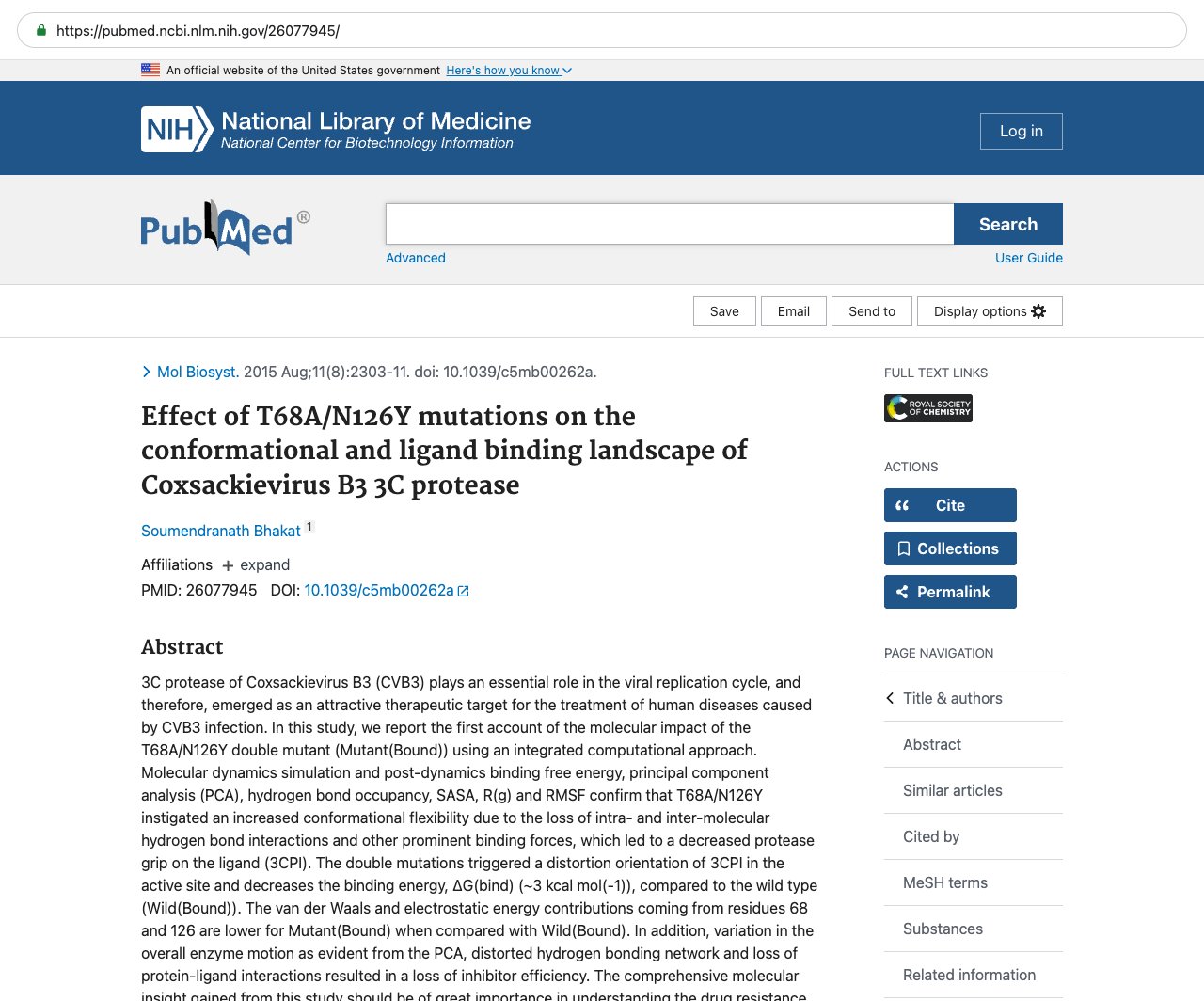
Screenshot of the PubMed page
This page mirrors the published abstract (© the authors / publisher) for reference and citation. The canonical source is the PubMed record linked above. This is not medical advice.