2016 · Chetty — Multi-Drug Resistance Profile of PR20 HIV-1 Protease Is Attributed to Distorted Conformational and Drug Binding Landscape: Molecular Dynamics Insights
Super-Abstract
This computational chemistry study analyzed how 20 mutations in the HIV-1 protease (PR20 variant) distort its structure and reduce drug binding, explaining the high multi-drug resistance of this variant. The study uses molecular dynamics simulation — intramolecular hydrogen bond networks are analyzed as part of the protein structure, not as molecular H₂ therapy. (Journal of Biomolecular Structure & Dynamics, 2016.)
Commentary
Chetty et al. performed extensive molecular dynamics (MD) simulations of wild-type and PR20 HIV-1 protease to understand how 20 simultaneous mutations confer extreme multi-drug resistance. Key findings: the PR20 variant spends more time in an open conformation, allowing bound inhibitors to diffuse away from the active site. Intramolecular hydrogen bond networks are disrupted, reducing inter-residue stability. MM/GBSA binding free energy calculations showed ~25 kcal/mol drop for a natural peptide substrate and ~5 kcal/mol for darunavir (a clinical HIV protease inhibitor). This is a pure computational structural biology study. The mention of „hydrogen bond“ refers to standard chemical bonds within the protein structure — there is no connection to molecular hydrogen (H₂) as a bioactive substance or to hydrogen medicine. This paper appears in the H₂ database exclusively due to keyword overlap.
Key quotes
- „The apo conformation of the PR20 variant of the HIV protease displayed a tendency to remain in the open conformation for a longer period of time when compared to the wild type.“ — structural explanation for reduced drug binding in the resistant variant
- „A diminished inter-residue hydrogen bond network and changes in inter-residue connections as a result of these mutations.“ — hydrogen bonds here = protein structural bonds, not H₂ therapy
- „Developing analogues of DRV by retaining its key pharmacophore features will be the way forward in the search for novel protease inhibitors against multi-drug resistant strains.“ — practical implication for HIV drug design
Our assessment
This is a computational structural biology study with no connection to hydrogen medicine or H₂ therapy. „Hydrogen bonds“ in this paper refer to standard chemical interactions within protein structure — a fundamental concept in structural biology with no relationship to molecular hydrogen (H₂) as a bioactive agent. The study is scientifically credible and relevant to HIV drug resistance, but completely outside the scope of H₂ medicine. Its presence in an H₂ database is a keyword-based false positive.
Study design
- Type: computational study (molecular dynamics simulation) · Model: wild-type and PR20 HIV-1 protease, in silico · Methods: comparative MD simulations, RMSF, radius of gyration, MM/GBSA binding free energy, residue interaction network analysis
- Result: PR20 adopts open conformation longer; inhibitors diffuse away from active site; ΔGbind drops ~25 kcal/mol (peptide substrate) and ~5 kcal/mol (darunavir); disrupted hydrogen bond network — no H₂ therapy component
Abstract
The PR20 HIV-1 protease, a variant with 20 mutations, exhibits high levels of multi-drug resistance; however, to date, there has been no report detailing the impact of these 20 mutations on the conformational and drug binding landscape at a molecular level. In this report, we demonstrate the first account of a comprehensive study designed to elaborate on the impact of these mutations on the dynamic features as well as drug binding and resistance profile, using extensive molecular dynamics analyses. Comparative MD simulations for the wild-type and PR20 HIV proteases, starting from bound and unbound conformations in each case, were performed. Results showed that the apo conformation of the PR20 variant of the HIV protease displayed a tendency to remain in the open conformation for a longer period of time when compared to the wild type. This led to a phenomena in which the inhibitor seated at the active site of PR20 tends to diffuse away from the binding site leading to a significant change in inhibitor-protein association. Calculating the per-residue fluctuation (RMSF) and radius of gyration, further validated these findings. MM/GBSA showed that the occurrence of 20 mutations led to a drop in the calculated binding free energies (ΔGbind) by ~25.17 kcal/mol and ~5 kcal/mol for p2-NC, a natural peptide substrate, and darunavir, respectively, when compared to wild type. Furthermore, the residue interaction network showed a diminished inter-residue hydrogen bond network and changes in inter-residue connections as a result of these mutations. The increased conformational flexibility in PR20 as a result of loss of intra- and inter-molecular hydrogen bond interactions and other prominent binding forces led to a loss of protease grip on ligand. It is interesting to note that the difference in conformational flexibility between PR20 and WT conformations was much higher in the case of substrate-bound conformation as compared to DRV. Thus, developing analogues of DRV by retaining its key pharmacophore features will be the way forward in the search for novel protease inhibitors against multi-drug resistant strains.
Source & links
Screenshot of the PubMed page
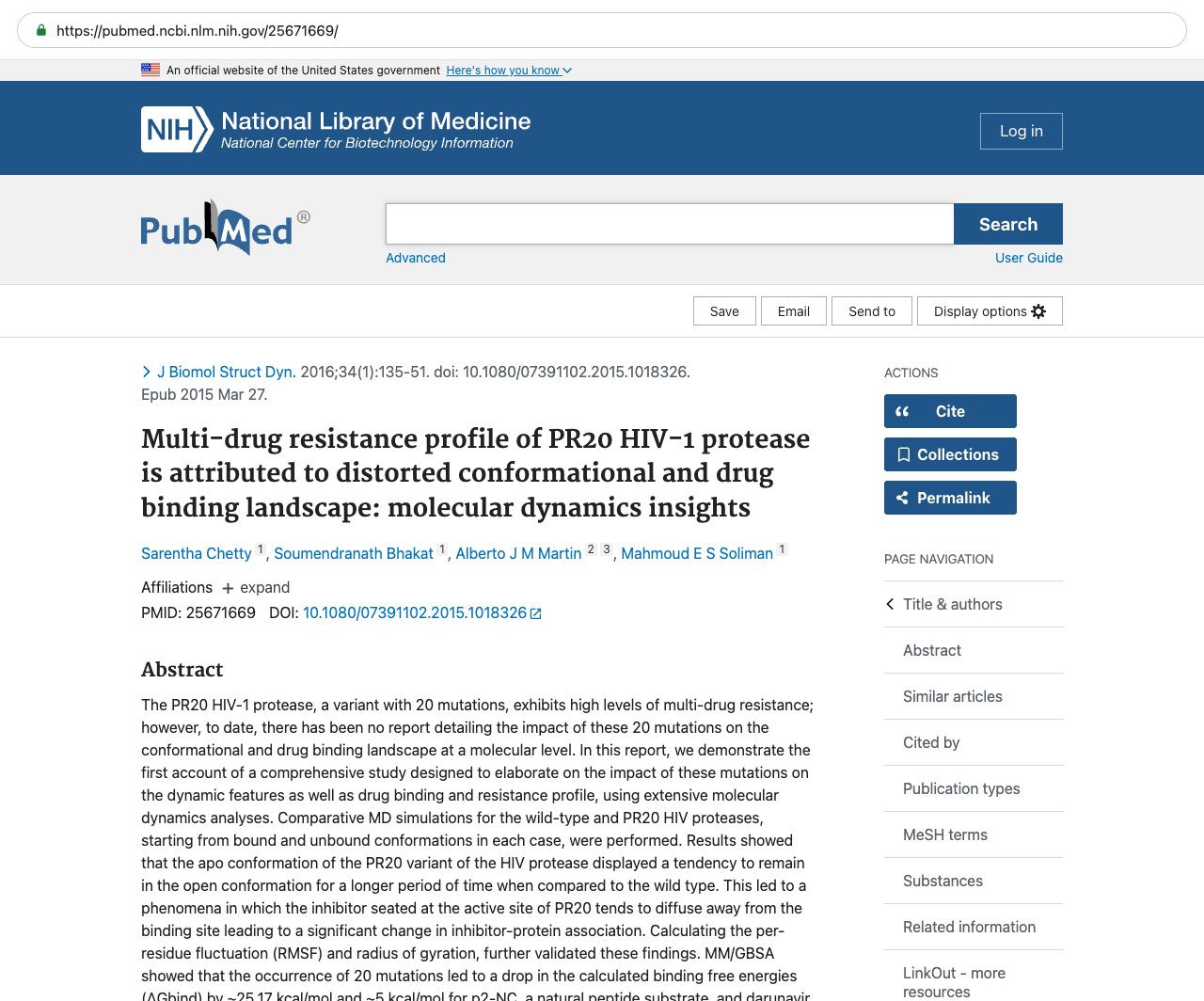
This page mirrors the published abstract (© the authors / publisher) for reference and citation. The canonical source is the PubMed record linked above. This is not medical advice.