2016 · Coplen — A revision in hydrogen isotopic composition of USGS42 and USGS43 human-hair stable isotopic reference materials for forensic science
Super-Abstract
This analytical chemistry paper revises the certified hydrogen isotope values of two international reference materials (USGS42 and USGS43) made from human hair, used in forensic stable isotope analysis. The revision corrects systematic measurement errors caused by hydrogen cyanide formation in older analytical methods. This paper has no connection to molecular hydrogen therapy or health applications. (Forensic Science International, 2016.)
Commentary
USGS42 and USGS43 are internationally recognised stable isotope reference materials made from human hair, used by forensic laboratories to calibrate measurements of hydrogen isotope ratios (δ²H) — for example to trace the geographic origin of crime-scene samples or unknown individuals. The paper identifies and corrects a systematic bias in the previous certified values: the older TC/EA (high-temperature conversion elemental analyser) method generated hydrogen cyanide (HCN) as a by-product when analysing nitrogen-bearing organic materials, leading to incomplete conversion of sample hydrogen into H₂ gas for mass spectrometric analysis and thus inaccurate δ²H values. A newer chromium-filled elemental analyser (Cr-EA) method avoids this artefact. The corrected values are approximately 5.7 mUr more positive than previously published. This is a technical metrological correction for an analytical chemistry reference standard — it has no relevance to molecular hydrogen as a biological or therapeutic agent.
Key quotes
- „The TC/EA IRMS method can produce inaccurate δ(2)HVSMOW-SLAP results when analyzing nitrogen-bearing organic substances owing to the formation of hydrogen cyanide (HCN), leading to non-quantitative conversion of a sample into molecular hydrogen (H2) for IRMS analysis.“ — the core analytical problem identified: HCN formation skews H₂ isotope measurements
- „Hot chromium scavenges all reactive elements except hydrogen.“ — why the Cr-EA method avoids the HCN artefact and gives more accurate H₂ measurements
- „On average, these revised δ(2)HVSMOW-SLAP values are 5.7 mUr more positive than those previously measured.“ — the magnitude of the correction applied to both reference materials
Our assessment
This paper is an analytical chemistry / forensic metrology study with no connection to molecular hydrogen as a health or therapeutic topic. The word „hydrogen” here refers to hydrogen stable isotopes used as forensic tracers — entirely different from H₂ supplementation biology. This paper does not provide any evidence for or against health effects of molecular hydrogen consumption. It is included in this database for completeness of the H₂ literature landscape, not as evidence of therapeutic relevance.
Study design
- Type: analytical/metrological method comparison study · n: two reference materials (USGS42, USGS43) analysed by TC/EA IRMS vs. Cr-EA IRMS · H₂ context: molecular hydrogen as IRMS analyte gas only — not biological H₂
- Result: Cr-EA IRMS produces more accurate δ²H values for nitrogen-bearing organic materials; corrected USGS42 and USGS43 values are ~5.7 mUr more positive than previously certified; correction recommended for all prior publications using these reference materials
Abstract
The hydrogen isotopic composition (δ(2)HVSMOW-SLAP) of USGS42 and USGS43 human hair stable isotopic reference materials, normalized to the VSMOW (Vienna-Standard Mean Ocean Water)-SLAP (Standard Light Antarctic Precipitation) scale, was originally determined with a high temperature conversion technique using an elemental analyzer (TC/EA) with a glassy carbon tube and glassy carbon filling and analysis by isotope-ratio mass spectrometer (IRMS). However, the TC/EA IRMS method can produce inaccurate δ(2)HVSMOW-SLAP results when analyzing nitrogen-bearing organic substances owing to the formation of hydrogen cyanide (HCN), leading to non-quantitative conversion of a sample into molecular hydrogen (H2) for IRMS analysis. A single-oven, chromium-filled, elemental analyzer (Cr-EA) coupled to an IRMS substantially improves the measurement quality and reliability of hydrogen isotopic analysis of hydrogen- and nitrogen-bearing organic material because hot chromium scavenges all reactive elements except hydrogen. USGS42 and USGS43 human hair isotopic reference materials have been analyzed with the Cr-EA IRMS method, and the δ(2)HVSMOW-SLAP values of their non-exchangeable hydrogen fractions have been revised: [Formula: see text] [Formula: see text] where mUr=0.001=‰. On average, these revised δ(2)HVSMOW-SLAP values are 5.7mUr more positive than those previously measured. It is critical that readers pay attention to the δ(2)HVSMOW-SLAP of isotopic reference materials in publications as they may need to adjust the δ(2)HVSMOW-SLAP measurement results of human hair in previous publications to ensure all results are on the same isotope-delta scale.
Source & links
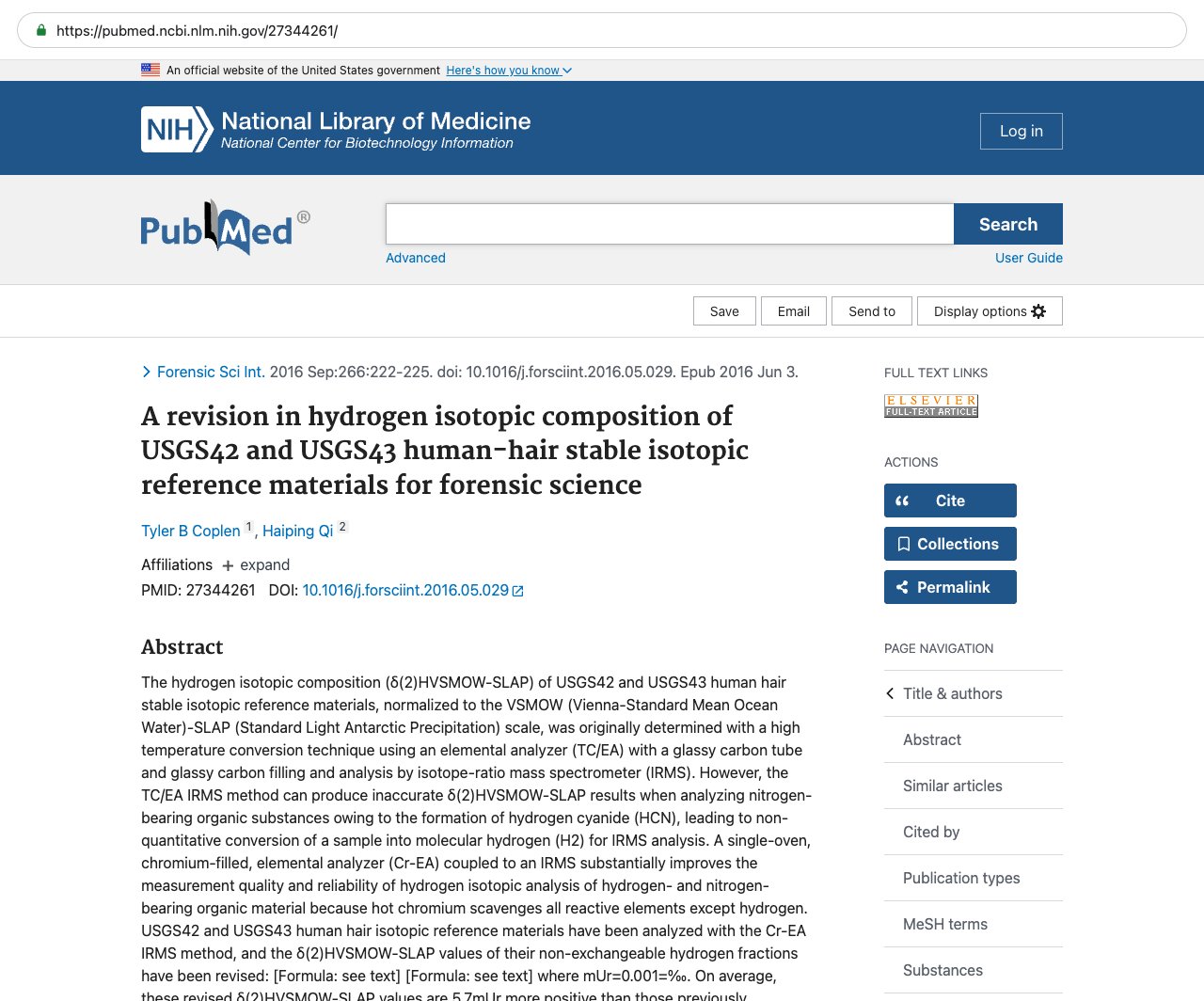
Screenshot of the PubMed page
This page mirrors the published abstract (© the authors / publisher) for reference and citation. The canonical source is the PubMed record linked above. This is not medical advice.