2018 · Karunakaran — A molecular dynamics approach to explore the structural characterisation of cataract causing mutation R58H on human γD crystallin
Super-Abstract
Using molecular dynamics simulations, researchers modelled how the R58H mutation in γD-crystallin — a lens protein — promotes protein misfolding and aggregation, potentially causing cataract. This is a computational protein-structure study with no connection to hydrogen medicine or H₂ therapy. (Molecular and Cellular Biochemistry, 2018.)
Commentary
This computational study used molecular dynamics (MD) simulations to model how a single amino acid substitution (arginine to histidine at position 58) affects the three-dimensional behaviour of γD-crystallin, a structural protein in the human lens. The R58H mutation increased intra-molecular hydrogen bonds, introduced α-helix secondary structure in a protein normally dominated by β-sheets, increased surface hydrophobicity, and showed unusual conformational dynamics in principal component analysis. These changes are proposed to drive protein aggregation and ultimately aculeiform cataract. The study has no connection whatsoever to hydrogen gas (H₂) therapy or molecular hydrogen supplementation. The word „hydrogen“ appears only in the context of hydrogen bonds between amino acids — a standard chemical concept entirely unrelated to H₂ medicine. This paper is in the database likely due to automatic keyword indexing.
Key quotes
- „Changes in the flexibility of residues favoured to increase the number of intra-molecular hydrogen bonds in mutant R58H.“ — the mutation alters protein flexibility and intra-molecular bonding — standard protein chemistry, not H₂ therapy
- „the increased surface hydrophobicity could be the cause of self-aggregation of mutant R58H leading to aculeiform cataract.“ — proposed mechanism for cataract formation from this mutation
- „mutant R58H showed unusual conformational dynamics along the two principal components when compared to the wild-type (WT)-γD crystallin.“ — the mutation destabilises the protein's normal structural behaviour
Our assessment
This paper has no relevance to H₂ medicine. It is a computational biophysics study about a cataract-associated lens protein mutation. The word „hydrogen“ in this context refers exclusively to hydrogen bonds between atoms in the protein — not molecular hydrogen (H₂). It is included for completeness of the literature record but contains no information about H₂ supplementation, antioxidant hydrogen, or human health benefits of H₂. No health conclusions of any kind can be drawn.
Study design
- Type: computational / theoretical study · Model: molecular dynamics (MD) simulation of wild-type and R58H mutant human γD-crystallin
- Methods: MD simulation, backbone RMSD analysis, hydrogen bond counting, secondary structure analysis, principal component analysis (PCA), surface hydrophobicity calculation
- Result: R58H mutation increases intra-molecular hydrogen bonds, introduces α-helix structure, increases surface hydrophobicity, shows destabilised conformational dynamics compared to wild-type — proposed as driver of aculeiform cataract
Abstract
The crystallins are a family of monomeric proteins present in the mammalian lens and mutations in these proteins cause various forms of cataracts. The aim of our current study is to emphasize the structural characterization of aggregation propensity of mutation R58H on γD crystallin using molecular dynamics (MD) approach. MD result revealed that difference in the sequence level display a wide variation in the backbone atomic position, and thus exhibits rigid conformational dynamics. Changes in the flexibility of residues favoured to increase the number of intra-molecular hydrogen bonds in mutant R58H. Moreover, notable changes in the hydrogen bonding interaction resulted to cause the misfolding of mutant R58H by introducing α-helix. Principal component analysis (PCA) result suggested that mutant R58H showed unusual conformational dynamics along the two principal components when compared to the wild-type (WT)-γD crystallin. In a nutshell, the increased surface hydrophobicity could be the cause of self-aggregation of mutant R58H leading to aculeiform cataract.
Source & links
Screenshot of the PubMed page
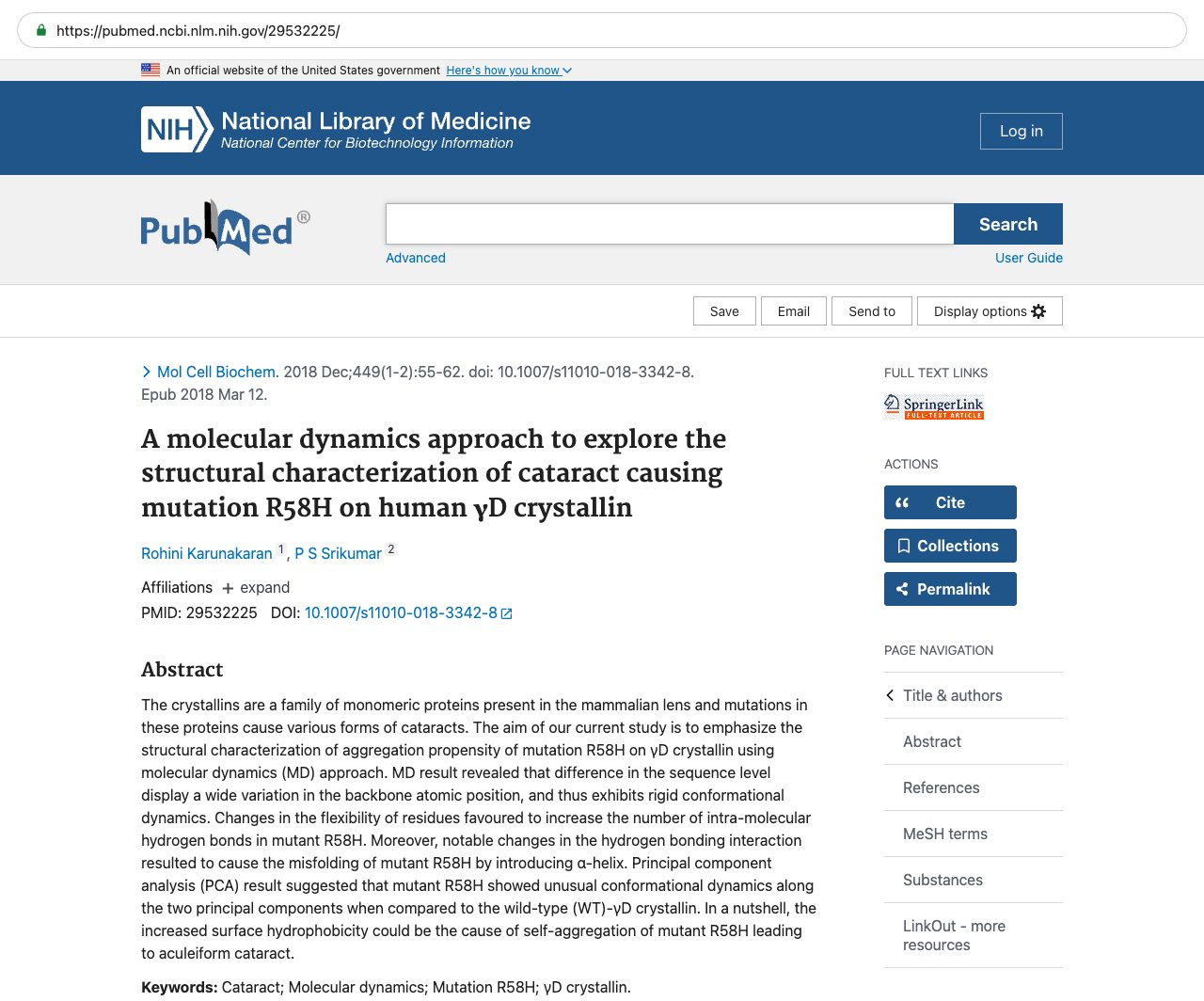
This page mirrors the published abstract (© the authors / publisher) for reference and citation. The canonical source is the PubMed record linked above. This is not medical advice.