2006 Proceedings of the National Academy of Sciences of the United States of America Review / Meta-analysis Unspecified
2006 · Klemperer — Interstellar chemistry
Super-Abstract
This theoretical review discusses the molecular chemistry of the interstellar medium, including the role of molecular hydrogen (H₂) and helium ionisation in driving the rich organic chemistry observed in galaxies. It is an astrophysics overview with no connection to biological or health-related applications of H₂.
Commentary
This paper is an editorial overview for a special PNAS issue on interstellar molecular chemistry. It discusses how radioastronomy has revealed a rich inventory of organic molecules in space, and outlines key processes: ionisation of abundant H₂ and atomic helium, secondary reactions, kinetic schemes governing molecular transformations, and the role of grain surfaces in interstellar chemistry. The molecular hydrogen discussed is purely an astrophysical species — the most abundant molecule in the universe — participating in interstellar ion-molecule reactions. There is absolutely no biological, medical, or nutritional dimension to this paper. It is included in this database presumably because it is indexed under hydrogen-related search terms.
Key quotes
- „Ionization of the very abundant molecular hydrogen and atomic helium followed by their secondary reactions is discussed.“ — H₂ here is an astrophysical molecule, not a biological agent
- „The rich variety of organic species observed is a challenge for complete understanding.“ — the complexity of interstellar organic chemistry
- „The role and nature of reactions involving grain surfaces as well as new spectroscopic observations of interstellar and circumstellar regions are topics presented in this special feature.“ — scope of the astrophysics special issue
Our assessment
This is an astrophysics review with no relevance whatsoever to biological effects of molecular hydrogen. H₂ appears only as the most abundant molecule in the universe, playing a role in interstellar ion-molecule chemistry. This paper provides no evidence of any kind regarding H₂ as a health or therapeutic agent.
Study design
- Type: theoretical/narrative review · Domain: astrophysics / astrochemistry · H₂ relevance: H₂ as the dominant molecule in the interstellar medium — no biological context
- Result: editorial overview of interstellar molecular chemistry; no experimental data; no biological endpoints
Abstract
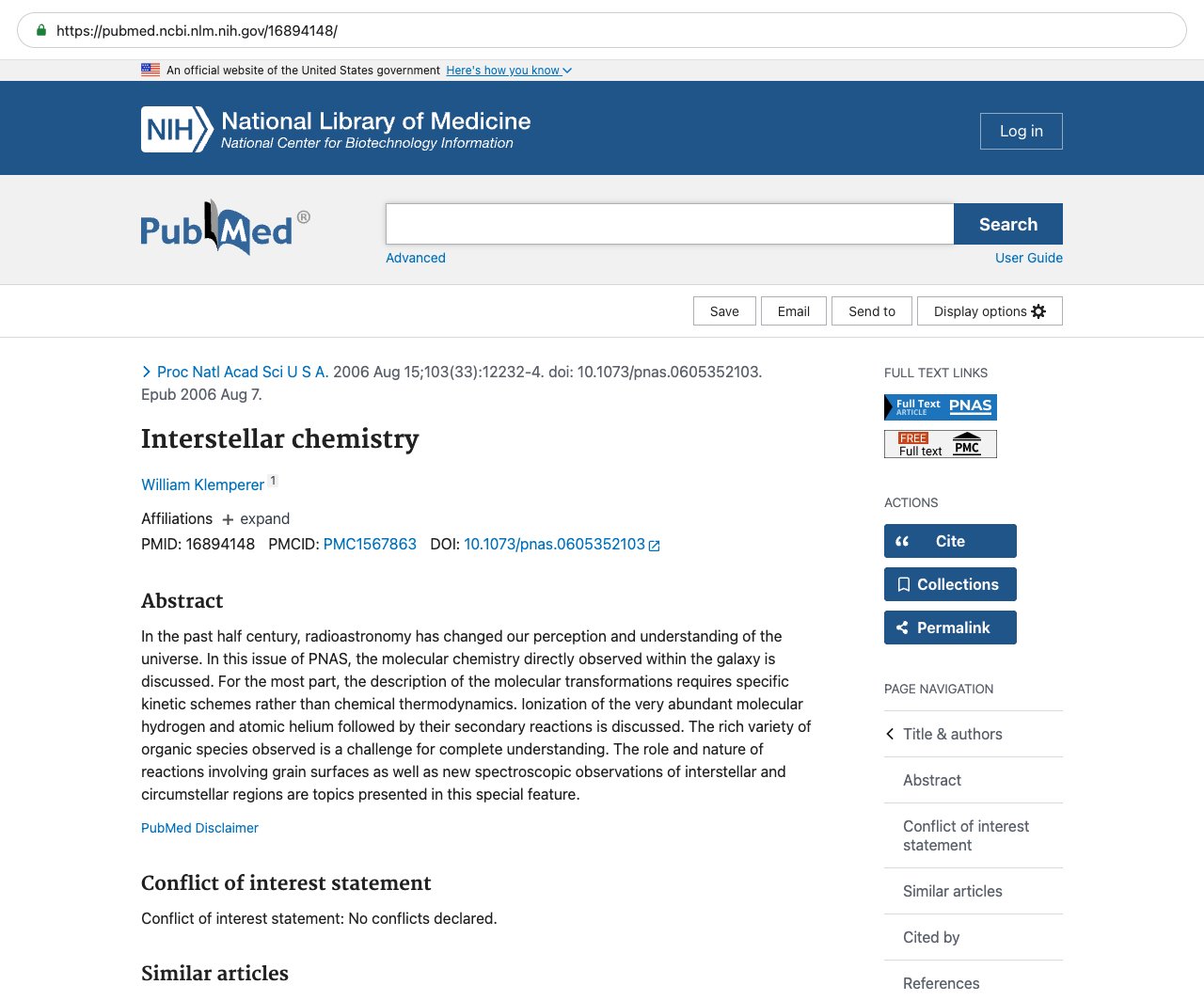
In the past half century, radioastronomy has changed our perception and understanding of the universe. In this issue of PNAS, the molecular chemistry directly observed within the galaxy is discussed. For the most part, the description of the molecular transformations requires specific kinetic schemes rather than chemical thermodynamics. Ionization of the very abundant molecular hydrogen and atomic helium followed by their secondary reactions is discussed. The rich variety of organic species observed is a challenge for complete understanding. The role and nature of reactions involving grain surfaces as well as new spectroscopic observations of interstellar and circumstellar regions are topics presented in this special feature.
Source & links
Screenshot of the PubMed page
This page mirrors the published abstract (© the authors / publisher) for reference and citation. The canonical source is the PubMed record linked above. This is not medical advice.