2016 · Lipinski — Rule of Five in 2015 and Beyond: Target and Ligand Structural Limitations, Ligand Chemistry Structure and Drug Discovery Project Decisions
Super-Abstract
This paper by the creator of the famous „Rule of Five“ (Ro5) re-examines the physicochemical limits of oral drug molecules and discusses how natural products — with their intramolecular hydrogen bonds — create exceptions to these rules. This is a drug discovery / medicinal chemistry theory paper with no connection to molecular hydrogen therapy.
Commentary
Christopher Lipinski's original „Rule of Five“ (1997) is one of the most cited principles in pharmaceutical chemistry: it describes the physicochemical profile (molecular weight, lipophilicity, hydrogen bond donor/acceptor counts) that predicts good oral drug bioavailability. This 2016 update revisits those rules in the context of modern targets — including more complex, larger molecules like macrocycles and natural product derivatives. The paper discusses intramolecular hydrogen bonding as a key mechanism that allows large, rule-breaking molecules (like cyclosporin A) to still achieve oral absorption through „molecular chameleon“ behaviour. The word „hydrogen“ in this paper refers exclusively to hydrogen bonds (–OH…N, –NH…O type chemical interactions in drug molecules) — a completely different concept from dissolved molecular hydrogen (H₂) gas. This paper has zero relevance to H₂ water, hydrogen inhalation, or any form of H₂ therapy.
Key quotes
- „Chemistry chameleon-like behavior of some NPs due to intra-molecular hydrogen bonding as exemplified by cyclosporine A is a strong contributor to NP Ro5 outliers.“ — intramolecular hydrogen bonds as a drug-chemistry concept — unrelated to H₂ therapy
- „The fragment derived, drug Navitoclax is an example of the extensive expertise, resources, time and key decisions required for the rare discovery of a non-NP Ro5 outlier.“ — illustrating the difficulty of developing drugs that violate the Rule of Five
- „Three of four parameters in Ro5 are fundamental to the structure of both target and drug binding sites.“ — the structural basis of why the Rule of Five works
Our assessment
This paper is entirely unrelated to molecular hydrogen (H₂) therapy. „Hydrogen“ in this context refers to hydrogen bonds in drug molecules — a standard concept of organic and medicinal chemistry, completely distinct from dissolved H₂ gas as a therapeutic agent. The Lipinski Ro5 paper is a classic reference in pharmaceutical sciences for oral drug design. Its inclusion in an H₂ health database appears to be a keyword-matching artefact (the word „hydrogen“ in the context of hydrogen bonding). Readers interested in H₂ therapy should disregard this entry.
Study design
- Type: theoretical/conceptual paper in medicinal chemistry · Topic: physicochemical rules for oral drug bioavailability (Rule of Five) · H₂ relevance: none — „hydrogen“ refers to hydrogen bonds in drug-protein interactions, not to molecular H₂
- Outcome: theoretical analysis; no experimental data; conclusion: Ro5 remains valid but natural product exceptions exist due to intramolecular hydrogen bonding (conformational flexibility)
Abstract
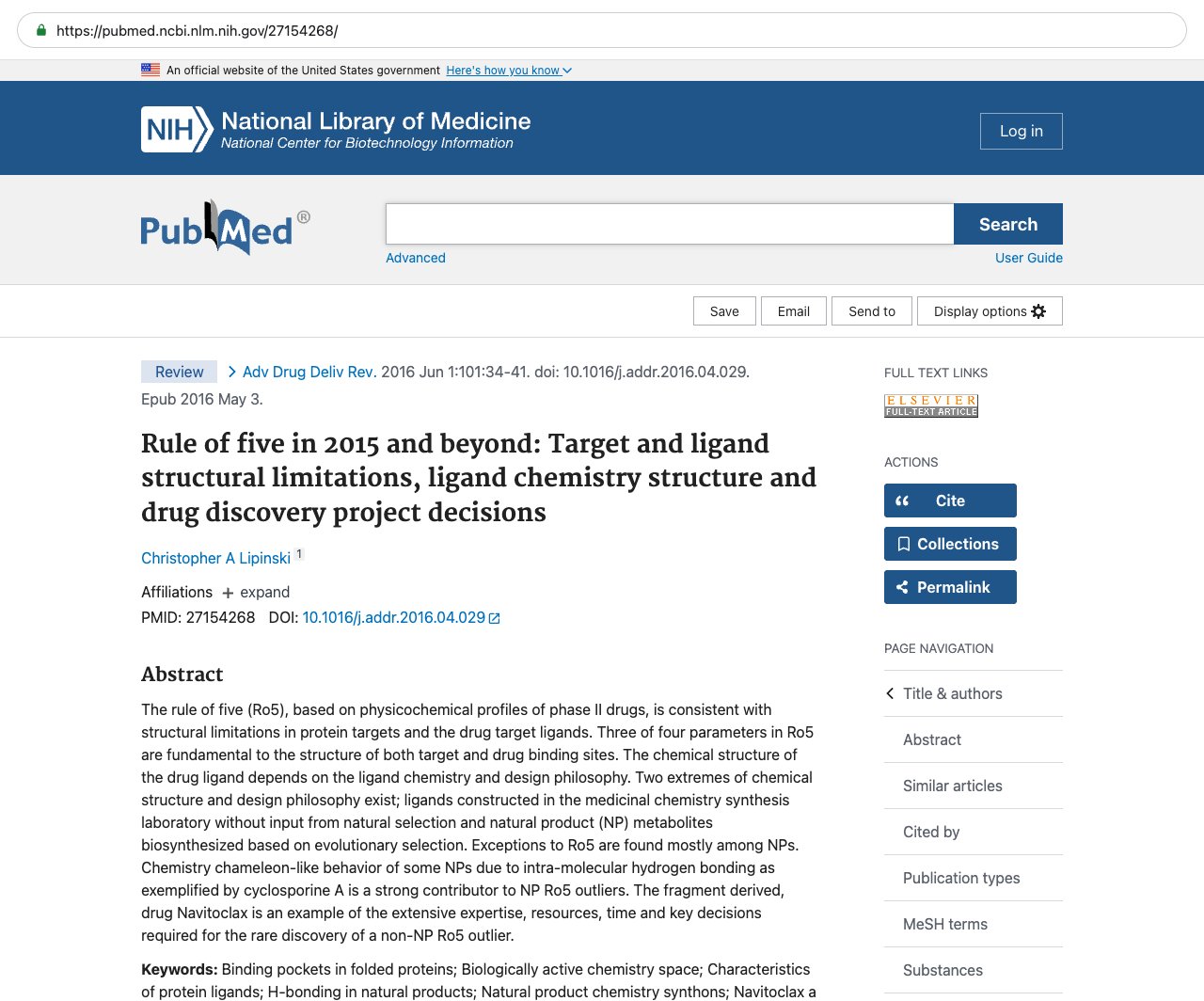
The rule of five (Ro5), based on physicochemical profiles of phase II drugs, is consistent with structural limitations in protein targets and the drug target ligands. Three of four parameters in Ro5 are fundamental to the structure of both target and drug binding sites. The chemical structure of the drug ligand depends on the ligand chemistry and design philosophy. Two extremes of chemical structure and design philosophy exist; ligands constructed in the medicinal chemistry synthesis laboratory without input from natural selection and natural product (NP) metabolites biosynthesized based on evolutionary selection. Exceptions to Ro5 are found mostly among NPs. Chemistry chameleon-like behavior of some NPs due to intra-molecular hydrogen bonding as exemplified by cyclosporine A is a strong contributor to NP Ro5 outliers. The fragment derived, drug Navitoclax is an example of the extensive expertise, resources, time and key decisions required for the rare discovery of a non-NP Ro5 outlier.
Source & links
Screenshot of the PubMed page
This page mirrors the published abstract (© the authors / publisher) for reference and citation. The canonical source is the PubMed record linked above. This is not medical advice.