2011 · Liu — Quinazolines with Intra-Molecular Hydrogen Bonding Scaffold (iMHBS) as PI3K/mTOR Dual Inhibitors
Super-Abstract
This medicinal chemistry study designs and synthesises a series of quinazoline molecules that use intra-molecular hydrogen bonding to form a pseudo-ring structure, acting as potent dual inhibitors of PI3K and mTOR — two kinases central to cancer cell proliferation and survival. The „hydrogen bonding“ in this paper refers to chemical bonds between atoms within drug molecules, not to molecular hydrogen (H₂) gas therapy. (Bioorganic & Medicinal Chemistry Letters, 2011.)
Commentary
PI3K (phosphoinositide 3-kinase) and mTOR (mechanistic target of rapamycin) are key signalling proteins in the PI3K/AKT/mTOR pathway, which is frequently overactivated in cancers. Dual PI3K/mTOR inhibitors are an active area of anticancer drug development. This study exploits intra-molecular hydrogen bonding (iMHBS) to constrain the conformation of quinazoline-based molecules, making them better fit the kinase active site — similar in principle to previously published pyrido[2,3-D]pyrimidin-7-one and pteridinone scaffolds. Crystal structure analysis in PI3Kγ enzyme confirmed the proposed binding mode. A novel synthetic route was also developed. This is a drug discovery chemistry paper. „Hydrogen bonding“ here is a fundamental chemical interaction between atoms — completely distinct from molecular hydrogen (H₂) as a therapeutic gas.
Key quotes
- „Intra-molecular hydrogen bonding was introduced to the quinazoline motif to form a pseudo ring (intra-molecular H-bond scaffold, iMHBS) to mimic our previous published core structures, pyrido[2.3-D]pyrimidin-7-one and pteridinone, as PI3K/mTOR dual inhibitors.“ — the design concept: using intramolecular H-bonding to rigidify drug scaffolds
- „This design results in potent PI3K/mTOR dual inhibitors and the purposed intra-molecular hydrogen bonding structure is well supported by co-crystal structure in PI3Kγ enzyme.“ — the key result: potent dual inhibitors confirmed by crystal structure
- „a novel synthetic route was developed for these analogs.“ — contribution to synthetic chemistry for this drug class
Our assessment
This is an in-vitro medicinal chemistry study. It has no connection to molecular hydrogen (H₂) therapy. The term „hydrogen“ in this paper refers exclusively to intra-molecular hydrogen bonds — a ubiquitous chemical interaction — within synthetic drug molecules. Honest note: this paper does not provide any evidence for or against H₂ water or H₂ gas as a health intervention. It is cancer drug discovery research and should not be cited in an H₂ medicine context.
Study design
- Type: in-vitro medicinal chemistry · Model: biochemical PI3K/mTOR kinase assays + PI3Kγ co-crystal structure · H₂ relevance: intra-molecular hydrogen bonds in drug design — completely unrelated to H₂ therapy
- Result: potent PI3K/mTOR dual inhibitors synthesised; binding mode confirmed by co-crystal structure; novel synthetic route established
Abstract
Intra-molecular hydrogen bonding was introduced to the quinazoline motif to form a pseudo ring (intra-molecular H-bond scaffold, iMHBS) to mimic our previous published core structures, pyrido[2.3-D]pyrimidin-7-one and pteridinone, as PI3K/mTOR dual inhibitors. This design results in potent PI3K/mTOR dual inhibitors and the purposed intra-molecular hydrogen bonding structure is well supported by co-crystal structure in PI3Kγ enzyme. In addition, a novel synthetic route was developed for these analogs.
Source & links
Screenshot of the PubMed page
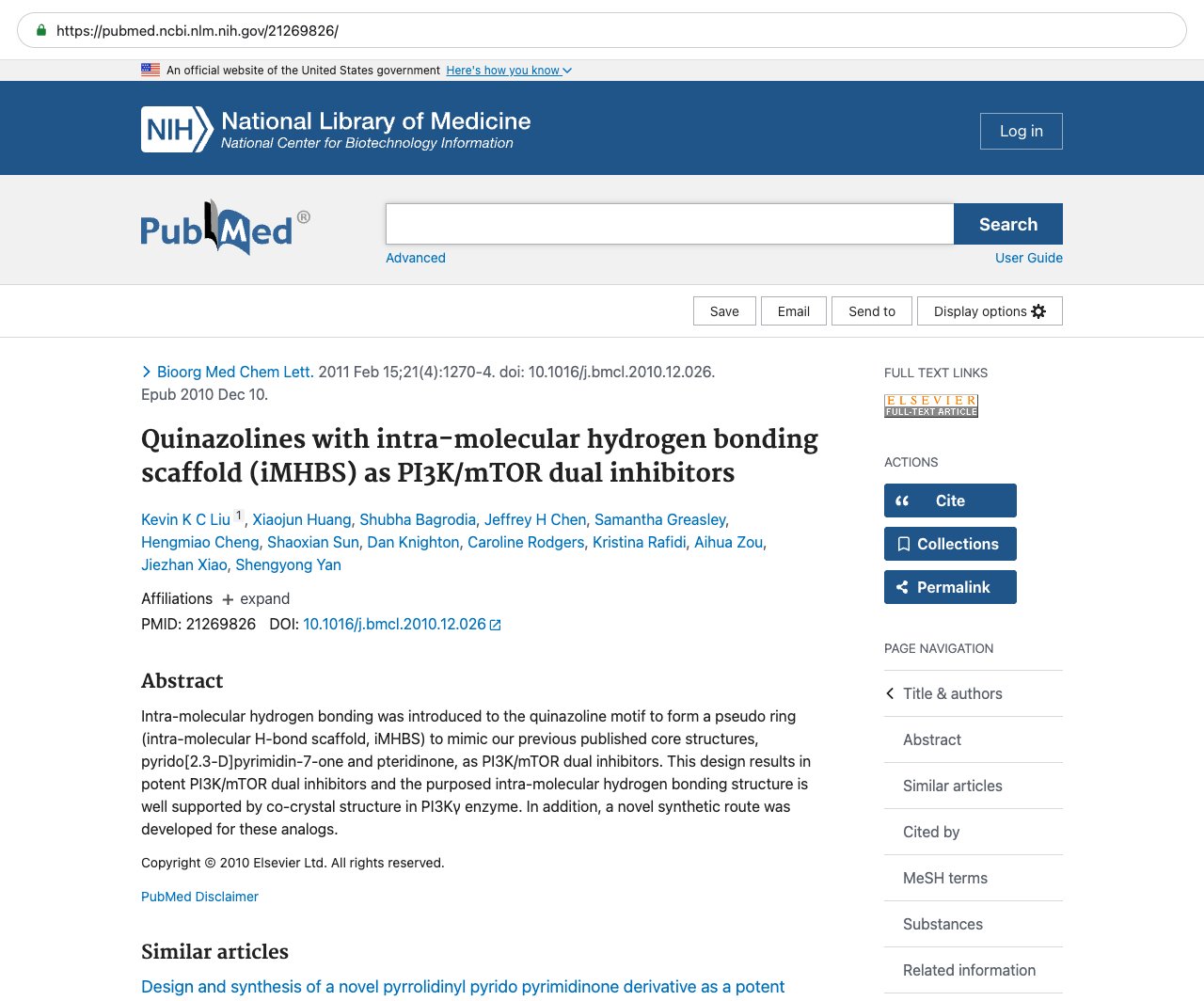
This page mirrors the published abstract (© the authors / publisher) for reference and citation. The canonical source is the PubMed record linked above. This is not medical advice.