1992 · McGown — Regeneration of Functional Hemoglobin from Iron(III) Hemoglobin by Reduction with Hydrogen and a Heterogeneous Catalyst
Super-Abstract
This in-vitro study showed that molecular hydrogen (H₂), together with a heterogeneous platinum catalyst embedded in an electroactive polymer, can reduce methemoglobin (iron(III)-hemoglobin) back to functional iron(II) hemoglobin — restoring oxygen-binding capacity with cooperative binding characteristics comparable to native hemoglobin. The approach avoids protein adsorption problems of bare platinum and allows easy removal of catalyst and by-products. (Analytical Biochemistry, 1992.)
Commentary
This is a biochemical proof-of-concept study demonstrating H₂'s capacity to reduce oxidized (ferric) hemoglobin to functional (ferrous) hemoglobin. The significance for hydrogen medicine lies in demonstrating that H₂ is a reactive reducing agent capable of interacting with iron-containing biological molecules — an early chemical demonstration of H₂ reactivity in a biologically relevant system. However, this is an in-vitro study using a specialized platinum-in-polymer catalyst under controlled laboratory conditions; it is not a physiological or clinical experiment. The slightly reduced Hill coefficients in regenerated hemoglobin are attributed to small irreversible oxidation during the initial autoxidation step.
Key quotes
- „Functional hemoglobin was regenerated from partially autoxidized hemoglobin by reduction with molecular hydrogen in the presence of a heterogeneous catalyst consisting of elemental platinum embedded in an electroactive polymer.“ — the experimental setup: H₂ plus platinum-in-polymer catalyst reduces methemoglobin
- „The regenerated hemoglobin displayed highly cooperative oxygen-binding characteristics. P50 values for oxidized-regenerated hemoglobin samples were not different from native hemoglobin.“ — the key outcome: oxygen-binding function fully restored
- „The heterogeneous catalyst avoids the problem of protein adsorption onto bare platinum.“ — a technical advantage of the polymer-embedded catalyst design
Our assessment
This is an in-vitro biochemistry study demonstrating H₂ as a reducing agent for methemoglobin — not a clinical or therapeutic study. The results confirm that H₂ can chemically reduce ferric hemoglobin under controlled in-vitro conditions, but these conditions are far from physiological and cannot be directly translated to human therapy. The study is historically interesting as an early demonstration of H₂ reactivity with biologically relevant iron-containing proteins. No therapeutic conclusions about H₂ supplementation should be drawn from this work.
Study design
- Type: in-vitro biochemistry study · Model: isolated human hemoglobin (partially autoxidized to methemoglobin) · H₂ delivery: molecular H₂ gas with heterogeneous platinum-in-electroactive-polymer catalyst
- Result: functional hemoglobin regenerated; visible spectrum identical to native iron(II) hemoglobin; P50 values unchanged vs. native; Hill coefficients slightly reduced (attributed to irreversible oxidation artifacts); catalyst easily removed; H⁺ by-product buffered
Abstract
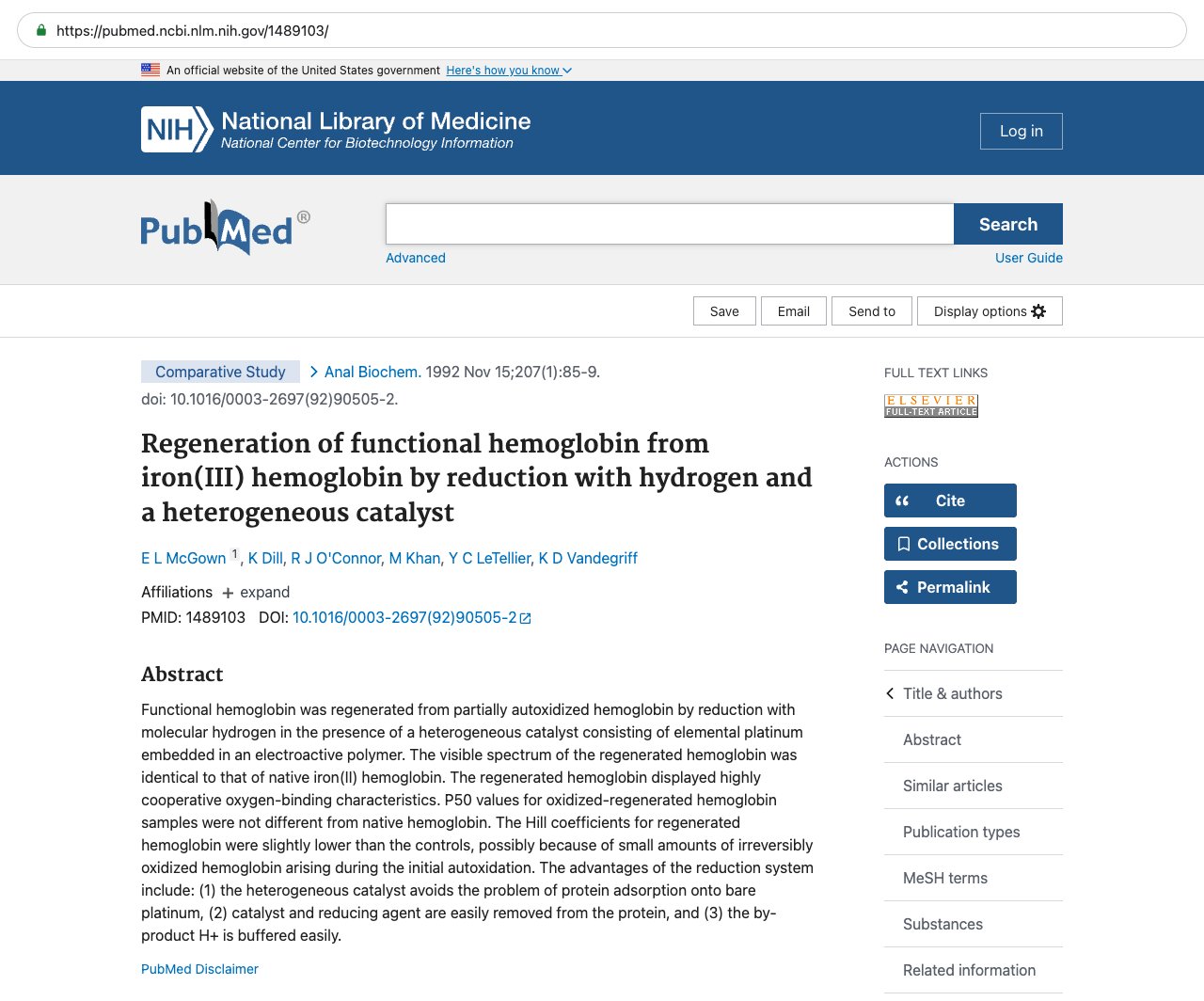
Functional hemoglobin was regenerated from partially autoxidized hemoglobin by reduction with molecular hydrogen in the presence of a heterogeneous catalyst consisting of elemental platinum embedded in an electroactive polymer. The visible spectrum of the regenerated hemoglobin was identical to that of native iron(II) hemoglobin. The regenerated hemoglobin displayed highly cooperative oxygen-binding characteristics. P50 values for oxidized-regenerated hemoglobin samples were not different from native hemoglobin. The Hill coefficients for regenerated hemoglobin were slightly lower than the controls, possibly because of small amounts of irreversibly oxidized hemoglobin arising during the initial autoxidation. The advantages of the reduction system include: (1) the heterogeneous catalyst avoids the problem of protein adsorption onto bare platinum, (2) catalyst and reducing agent are easily removed from the protein, and (3) the by-product H+ is buffered easily.
Source & links
Screenshot of the PubMed page
This page mirrors the published abstract (© the authors / publisher) for reference and citation. The canonical source is the PubMed record linked above. This is not medical advice.