1999 · Nakayama — CTAB-mediated enrichment for active forms of novel dimeric maxizymes.
Super-Abstract
This in-vitro study shows that the cationic detergent CTAB dramatically enhances the activity of dimeric ribozymes called maxizymes, by promoting the conversion of inactive conformations into active forms. In the most striking case, the activity of the least stable maxizyme was enhanced 100-fold. The „hydrogen“ connection is limited to hydrogen bonds stabilising inactive RNA conformations that CTAB disrupts. (FEBS Letters, 1999.)
Commentary
This biochemistry study by Nakayama and colleagues explores how to improve the activity of shortened hammerhead ribozymes (maxizymes) — RNA molecules designed to cleave specific target sequences and potentially inactivate genes. CTAB, a strand-displacement-promoting detergent, converts inactive intramolecular hydrogen-bonded RNA folds into the active dimeric form. The study is relevant to gene therapy and RNA biochemistry. The „hydrogen“ in this paper refers exclusively to intramolecular hydrogen bonds in RNA secondary structure — there is no connection whatsoever to molecular H₂ gas or H₂ therapy.
Key quotes
- „CTAB instead enhanced the activity of a variety of maxizymes, with the extent of enhancement depending on the conditions.“ — unexpected positive result: CTAB enhances maxizyme activity rather than inhibiting it
- „The strand displacement activity of CTAB thus appears to enhance the conversion of alternative conformations of inactive maxizymes, with intra- and inter-molecular hydrogen bonds, to active forms.“ — mechanism: CTAB disrupts hydrogen-bonded inactive folds — note: hydrogen bonds, not H₂ gas
- „The activity of our least stable, least active maxizyme was enhanced 100-fold by CTAB.“ — magnitude of effect: up to 100-fold enhancement
Our assessment
This is a basic in-vitro RNA biochemistry study with no relevance to molecular H₂ therapy. The mention of „hydrogen“ refers to intramolecular hydrogen bonds in RNA secondary structure — a completely different chemical phenomenon from molecular H₂ gas. The study is of interest for gene therapy and RNA engineering. Readers looking for H₂ health evidence will find nothing relevant here. The inclusion in a hydrogen database appears to be a false-positive keyword match.
Study design
- Type: in-vitro RNA biochemistry · Model: maxizymes (shortened hammerhead ribozymes) — cell-free system + cell culture validation · H₂ relevance: none — hydrogen refers to intramolecular H-bonds in RNA
- Result: CTAB enhanced maxizyme activity up to 100-fold by converting inactive H-bonded conformers to active dimers; validated in cell culture as gene-silencing agent
Abstract
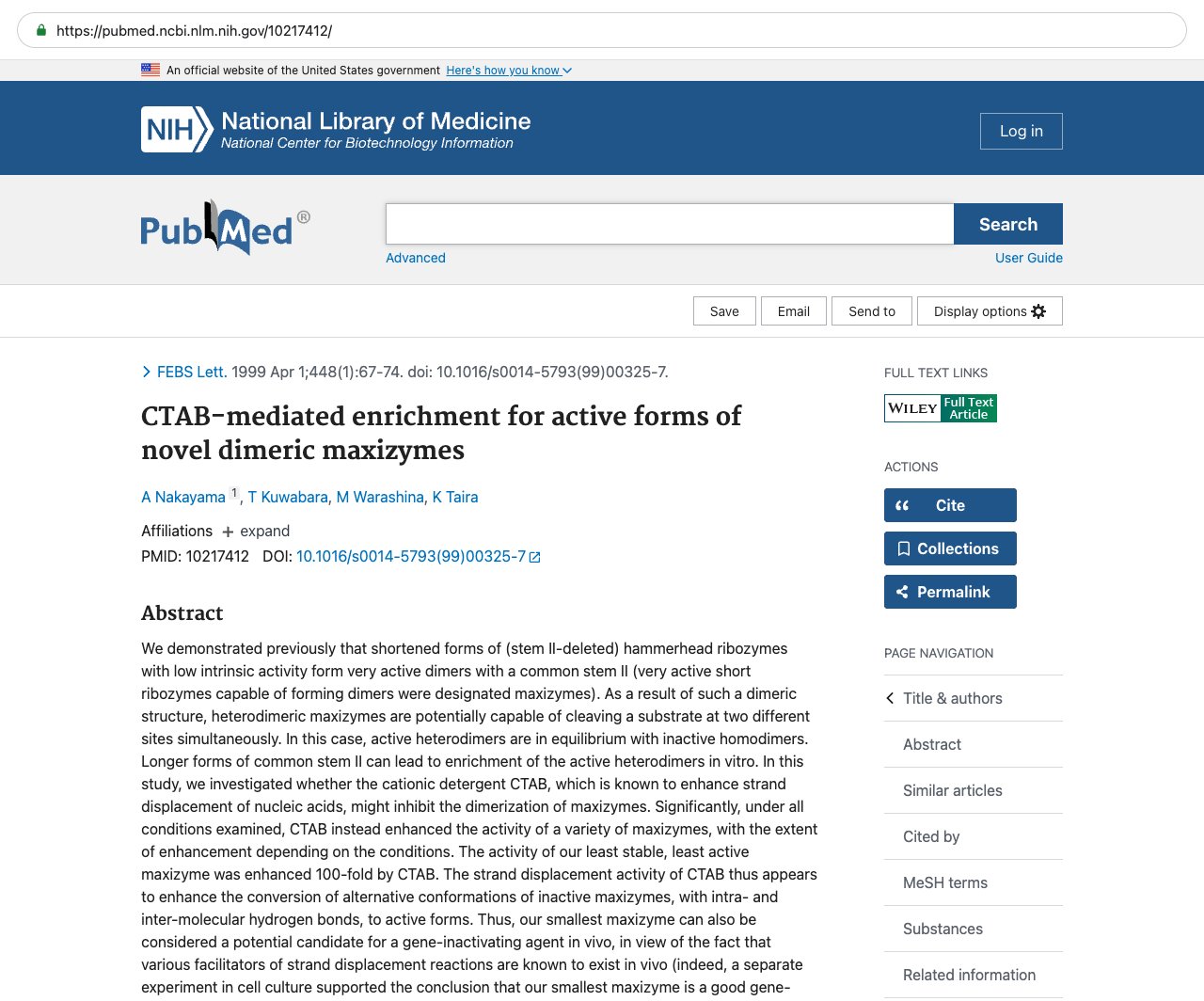
We demonstrated previously that shortened forms of (stem II-deleted) hammerhead ribozymes with low intrinsic activity form very active dimers with a common stem II (very active short ribozymes capable of forming dimers were designated maxizymes). As a result of such a dimeric structure, heterodimeric maxizymes are potentially capable of cleaving a substrate at two different sites simultaneously. In this case, active heterodimers are in equilibrium with inactive homodimers. Longer forms of common stem II can lead to enrichment of the active heterodimers in vitro. In this study, we investigated whether the cationic detergent CTAB, which is known to enhance strand displacement of nucleic acids, might inhibit the dimerization of maxizymes. Significantly, under all conditions examined, CTAB instead enhanced the activity of a variety of maxizymes, with the extent of enhancement depending on the conditions. The activity of our least stable, least active maxizyme was enhanced 100-fold by CTAB. The strand displacement activity of CTAB thus appears to enhance the conversion of alternative conformations of inactive maxizymes, with intra- and inter-molecular hydrogen bonds, to active forms. Thus, our smallest maxizyme can also be considered a potential candidate for a gene-inactivating agent in vivo, in view of the fact that various facilitators of strand displacement reactions are known to exist in vivo (indeed, a separate experiment in cell culture supported the conclusion that our smallest maxizyme is a good gene-inactivating agent). Although activities of ribozymes in vitro do not necessarily reflect their activities in vivo, our findings suggest that the activity of ribozymes in vivo can be better estimated by running ribozyme kinetics in the presence of CTAB in vitro.
Source & links
Screenshot of the PubMed page
This page mirrors the published abstract (© the authors / publisher) for reference and citation. The canonical source is the PubMed record linked above. This is not medical advice.