2016 · Ostojic — Is Melanin a Source of Bioactive Molecular Hydrogen?
Super-Abstract
This theoretical paper proposes that melanin — the pigment in human skin, hair, and eyes — may act as a natural biological source of molecular hydrogen (H₂) in the body. It is a hypothesis paper with no experimental data; the abstract is not publicly available for this record. (Pharmacological Research, 2016.)
Commentary
Ostojic raises an intriguing theoretical question: could the human body produce bioactive molecular hydrogen endogenously through melanin? Melanin is known to undergo photochemical reactions and has redox-active properties. If it can generate H₂ under physiological conditions, this would have implications for understanding natural antioxidant defense and might explain some of the broad tissue distribution of H₂ effects. This is a speculative hypothesis paper — the full abstract is not available in this record (empty abstract field), so the precise arguments and any supporting evidence cannot be fully evaluated. Without access to the complete text, it is not possible to assess the quality or plausibility of the proposed mechanism. The topic is scientifically novel and the DOI is available for full-text access.
Key quotes
- „Is melanin a source of bioactive molecular hydrogen?“ — the paper's central research question — the title itself states the hypothesis
Our assessment
This is a theoretical/hypothesis paper — not an experimental study and not a human trial. The abstract is empty in this database record, making a complete scientific evaluation impossible here. The hypothesis that melanin could generate bioactive H₂ is novel and potentially interesting, but unverified. No experimental evidence, no clinical data, no conclusions about therapeutic H₂ can be drawn from this record. Readers interested in the full argument should consult the paper directly via its DOI (10.1016/j.phrs.2015.12.002).
Study design
- Type: theoretical/hypothesis paper · Model: not applicable (conceptual analysis) · H₂ angle: endogenous H₂ production from melanin as proposed mechanism
- Result: no experimental data available in this record; abstract empty — full paper required for complete evaluation
Source & links
Screenshot of the PubMed page
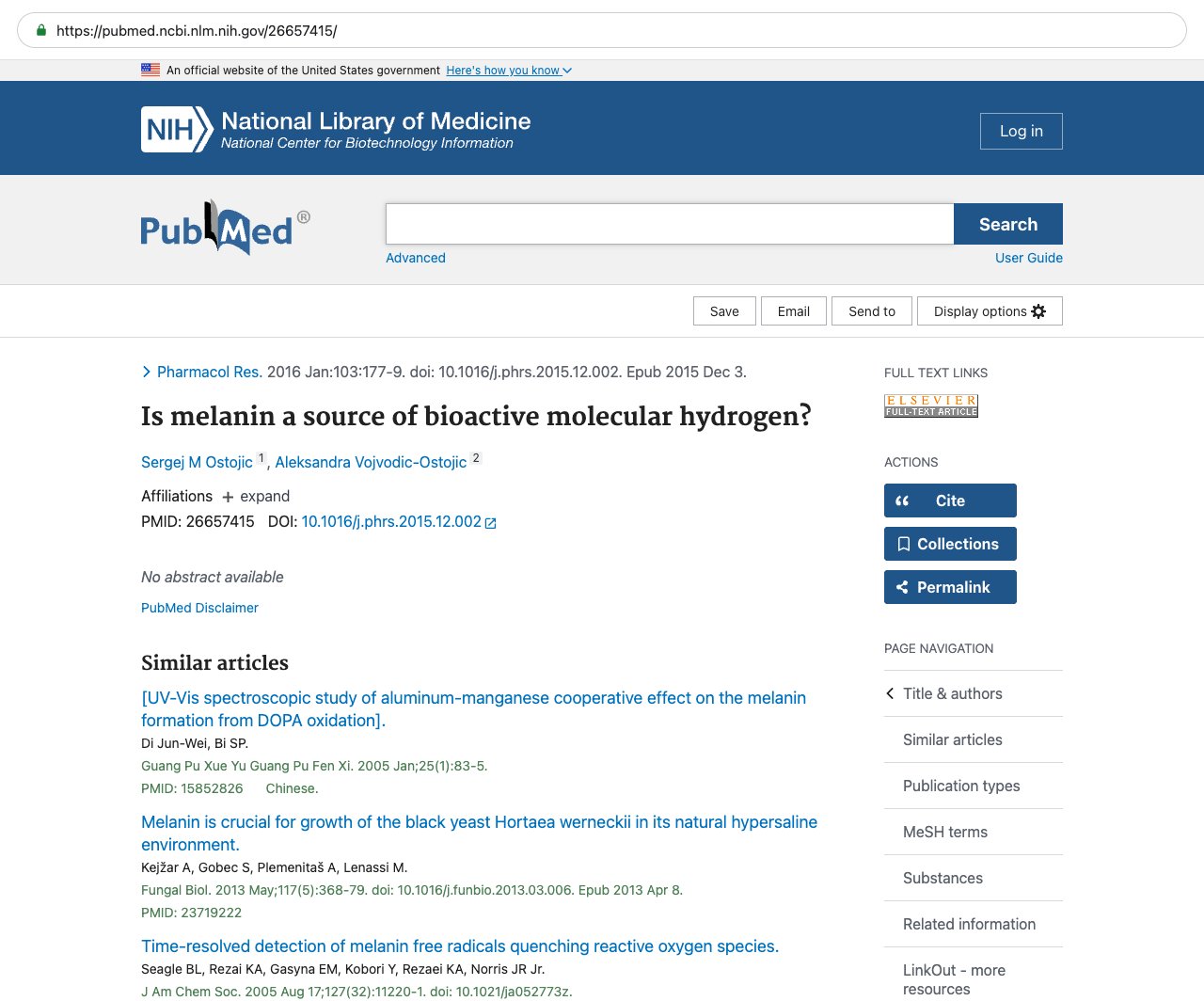
This page mirrors the published abstract (© the authors / publisher) for reference and citation. The canonical source is the PubMed record linked above. This is not medical advice.