2010 · Qian — The hypothesis of an effective safe and novel radioprotective agent: hydrogen-rich solution.
Super-Abstract
This theory paper proposes that hydrogen-rich saline could serve as a safe radioprotective agent — protecting cells from ionising radiation damage by selectively scavenging hydroxyl radicals. The authors note that most radiation damage is caused by reactive oxygen species, and that H₂-rich saline is far safer than explosive H₂ gas, making it a potentially practical clinical tool. This is a theoretical proposal, not an experimental study.
Commentary
Published in West Indian Medical Journal in 2010, this brief hypothesis paper draws a logical parallel: classical radioprotectors like amifostine work by scavenging reactive oxygen species (ROS), and H₂ has been shown in preclinical models to selectively neutralise the most destructive ROS (hydroxyl radicals and peroxynitrite). The authors therefore propose H₂-rich physiological saline as a candidate radioprotector. The argument is mechanistically coherent but entirely speculative at this stage — no animal experiments or cell data specific to radiation are presented. The safety argument (avoiding explosive H₂ gas by using dissolved H₂ in saline) is practically important and well-reasoned.
Key quotes
- „Most ionizing radiation-induced damage is caused by radical oxygen species (ROS).“ — the radiobiological premise underpinning the hypothesis
- „We hypothesize that hydrogen may be an effective, specific and novel radioprotective agent.“ — the central claim — explicitly framed as a hypothesis, not a finding
- „H2 is explosive, while hydrogen-rich solution (solution such as physiological saline saturated with molecular hydrogen) is safer.“ — the practical safety argument for using H₂-saturated saline over gaseous H₂
Our assessment
This is a preclinical theory paper — it contains no experimental data and makes no human health claims. The mechanistic reasoning (radiation → ROS → hydroxyl radicals → H₂ as selective scavenger) is plausible and scientifically grounded in the broader H₂ literature, but the specific application to radiation protection had not been tested at the time of writing. This is not evidence that H₂ saline protects humans from radiation; it is a reasoned call for experimental investigation.
Study design
- Type: theory/hypothesis paper · n: n/a (no experimental data) · H₂ delivery: H₂-saturated physiological saline (proposed)
- Result: theoretical proposal that H₂-rich saline may scavenge radiation-induced hydroxyl radicals; no empirical findings reported
Abstract
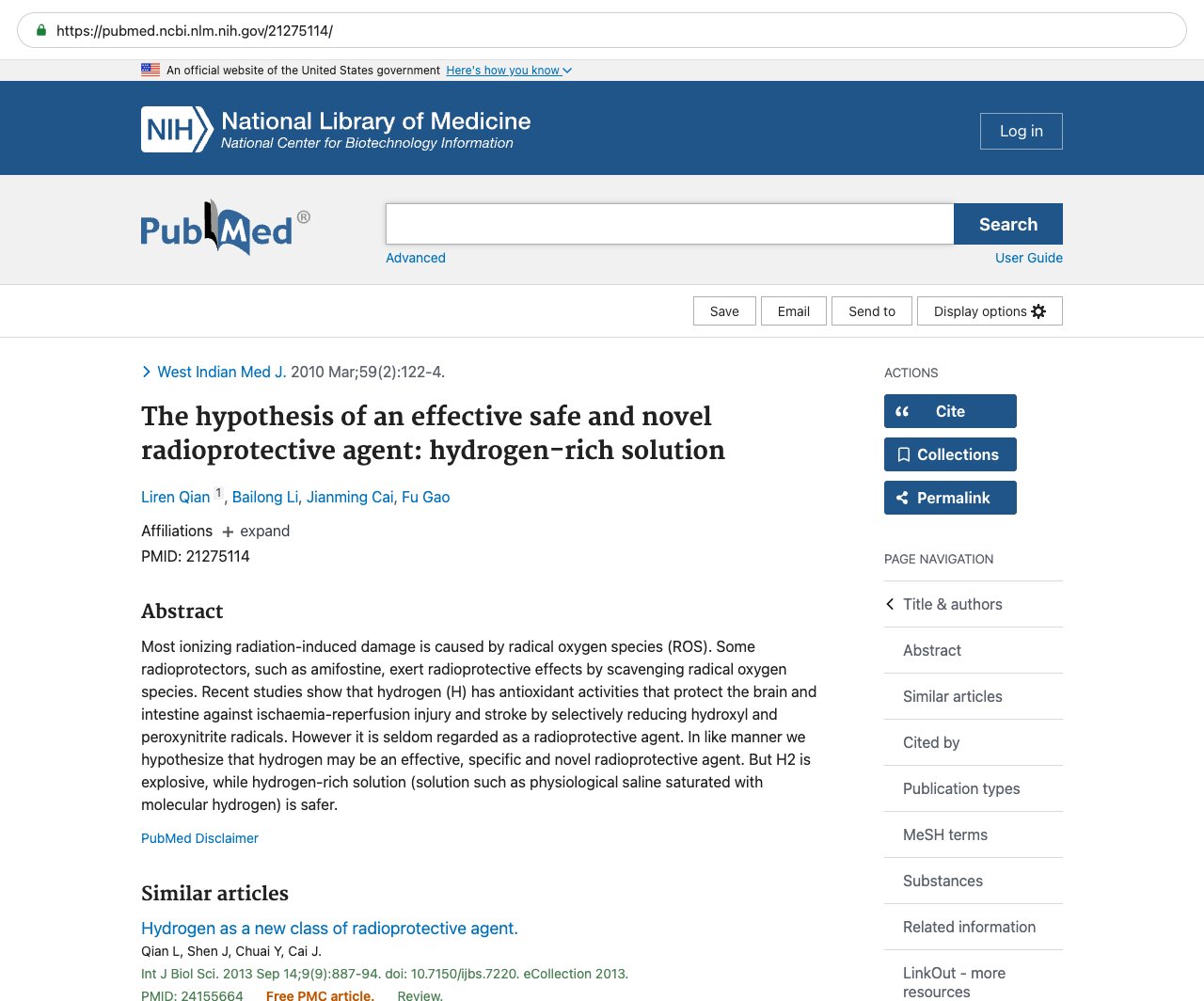
Most ionizing radiation-induced damage is caused by radical oxygen species (ROS). Some radioprotectors, such as amifostine, exert radioprotective effects by scavenging radical oxygen species. Recent studies show that hydrogen (H) has antioxidant activities that protect the brain and intestine against ischaemia-reperfusion injury and stroke by selectively reducing hydroxyl and peroxynitrite radicals. However it is seldom regarded as a radioprotective agent. In like manner we hypothesize that hydrogen may be an effective, specific and novel radioprotective agent. But H2 is explosive, while hydrogen-rich solution (solution such as physiological saline saturated with molecular hydrogen) is safer.
Source & links
Screenshot of the PubMed page
This page mirrors the published abstract (© the authors / publisher) for reference and citation. The canonical source is the PubMed record linked above. This is not medical advice.